The launch of the White Cross Project in Washington, DC, has exposed a familiar divide in South African public discourse: the same event can be interpreted in dramatically different ways depending on which online community is watching.
- Two narratives emerged around the White Cross Project
- The phrase everyone was arguing about — without actually being used
- Why the 2026 conversation was different from 2025
- Elon Musk’s absence was significant
- A debate over crime — and what the numbers mean
- From international culture war to South African political argument
- The bigger lesson from the White Cross Project
According to an analysis by Murmur Intelligence of thousands of posts on X, the debate surrounding the project was not simply a replay of the international “white genocide” controversy that dominated social media in 2025.
Instead, the conversation was largely driven by South Africans, with limited international amplification.
That distinction matters because the online environment surrounding the White Cross Project appears markedly different from the one that developed around farm attacks, Afrikaner refugees and the “white genocide” narrative when US President Donald Trump and President Cyril Ramaphosa met at the White House in 2025.
Two narratives emerged around the White Cross Project
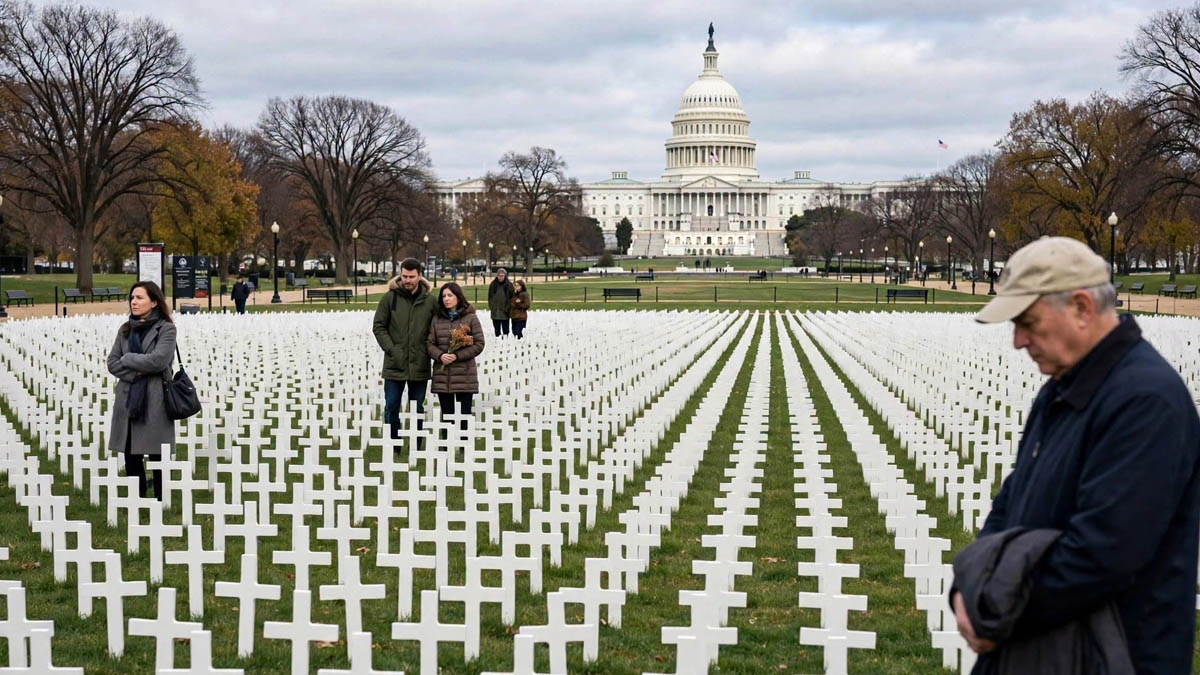
Between 20 and 28 September, organisers planted 3,000 white wooden crosses in Washington, DC, saying they represented victims of farm murders across racial groups over several decades.
The project was organised by Lex Libertas, an organisation associated with former AfriForum executive Ernst Roets.
Murmur Intelligence analysed 5,681 X posts specifically mentioning the White Cross Project, originating from approximately 2,700 accounts.
The analysis found two competing interpretations of the memorial.
For supporters, the crosses represented victims of violent crime and were intended to draw attention to rural safety.
One widely circulated post described the project as an attempt to highlight farm murders involving victims “no matter what race”.
The second interpretation was substantially more political.
Critics argued that the project presented farm-murder victims through a racialised political narrative and was designed partly for an American audience.
Some South African media coverage reflected that criticism, including reports quoting opponents who accused the organisers of turning victims into political symbols.
South Africa’s ambassador to the United States, Roelf Meyer, also rejected claims that white South African farmers are being subjected to political persecution.
The phrase everyone was arguing about — without actually being used
Perhaps the most revealing aspect of the online debate was the role played by the phrase “white genocide”.
The organisers themselves largely avoided it.
According to the Murmur Intelligence analysis, Roets’ posts during the week did not use the phrase, while fewer than one in 200 posts within the Lex Libertas community mentioned it.
Even more significantly, many of those references came from supporters who were explicitly arguing that the organisers had not used the term.
At a vigil, Free Market Foundation representative Martin van Staden highlighted the absence of the phrase, saying that nobody had uttered the words during the preceding two days.
The clip subsequently circulated among supporters of the project.
Among South African conservative commentators, however, the phrase appeared more frequently. Murmur Intelligence found that almost 12% of posts in this particularly active pro-project group referred to “white genocide”, with most of those references reportedly being used to deny that the White Cross Project itself promoted the concept.
That created an unusual situation.
The organisers could point to the language they actually used: crime, farm attacks and rural safety.
Critics, meanwhile, argued that language was not the only thing that mattered.
From their perspective, the choice of white crosses, the location in Washington and the project’s connections with US conservative political groups conveyed a broader political message regardless of whether the words “white genocide” appeared in promotional material.
Both interpretations can therefore exist simultaneously: the organisers avoided the terminology, while some supporters and US-based amplifiers connected the project to the wider culture-war debate.
Why the 2026 conversation was different from 2025
The online reaction looks particularly different when compared with the controversy surrounding farm attacks during 2025.
When President Cyril Ramaphosa met Donald Trump in the Oval Office, discussions surrounding South African farm attacks, Afrikaner refugees and allegations of “white genocide” reached a vastly larger international audience.
According to the analysis cited in the original article, US-based accounts played a dominant role in that conversation.
Elon Musk was also a major node in the online network at the time, helping amplify the narrative to an international audience.
The White Cross Project did not generate the same dynamic.
This time, South African accounts formed the majority of participants, while American users represented a smaller portion of the discussion.
International coverage did occur.
US conservative outlet One America News and British broadcaster GB News were among the organisations that helped carry the story beyond South Africa.
But they were not at the centre of the online conversation in the way that major US-based amplification was during the 2025 controversy.
Elon Musk’s absence was significant
One of the clearest differences identified in the analysis was the absence of Elon Musk.
Musk did not post about the White Cross Project, and the analysis found no evidence that participants were widely reposting him in connection with the event.
Supporters repeatedly tagged Musk and the account associated with the US presidency, but the social-media amplification pattern seen in 2025 did not materialise.
That matters because online political narratives can change dramatically depending on who amplifies them.
A relatively contained national debate can become an international story when a highly followed political or technology figure places it in front of a much larger audience.
Without that amplification, the White Cross Project remained primarily a South African argument about crime, race, rural safety and political symbolism.
A debate over crime — and what the numbers mean
At the heart of the disagreement is an issue neither side appears to dispute: rural safety remains a serious concern.
The disagreement lies elsewhere.
Supporters of the White Cross Project argue that farm attacks and murders deserve greater public attention and that the victims should be remembered.
Critics question whether farm murders should be treated as a distinct statistical phenomenon and whether presenting the victims through a specifically white-cross memorial creates a racial interpretation that goes beyond the underlying crime data.
The distinction is important.
A memorial can simultaneously commemorate victims of violence and become part of a political argument about the meaning of that violence.
That appears to be precisely what happened in Washington.
From international culture war to South African political argument
The Murmur Intelligence analysis suggests that the White Cross Project should not automatically be treated as a continuation of the enormous international “white genocide” debate that emerged in 2025.
Its digital footprint was considerably smaller and more South African.
The project nevertheless entered an already polarised environment where questions about farm attacks, race, rural crime and international political influence have accumulated significant political meaning.
That is why the same 3,000 crosses could represent very different things to different audiences.
To supporters, they were a memorial to victims.
To critics, they represented a political message being exported to Washington.
And to some international observers, they became another entry point into an established debate about South Africa’s treatment of its white farming community.
The underlying facts of individual farm attacks and murders do not disappear because competing political narratives form around them. But neither does the meaning attached to a public memorial exist independently of the context in which it is presented.
The bigger lesson from the White Cross Project
The most striking conclusion from the online conversation may therefore have less to do with the crosses themselves than with how South Africans consume information.
Two communities can encounter the same event, use the same photographs and watch the same speeches, yet emerge with entirely different interpretations.
That phenomenon is hardly unique to South Africa, but the country’s deeply contested political and racial history makes such divisions particularly pronounced.
The White Cross Project became another example of that dynamic.
For its supporters, it was primarily about remembering victims and highlighting rural crime.
For its critics, the symbolism and international setting made it inseparable from a broader political narrative.
The online data suggests that, unlike the much larger controversy of 2025, this time the argument remained largely South Africa talking to itself.
And perhaps that is the most important point: before South Africa’s competing narratives reach the rest of the world, they are already being constructed, amplified and challenged at home.