
South Africa is famous for its wildlife, beaches, mountains and vibrant cities. But beyond the attractions that appear on almost every tourist brochure lies something even more remarkable: a collection of natural, cultural, historical and sporting phenomena that have helped give the country an identity unlike anywhere else.
- 1. The Cradle of Humankind
- 2. A country named after its continent
- 3. Twelve official languages
- 4. Rooibos grows naturally in South Africa
- 5. The Cape Floral Kingdom
- 6. Pinotage: South Africa’s signature grape
- 7. Vilakazi Street and two Nobel laureates
- 8. Table Mountain has a constellation named after it
- 9. The Vredefort Dome
- 10. Three capital cities
- 11. South Africa voluntarily dismantled its nuclear weapons programme
- 12. The Blyde River Canyon
- 13. The Sardine Run
- 14. The Big Hole of Kimberley
- 15. Johannesburg’s urban forest
- 16. The Comrades Marathon
- 17. The Cape Town Cycle Tour
- 18. Boulders Beach and African penguins
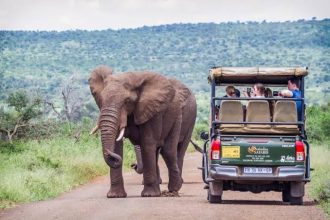
- 19. The South African “Big Seven”
- 20. Bunny Chow
- More than attractions: a country of extraordinary contrasts
From some of the oldest evidence of human ancestry to a floral kingdom contained within one country, South Africa’s list of extraordinary distinctions stretches across millions of years of history.
Some are geological. Others are cultural. A few are sporting records, while others are traditions that have travelled far beyond the country’s borders.
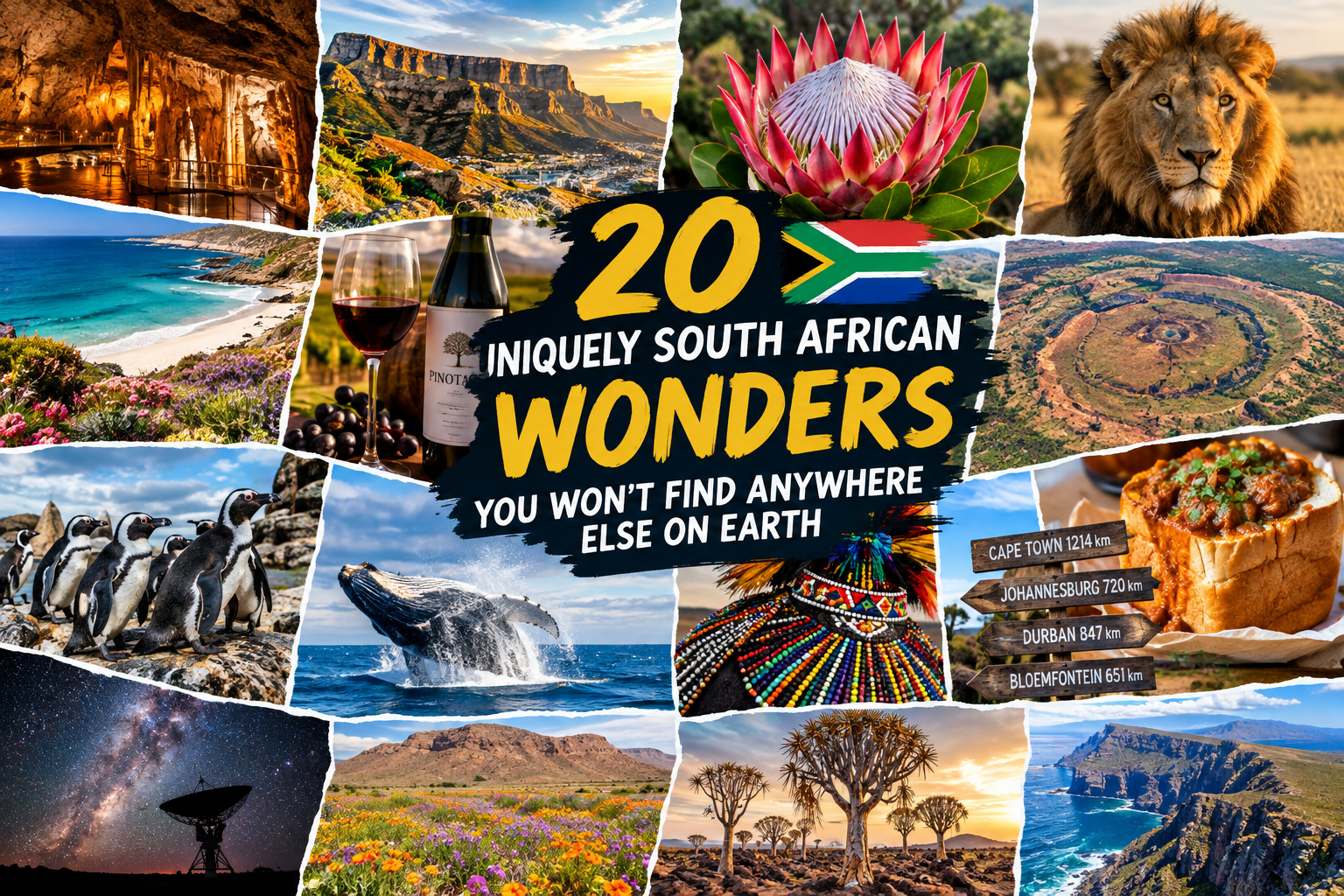
Here are 20 remarkable South African wonders and distinctions highlighted in the supplied source material.
1. The Cradle of Humankind
Gauteng’s Cradle of Humankind is one of the world’s most important palaeoanthropological sites.
The UNESCO-listed area has produced a remarkable collection of hominin fossils and archaeological evidence, offering scientists valuable insight into humanity’s distant past.
The region contains a significant proportion of the world’s known human-ancestor fossils and has played a central role in research into human evolution.
For South Africa, the significance extends far beyond tourism. The fossils discovered in the region have helped establish southern Africa as one of the key areas in the scientific story of human origins.
2. A country named after its continent
South Africa has an unusual geographic distinction: its name directly describes its position on the African continent.
The name “South Africa” is therefore essentially a geographic description that became the country’s official name.
It is a deceptively simple feature, but one that forms part of the country’s unique identity on the world map.
3. Twelve official languages
South Africa’s linguistic diversity is written directly into its Constitution.
The country recognises 12 official languages, following the inclusion of South African Sign Language.
They are:
- isiZulu
- isiXhosa
- Afrikaans
- English
- Sepedi
- Setswana
- Sesotho
- Xitsonga
- siSwati
- Tshivenda
- isiNdebele
- South African Sign Language
Few countries reflect such a broad range of linguistic communities within their constitutional framework.
Language is consequently not merely a means of communication in South Africa; it is deeply connected to history, identity and culture.
4. Rooibos grows naturally in South Africa
Rooibos, scientifically known as Aspalathus linearis, has become one of South Africa’s best-known agricultural exports.
The plant is naturally associated with the Cederberg region of the Western Cape, where its relationship with the local environment has helped make rooibos a distinctly South African product.
Its distinctive flavour and caffeine-free properties have turned what was once a regional drink into an internationally recognised tea.
The Cederberg landscape remains at the heart of rooibos production.
5. The Cape Floral Kingdom
South Africa’s botanical credentials are extraordinary.
The Cape Floral Kingdom, centred largely in the Western Cape, is one of the world’s recognised floral kingdoms and is renowned for its extraordinary concentration of plant diversity.
Fynbos dominates much of this landscape, with iconic plants such as proteas and ericas forming part of an ecosystem found nowhere else in quite the same combination.
The Cape Floral Kingdom is also remarkably small compared with other major botanical regions, yet contains an exceptional number of plant species.
For visitors, this means that a relatively compact part of South Africa contains an astonishing botanical variety.
6. Pinotage: South Africa’s signature grape
South Africa has given the wine world its own distinctive grape variety.
Pinotage was developed in 1925 at Stellenbosch University through a cross between Pinot Noir and Cinsault, historically known as Hermitage.
The variety went on to become closely associated with South African winemaking.
Its dark fruit characteristics and distinctive character have made Pinotage a recognisable part of the country’s wine identity.
While the grape is now cultivated outside South Africa, its origins and strongest cultural association remain firmly rooted in the country’s Cape Winelands.
7. Vilakazi Street and two Nobel laureates
Soweto’s Vilakazi Street occupies a remarkable place in South African history.
The street is famous for having been home to two Nobel Peace Prize laureates: former President Nelson Mandela and Archbishop Desmond Tutu.
That connection has transformed the street into one of Soweto’s most recognisable historical landmarks.
It also provides a remarkable physical reminder of the people and events that shaped South Africa’s transition from apartheid to democracy.
8. Table Mountain has a constellation named after it
Cape Town’s Table Mountain is one of South Africa’s most recognisable natural landmarks.
Its connection with astronomy is less well known.
The southern constellation Mensa takes its name from Mons Mensae, Latin for “Table Mountain”. It was named by French astronomer Nicolas-Louis de Lacaille in the 18th century.
That means the mountain’s name has travelled far beyond the Cape Peninsula and into the night sky.
9. The Vredefort Dome
Near Parys in the Free State lies one of Earth’s most extraordinary geological scars: the Vredefort Dome.
The structure is associated with an enormous meteorite impact that occurred more than two billion years ago.
It is recognised as the world’s largest confirmed impact structure and provides scientists with evidence of an event that occurred long before humans existed.
The scale of the ancient collision is difficult to comprehend. The impact fundamentally altered the surrounding geology and left a geological footprint that remains visible today.
10. Three capital cities
South Africa has a highly unusual governmental arrangement involving three capital cities.
Pretoria serves as the administrative and executive capital.
Cape Town is the legislative capital and is home to Parliament.
Bloemfontein is traditionally recognised as the judicial capital.
The arrangement reflects South Africa’s distinctive constitutional and political history and distributes key functions of government between different parts of the country.
11. South Africa voluntarily dismantled its nuclear weapons programme
South Africa has a unique chapter in nuclear history.
During the apartheid era, the country developed a nuclear weapons capability.
It subsequently dismantled its nuclear weapons programme and abandoned its arsenal before the country’s transition to democracy.
South Africa later joined the international nuclear non-proliferation framework, making the episode one of the most unusual examples of a state voluntarily giving up a nuclear weapons capability.
12. The Blyde River Canyon
Mpumalanga’s Blyde River Canyon is famous for combining dramatic geological formations with lush vegetation.
Unlike the dry landscapes associated with many of the world’s famous canyons, Blyde’s subtropical environment gives the canyon its distinctive green appearance.
The landscape includes dramatic cliffs, waterfalls, forests and viewpoints overlooking the Blyde River and surrounding mountains.
It is one of the defining natural attractions of the Panorama Route.
13. The Sardine Run
Every year, South Africa’s eastern coastline becomes the stage for one of the world’s most spectacular marine migrations.
The Sardine Run sees enormous shoals of sardines moving along the coastline, attracting predators ranging from dolphins and sharks to seabirds and whales.
The event has become a major attraction for divers, photographers, marine researchers and wildlife enthusiasts.
Its scale has earned it the nickname “the greatest shoal on Earth” and turned the annual migration into one of South Africa’s most extraordinary wildlife spectacles.
14. The Big Hole of Kimberley
Kimberley’s Big Hole is a monument to South Africa’s diamond-mining history.
During the diamond rush, miners excavated an enormous open pit using largely manual labour and basic tools.
More than 22 million tonnes of earth were removed during the operation, while millions of carats of diamonds were recovered.
Today, the Big Hole forms part of the Kimberley Mine Museum and remains a powerful reminder of the enormous economic and social impact that diamonds had on South Africa.
15. Johannesburg’s urban forest
Johannesburg has another surprising distinction.
Despite being one of Africa’s largest and busiest cities, Johannesburg is renowned for its enormous tree canopy.
The city’s suburbs, parks and streets contain millions of trees, creating an extensive urban forest across the metropolitan area.
From above, the green landscape can make parts of Johannesburg appear almost unexpectedly rural.
It is one of the characteristics that sets the city’s visual identity apart from many other major African urban centres.
16. The Comrades Marathon
South Africa’s contribution to endurance sport is epitomised by the Comrades Marathon.
The ultra-marathon traditionally links Durban and Pietermaritzburg, testing runners over an exceptionally demanding long-distance course.
First held in 1921, the race has grown into one of the world’s most famous ultra-marathons.
For generations of South African runners, completing Comrades has become more than a sporting achievement. It is a cultural milestone and an enduring part of the country’s sporting heritage.
17. The Cape Town Cycle Tour
Cape Town also hosts one of the world’s largest mass cycling events.
The Cape Town Cycle Tour, formerly known as the Cape Argus, attracts tens of thousands of cyclists who tackle a spectacular route around the Cape Peninsula.
The combination of competitive racing, mass participation and extraordinary coastal scenery has made the event an international fixture on the cycling calendar.
Few cycling events can match the combination of scale and scenery found on the Cape Peninsula.
18. Boulders Beach and African penguins
At Boulders Beach near Simon’s Town, visitors can experience something remarkably unusual: a beach environment where wild African penguins live alongside people.
The colony has become one of Cape Town’s best-known wildlife attractions.
Visitors can observe the penguins from designated areas and, at permitted sections of the coastline, share the surrounding beach environment with these endangered birds.
It is a striking reminder that major wildlife experiences do not always require travelling deep into a national park.
19. The South African “Big Seven”
South Africa’s safari reputation is traditionally built around the Big Five: lion, leopard, elephant, rhino and buffalo.
But the country’s coastline adds two remarkable marine species to the equation.
The concept of the Big Seven expands the traditional list to include the great white shark and southern right whale.
The idea captures something distinctive about South Africa’s geography: within a single national destination, visitors can combine major terrestrial wildlife experiences with spectacular marine encounters.
It is a reminder that South Africa’s biodiversity extends from its savannahs to its oceans.
20. Bunny Chow
Few foods represent South African cultural fusion quite like bunny chow.
The dish emerged from Durban’s Indian community and consists of a hollowed-out loaf or quarter loaf of bread filled with curry.
Over the decades, bunny chow has become far more than a convenient meal. It has become a recognisable symbol of Durban’s multicultural food culture.
Mutton, chicken and bean versions are among the varieties commonly encountered.
Its story is also a reminder of how South African cuisine has been shaped by migration, adaptation and communities creating new traditions from the circumstances around them.
More than attractions: a country of extraordinary contrasts
South Africa’s uniqueness does not come from one landmark or one world record.
It comes from the sheer variety packed into one country.
Ancient geological formations sit alongside modern cities. A globally significant fossil record exists alongside some of the world’s richest botanical ecosystems. Traditional foods share the national stage with internationally recognised wine, endurance sport and wildlife tourism.
From the Cradle of Humankind to the Cape Floral Kingdom, from Johannesburg’s urban forest to the beaches of the Cape, South Africa offers an unusual combination of history, nature, culture and human achievement.
And perhaps that is the country’s greatest wonder of all: there is no single South African experience.
There are many — and they stretch from the deepest chapters of Earth’s history to traditions still being created today.