
South Africa’s clothing and textile industry is facing renewed pressure as the Congress of South African Trade Unions (Cosatu) backs calls for the government to ban international shopping platforms Shein and Temu over concerns about local jobs, wages and the survival of domestic manufacturers.
- Cosatu Supports Calls to Ban Shein and Temu
- How Shein and Temu Gained Ground in South Africa
- Shein and Temu Captured R7.3 Billion in Sales
- SARS Tax Changes Have Already Slowed Their Growth
- Why Economists Warn Against an Outright Ban
- Local Manufacturers Face Problems Beyond Cheap Imports
- Could a Ban Protect Jobs Without Hurting Consumers?
- The Fight Over Shein and Temu Is Far From Over
The Southern African Clothing and Textile Workers’ Union (Sactwu) has warned that the platforms could put as many as 34,000 South African jobs at risk by 2030, based on estimates from a 2025 study.
However, the proposed ban has also raised questions about competition, consumer prices and whether restricting foreign shopping platforms would solve the deeper structural problems affecting local manufacturers.
Cosatu Supports Calls to Ban Shein and Temu
The issue featured prominently on Wednesday, 15 October, during the third day of Cosatu’s 15th National Conference at Emperor’s Palace in Johannesburg.
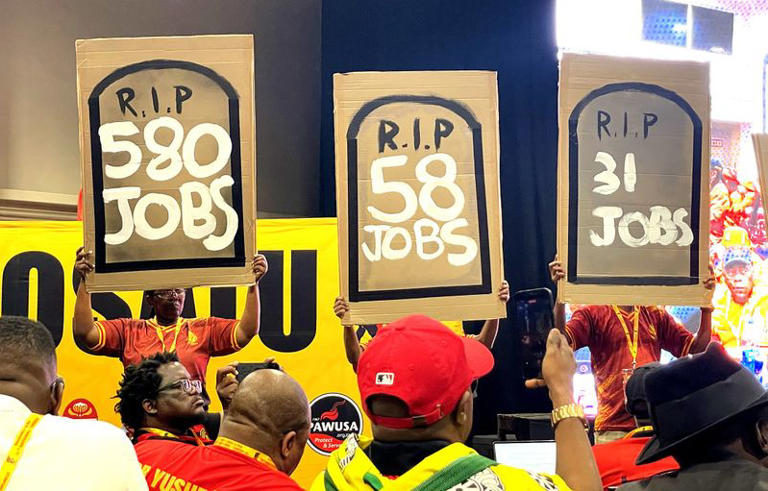
Sactwu presented its case for government intervention, with union members displaying placards highlighting estimated job losses across clothing, textiles, leather goods and related industries.
The figures displayed ranged from seven to 304 jobs across individual categories and factory employment estimates, while the union warned that the cumulative threat could reach 34,000 jobs by 2030.
Sactwu president Susan Khumalo argued that the rapid growth of the two online retailers was placing mounting pressure on local businesses and workers.
She said cheap imports were contributing to job losses, downward pressure on wages and deteriorating employment conditions.
Cosatu subsequently backed the union’s call and urged its members to delete the Shein and Temu apps and support local retailers instead.
The proposed ban remains a union-backed demand, rather than an indication that the government has already prohibited the platforms.
How Shein and Temu Gained Ground in South Africa


Temu entered the local market in 2024, intensifying competition in online retail.
Both platforms operate primarily through e-commerce, avoiding many of the overheads associated with maintaining extensive physical store networks. Their large shipment volumes, aggressive marketing and low advertised prices have helped them attract cost-conscious shoppers.
However, their growth has fuelled concern among local retailers and manufacturers that struggle to compete with imported products sold at lower prices.
The controversy also highlights the tension between consumers’ desire for affordable goods and the need to sustain domestic production and employment.
Shein and Temu Captured R7.3 Billion in Sales
The scale of the platforms’ expansion is reflected in figures cited in the report.
By the end of 2024, Shein and Temu had generated a combined R7.3 billion in sales, accounting for 37.1% of South Africa’s online retail market for clothing, textiles, footwear and leather goods, according to figures reported by Reuters.
The Bureau for Economic Research also reported a sharp decline in confidence among retailers selling semi-durable goods during the second quarter of 2024.
Confidence fell to 38%, from 68% in the first quarter, amid concerns that online competitors such as Shein could place additional strain on domestic clothing retailers.
These figures illustrate the scale of the competitive challenge, although they do not establish that all the reported pressure or potential job losses were caused exclusively by the two platforms.
SARS Tax Changes Have Already Slowed Their Growth
The debate over a possible ban comes after changes to South Africa’s treatment of low-value imported goods.
According to the supplied report, the South African Revenue Service (SARS) tightened the tax treatment of imported goods priced below R500 in 2025, removing the previous tax advantage associated with qualifying low-value imports.
The changes were intended to address disparities between imported goods and products sold by local businesses.
The report says Shein’s growth slowed from annual rates of between 30% and 50% to approximately 11% in 2025. Temu, meanwhile, recorded average monthly declines of 42% over the same period.
These figures suggest that tax changes may already be affecting the platforms’ performance in South Africa.
Independent economic strategist and board adviser Refilwe Moloto questioned whether the union’s projection of 34,000 jobs at risk adequately reflects the market after the tax amendments.
She argued that the estimate might be outdated because it was calculated before the changes took effect.
Why Economists Warn Against an Outright Ban
Moloto cautioned that banning Shein and Temu could create unintended consequences for South Africa’s economy.
She argued that restrictive measures could encourage informal or unregulated trading, making it harder for authorities to monitor imports and collect the taxes due.
In her view, the government should focus on ensuring fair taxation and addressing the underlying factors that make local production more expensive.
She also noted that Shein and Temu have disrupted retail markets in other regions, including the United States, France and Latin America.
The challenge for policymakers is therefore not limited to South Africa. It reflects a wider debate over how governments should respond to global online retailers that compete aggressively on price.
Local Manufacturers Face Problems Beyond Cheap Imports
The pressure on South African clothing and textile businesses also reflects longstanding domestic challenges.
Moloto pointed to high energy costs, problems with rail transportation and administrative expenses as factors that undermine local competitiveness.
These costs affect how efficiently manufacturers can produce and distribute goods, as well as the margins retailers can maintain.
Even if imported products face higher taxes or tighter restrictions, local manufacturers may continue to struggle unless these structural problems are addressed.
This complicates the argument for an outright ban. Protecting local producers from foreign competition may offer some relief, but it would not automatically make domestic manufacturing more efficient or reduce production costs.
Could a Ban Protect Jobs Without Hurting Consumers?
Cosatu and Sactwu argue that intervention is needed to protect workers and prevent further damage to the local industry.
Their concerns centre on employment, wages and the survival of businesses that provide jobs across clothing, textile, footwear and leather manufacturing.
Opponents of an outright ban warn that restricting the platforms could reduce consumer choice, limit access to lower-priced goods and encourage informal trading.
The government therefore faces a difficult policy question: how to ensure fair competition while protecting local employment and keeping everyday products affordable.
Options such as consistent tax enforcement, stronger support for domestic manufacturers and improvements to transport and energy infrastructure could address some of the competitive disadvantages identified in the debate. However, the effectiveness of any approach would depend on its design and implementation.
The Fight Over Shein and Temu Is Far From Over
Cosatu’s backing gives Sactwu’s campaign greater visibility, but the demand for a ban remains contested.
The union’s warning of 34,000 jobs at risk has intensified calls for government action, while questions remain about the estimate’s assumptions and how much of the projected impact can be attributed to Shein and Temu.
For South African consumers, the outcome could affect shopping options and prices. For workers and local manufacturers, it could influence the future of an industry already struggling with high operating costs and international competition.
The central issue is whether South Africa can protect local jobs and enforce fair trading rules without creating new economic problems for consumers and businesses.