
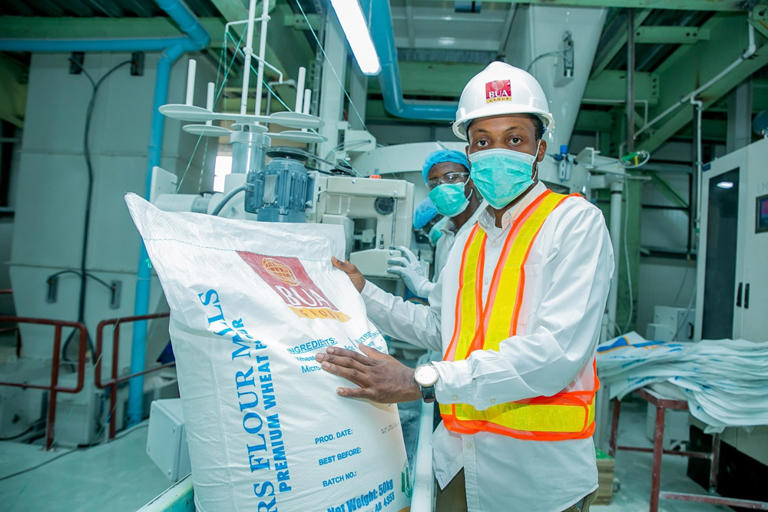
Africa’s third-richest businessman, Abdulsamad Rabiu, is making his biggest strategic move yet in Nigeria’s food manufacturing sector after BUA Foods announced its largest expansion programme since the company was established.
- Billion-rand equivalent investment backed by record financial performance
- Expansion targets Nigeria’s fastest-growing food categories
- Instant noodles become the next competitive battleground
- Local manufacturing strategy aligns with national priorities
- Shareholders rewarded after record year
- Can BUA Foods overtake Nigeria’s established food giants?
- A defining moment for Nigeria’s food manufacturing industry
The ambitious investment follows a year of record financial performance, positioning the company to compete more aggressively across several of Nigeria’s largest food categories. If completed on schedule, the expansion could propel BUA Foods to become the country’s largest food manufacturer by next year.
The move comes as Nigeria’s consumer market continues to face rising demand for affordable staple foods despite persistent inflation, currency volatility and higher production costs.
Billion-rand equivalent investment backed by record financial performance
BUA Foods enters this expansion from a position of financial strength.
The company reported revenue of ₦1.77 trillion during 2025, while profit after tax climbed to ₦518.4 billion, reflecting a 95% increase compared with the previous year.
Using the exchange rate referenced in the company’s results, the profit equates to approximately R9.8 billion, while annual revenue is roughly R33.6 billion.
Gross profit reached ₦737.3 billion, earnings per share increased to ₦28.80, and total assets expanded by 27% to ₦1.39 trillion, highlighting continued growth across its operations.
The company attributed the performance to sustained consumer demand, improved operational efficiency, tighter cost controls and stronger supply chain management despite Nigeria’s difficult economic environment.
Expansion targets Nigeria’s fastest-growing food categories
The investment programme covers several of Nigeria’s most important food manufacturing segments.
BUA Foods plans to:
- Expand wheat milling capacity.
- Complete its edible oils production business.
- Invest further in integrated food manufacturing facilities.
- Enter the instant noodles market for the first time.
The diversification places the company in direct competition with some of Nigeria’s longest-established food manufacturers across multiple product categories simultaneously.
Chairman Abdulsamad Rabiu said the objective is not simply to become a larger business but to build the operational scale required to compete more efficiently.
“By next year, when our current projects are completed, BUA will become the largest player in our sector in Nigeria. We are not pursuing growth simply for the sake of becoming bigger. We are pursuing growth because scale matters in an industry like ours,” he said.
Instant noodles become the next competitive battleground
One of the most significant developments is BUA Foods’ planned entry into Nigeria’s instant noodles market.
Instant noodles have become one of the country’s most widely consumed packaged food products, supported by rapid urbanisation, population growth and demand for affordable convenience meals.
The market has historically been dominated by established manufacturers, making BUA Foods’ entry one of the biggest competitive developments in Nigeria’s fast-moving consumer goods sector in recent years.
At the same time, the company is increasing wheat milling capacity, strengthening its position in another strategically important industry.
Nigeria remains heavily dependent on imported wheat because local production cannot fully satisfy domestic demand.
Expanding milling capacity is expected to improve local food processing while supporting government efforts to increase domestic manufacturing and reduce reliance on imported finished products.
Local manufacturing strategy aligns with national priorities
BUA Foods’ expansion also reflects Nigeria’s broader industrial policy of encouraging local value addition.
Food manufacturing has become increasingly important as policymakers seek to strengthen domestic production, improve food security and reduce pressure on foreign exchange reserves created by imported goods.
By expanding production across staple products such as flour, pasta, edible oils and instant noodles, the company hopes to benefit from continued population growth and resilient consumer demand.
Even during periods of economic uncertainty, these products remain household essentials for millions of Nigerians.
Shareholders rewarded after record year
The company’s strong financial results have also translated into one of the Nigerian Exchange’s largest shareholder payouts.
Shareholders approved a final dividend of ₦28 per share, bringing the total dividend distribution to approximately ₦504 billion, equivalent to roughly R9.5 billion.
The dividend more than doubles the previous year’s payment and continues a pattern of increasing shareholder returns.
Because BUA Group owns approximately 90% of BUA Foods, Rabiu is expected to receive the majority of the dividend distribution.
Can BUA Foods overtake Nigeria’s established food giants?
The expansion represents one of the most ambitious growth strategies undertaken by a Nigerian food manufacturer in recent years.
However, delivering multiple large-scale industrial projects simultaneously presents significant challenges.
The company will need to manage construction timelines, rising input costs, exchange-rate volatility, financing pressures and changing consumer purchasing power while maintaining profitability.
Success will depend not only on expanding production capacity but also on executing projects efficiently and competing effectively against well-established rivals.
A defining moment for Nigeria’s food manufacturing industry
Rabiu has spent decades building BUA Group into one of Africa’s largest industrial conglomerates, with operations spanning cement, food manufacturing, sugar refining, real estate and infrastructure.
The latest expansion reinforces confidence in Nigeria’s long-term consumer market despite current economic headwinds.
If the projects are completed as planned, BUA Foods could significantly reshape competition across Africa’s largest economy, strengthen domestic food production and accelerate investment in local manufacturing.
For Nigeria, the outcome extends beyond one company’s growth ambitions. Increased local production capacity could improve food availability, support industrial employment and contribute to broader economic resilience in one of the continent’s most important consumer markets.