
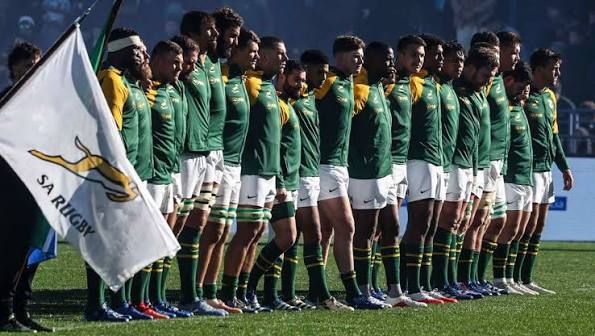
Springbok supporters are questioning South African Rugby’s ticketing strategy after additional tickets for Saturday’s blockbuster Test against the All Blacks were released only days before kick-off, with prices reaching R4,000.
The first match of the four-Test Rugby’s Greatest Rivalry series takes place at Ellis Park in Johannesburg on Saturday, 22 August. Tickets released on Tuesday evening were reportedly still available on Wednesday morning, with some costing R1,650 and others reportedly ranging from R850 to R4,000.
The late release has reignited concerns about ticket affordability and whether the way premium allocations are managed could be contributing to empty seats at major Springbok fixtures.
Why were tickets released so late?
The situation is particularly confusing because the Ellis Park fixture had previously been presented as sold out.
On 27 June, the official Rugby’s Greatest Rivalry Instagram account published a graphic indicating that tickets for the Ellis Park and Cape Town Tests were sold out, while tickets remained available for the later matches at FNB Stadium and M&T Bank Stadium in Baltimore.
However, Saru has apparently never explicitly announced that Ellis Park itself was completely sold out.
According to Saru, the publicly available general-access tickets had sold out. The tickets released this week had been reserved for commercial partners who ultimately did not exercise their allocations.
A Saru spokesperson explained that sponsors receive complimentary tickets as part of their agreements, together with an option to purchase additional tickets.
“The general access tickets (i.e. publicly available tickets) were sold out. The ones now available are tickets that were blocked out for commercial partners who have now not taken up their option.”
Saru declined to disclose the size of those allocations, citing commercial sensitivity.
Fans question affordability
The late release is unlikely to ease criticism surrounding the cost of attending Springbok Tests.
With some of the newly available seats costing thousands of rand, attending a major international rugby match can become a significant expense for families and ordinary supporters, particularly when transport, food and other match-day costs are added.
The issue also raises a broader question: would some of these tickets have been sold earlier if they had been made available to the public instead of being held for commercial partners?
That question becomes even more relevant when large numbers of seats remain unoccupied at supposedly sold-out sporting events.
Uncertainty surrounds Cape Town Test
The ticketing picture for the second major Test in South Africa is even less clear.
The Springboks face the All Blacks at Cape Town Stadium on 29 August, but although the match was previously indicated as sold out, a source within Saru reportedly told Daily Maverick that approximately 3,000 tickets remain available.
Attempts to purchase tickets through the Ticketmaster link on Saru’s website have reportedly been unsuccessful. The event does not clearly display a “sold out” message, but the seating map does not allow users to select seats.
There is therefore uncertainty over whether the tickets are genuinely unavailable, have yet to be released, or are being held under another allocation.
Thousands could remain at FNB Stadium
The third Test, scheduled for 5 September at Johannesburg’s FNB Stadium, also appears to have a sizeable number of unsold seats.
According to the source cited by Daily Maverick, approximately 4,000 tickets remain available at the stadium, which has a capacity of roughly 95,000.
That would still represent a relatively small proportion of the venue, but the figure is notable given the scale and importance of the Rugby’s Greatest Rivalry series.
The fourth Test will take place at Baltimore’s M&T Bank Stadium on 12 September.
A bigger issue for South African rugby
The controversy goes beyond whether individual tickets were released too late.
The Springboks remain one of South Africa’s biggest sporting attractions, and demand for matches against New Zealand is traditionally enormous. Yet ticket pricing, availability and commercial allocations increasingly form part of the conversation around the spectator experience.
For supporters, the frustration is not simply that expensive tickets exist. It is the lack of clarity around when tickets are available, who has access to them and why seats can appear days before a major Test after fans were led to believe that public tickets were gone.
Saru’s explanation provides context for the Ellis Park release, but it also highlights the tension between commercial sponsorship arrangements and ensuring that stadium seats are ultimately occupied by paying supporters.
With the All Blacks arriving in Johannesburg for the opening match on Saturday, the immediate question is no longer whether demand exists — it is whether the available seats can be filled before one of rugby’s biggest rivalries gets under way.