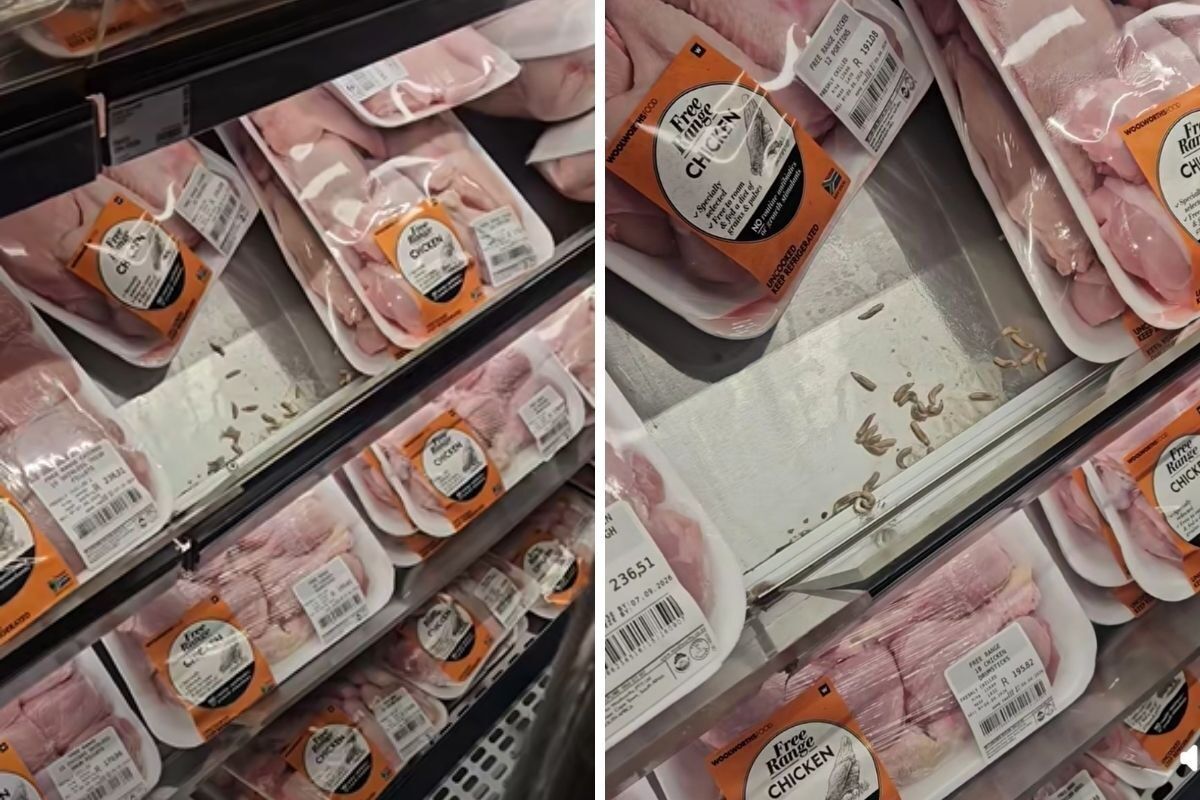
A Woolworths food store in Johannesburg is investigating a disturbing food-safety incident after a video appearing to show maggots inside a refrigerator containing raw chicken circulated widely on social media.
The incident reportedly occurred at the retailer’s Bel Air shopping centre store, where a customer said he discovered the insects among shelves containing packaged chicken.
The footage has prompted questions about how such a situation could occur inside a modern food retailer and what controls are in place to prevent contamination.
Woolworths has described the incident as “unique and isolated” and said it has launched an investigation to establish what went wrong.
Customer raises alarm over Woolworths discovery
The video was posted on Facebook by customer John Mawere, who said he was shocked by what he encountered while shopping at the store.
Mawere said he had traditionally associated Woolworths with quality, freshness and strict food-handling standards.
His concern was heightened by the fact that the discovery allegedly occurred in an area where raw chicken products were being stored.
The customer called on Woolworths to explain how the incident happened and what measures would be taken to ensure that customers were protected.
The video subsequently attracted attention online, placing renewed focus on food hygiene and the responsibilities of retailers handling perishable products.
Woolworths removes products and starts deep cleaning
Woolworths said it acted after becoming aware of the incident.
According to the retailer, independent hygiene experts were brought in, all products were removed from the affected area and a deep-cleaning process was initiated.
The company said the incident has triggered a full investigation aimed at identifying its root cause.
Woolworths also pointed out that the store had recently undergone a hygiene audit and that no anomalies had been detected during that assessment.
The retailer apologised to customers and acknowledged the seriousness of the incident.
“We recognise that we have let our customers down on this occasion and sincerely apologise,” Woolworths said.
How could maggots end up in a chicken fridge?
The presence of maggots in a refrigerated food display can have several possible explanations, but the cause cannot be established from the video alone.
Maggots are fly larvae and generally develop when flies have access to suitable organic material. In a food-retail environment, that could potentially involve damaged packaging, food waste, a leak, an unnoticed spill or another source of organic matter.
Temperature control is also important when dealing with fresh meat.
Refrigeration slows the growth of microorganisms and helps preserve food, but it does not make a food-storage area immune to contamination. If there is a breach in packaging, a sanitation problem or access for insects, a localised hygiene issue can potentially develop.
However, these are possible explanations rather than findings in this particular incident.
Woolworths’ investigation will need to establish the actual source and determine how the insects entered the area.
Why food retailers face strict hygiene expectations
Fresh chicken and other raw meat require careful handling because they can carry microorganisms capable of causing foodborne illness if products are contaminated or handled incorrectly.
Retailers therefore have to manage several risks simultaneously, including refrigeration temperatures, cleaning schedules, pest control, product rotation, packaging integrity and the separation of raw products from other foods.
A visible pest problem in a fresh-food display is consequently more than a matter of appearance.
It can raise questions about the effectiveness of the controls operating behind the scenes.
That is why Woolworths’ decision to remove products, bring in independent hygiene specialists and conduct a deep clean will be closely watched by customers concerned about food safety.
A single incident can damage consumer trust
The incident also highlights another vulnerability for premium food retailers: consumer confidence.
Customers paying premium prices often expect more than attractive stores and branded packaging. They expect rigorous controls over how food is stored, handled and presented.
That makes incidents involving visible contamination particularly damaging to a retailer’s reputation, even when the problem ultimately proves to be isolated.
For Woolworths, the challenge will therefore be twofold — establishing exactly what happened at Bel Air and demonstrating that the appropriate controls are in place to prevent a repeat.
Investigation will determine what went wrong
At this stage, Woolworths has not publicly attributed the incident to a particular failure in its food-safety system.
The retailer maintains that the Bel Air incident is isolated and says its investigation is continuing.
The recent hygiene audit cited by the company also means investigators will need to establish what, if anything, changed between that assessment and the discovery reported by the customer.
Until that investigation is completed, it would be premature to conclude how the maggots entered the refrigerator or whether the incident points to a wider problem.
For customers, however, the episode serves as a reminder of why food hygiene, refrigeration, pest control and product handling remain critical in fresh-food retail.
Woolworths’ response — and the findings of its investigation — will ultimately determine whether the incident was an isolated breakdown or whether additional measures are needed at the store.