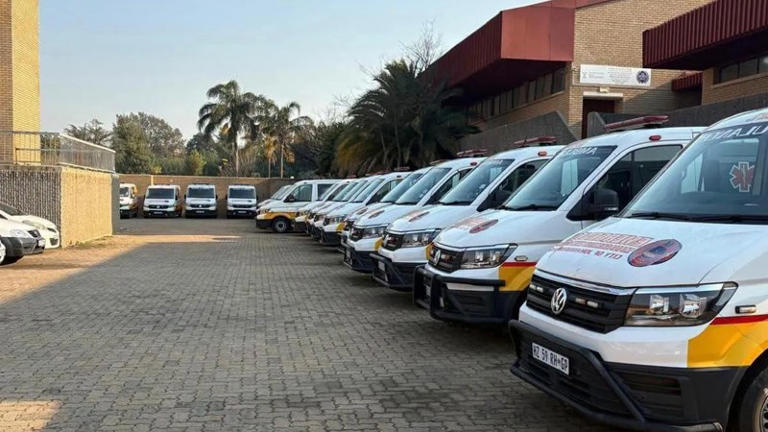
The City of Johannesburg’s 41 ambulances, purchased for approximately R41 million, have remained largely unused for six years, despite ongoing demand for emergency medical services across the city.
- City waits for Gauteng operating licence
- Why Johannesburg cannot simply use its own ambulances
- ‘We don’t have the required licence’
- First application was rejected
- City says ambulances are ready to serve
- Gauteng may absorb the ambulances
- DA calls for audit of R41 million fleet
- Six years later, the ambulances are still waiting
The vehicles were acquired by the city’s Emergency Management Services (EMS) in 2019, at a cost of roughly R1 million each. Their deployment was disrupted when Gauteng began taking greater control of municipal ambulance services.
Six years later, the city is still waiting for the provincial government to decide whether it can independently operate the ambulances.
City waits for Gauteng operating licence
Gauteng government spokesperson Elijah Mhlanga confirmed that the City of Johannesburg submitted its latest application for an operating licence in July 2026.
The application covers six fire stations and is now under consideration.
Mhlanga said the final decision rests with the Gauteng Health head of department.
The provincial government will also engage with the City of Johannesburg about what should happen to the 41 ambulances, including the possibility of incorporating them into the provincial emergency medical services system.
The province stressed that it was not involved in purchasing, funding or acquiring the vehicles.
Why Johannesburg cannot simply use its own ambulances
The unusual situation stems from Gauteng’s long-running provincialisation of ambulance services.
Gauteng Health began taking over municipal ambulance services in 2009, with the aim of bringing emergency medical services under provincial control and aligning them with national legislation.
By around 2020, the provincialisation process had reached Johannesburg.
However, the 41 ambulances were purchased by the city shortly before the takeover and were not included among the vehicles transferred to Gauteng.
As a result, the ambulances remained City of Johannesburg property — but the city no longer had the required authority to operate them independently.
‘We don’t have the required licence’
Johannesburg EMS spokesperson Robert Mulaudzi said municipalities had historically delivered ambulance services on behalf of the provincial government before the responsibility was progressively transferred back to the province.
The city’s 41 ambulances fell into an unusual gap because they had been purchased before the provincialisation process was completed.
Mulaudzi said the city could not simply deploy them because it lacked the necessary competency and operating licence.
The city therefore sought permission from its council to fund and operate the ambulances independently.
Council subsequently approved the request, allowing the city to pursue the required operating licence.
First application was rejected
Johannesburg first applied for an operating licence in 2025, according to Mulaudzi.
That application was rejected.
Gauteng Health spokesperson Steve Mabona provided further details, saying the city initially submitted an application on 30 March 2026 covering 15 fire stations.
The city subsequently revised the application, reducing the number of stations covered to six.
The revised application was submitted on 15 July 2026.
Mabona said the application had gone through the required assessment processes, although some regulatory procedures still had to be completed before a final decision could be made.
City says ambulances are ready to serve
Johannesburg EMS says it believes the vehicles could provide much-needed additional emergency capacity.
Mulaudzi said residents continued to approach fire stations when they needed medical assistance, arguing that the demand for ambulances had not disappeared simply because the provincialisation process had taken place.
He said there would always be a need for emergency medical services and that the 41 ambulances could help improve response times across Johannesburg.
The city is now waiting for Gauteng Health to determine whether it will receive permission to operate them.
Gauteng may absorb the ambulances
The future of the vehicles may ultimately depend on more than the licence application.
Mhlanga said the provincial government would discuss with Johannesburg whether the 41 ambulances could potentially be absorbed into Gauteng’s provincial EMS system.
That would provide an alternative to the city operating the vehicles independently.
For now, however, the ambulances remain city-owned assets.
Mulaudzi said the vehicles are available and ready to serve communities, but the decision ultimately rests with the provincial authorities.
“The ball now is in their court,” he said, referring to the decision over the future of the vehicles.
DA calls for audit of R41 million fleet
The Democratic Alliance has called for an audit of the 41 ambulances, including an assessment of their current condition and value.
The party has also questioned why vehicles purchased using public funds have remained out of service while Johannesburg residents continue to require emergency medical assistance.
The situation raises questions about public-sector coordination and the consequences of transferring responsibilities between different levels of government.
The city owns the vehicles, the province controls the relevant ambulance-service regulatory framework, and residents remain dependent on whichever authority ultimately has the capacity and legal mandate to deploy them.
Six years later, the ambulances are still waiting
The 41 ambulances were bought in 2019 for around R41 million.
They were caught in the transition surrounding Gauteng’s provincialisation of emergency medical services and have remained unavailable for normal independent municipal ambulance operations.
Johannesburg now has a revised application before Gauteng Health covering six stations.
Until a decision is made — or an alternative arrangement is reached to incorporate the vehicles into the provincial system — the city’s R41 million ambulance fleet remains largely on the sidelines.
For residents needing emergency medical assistance, the central question is no longer why the ambulances were purchased, but when the vehicles will finally be allowed to serve the communities they were bought for.