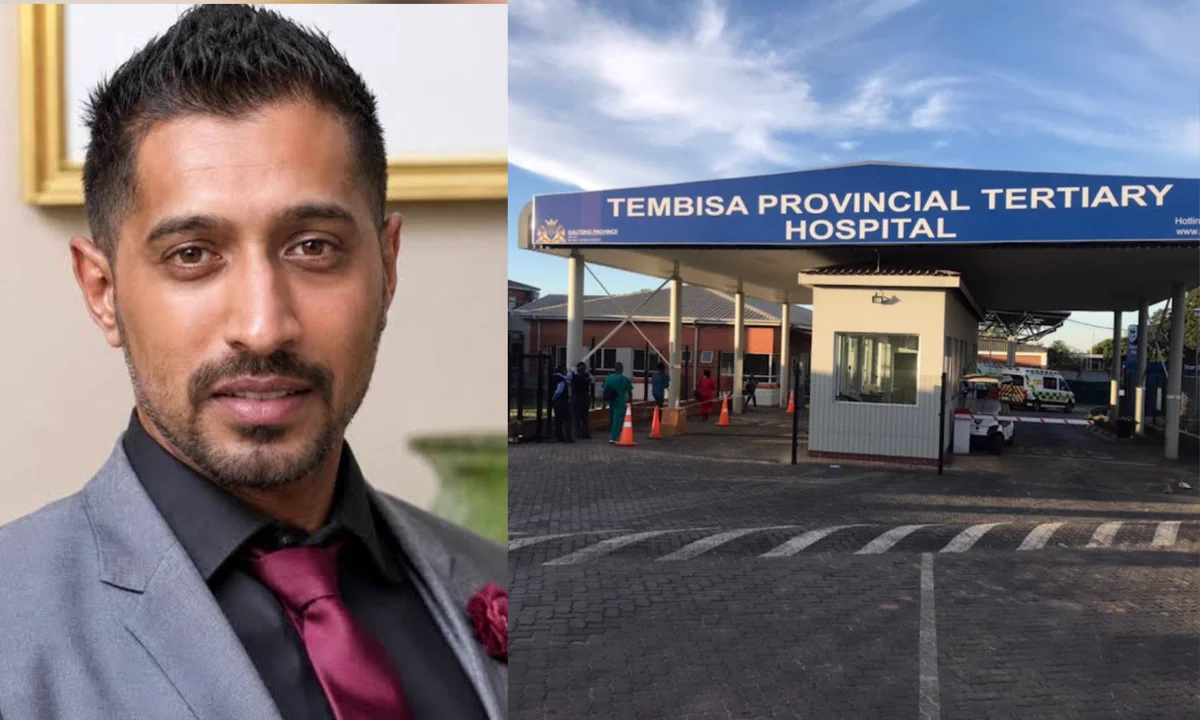
A man at the centre of a major investigation into alleged procurement irregularities at Tembisa Hospital has been granted R200,000 bail, days after returning to South Africa from the Seychelles.
- Hawks allege procurement system was manipulated
- 73 companies and 1,237 contracts
- Govindraju’s arrest followed return from Seychelles
- What charges does Govindraju face?
- The Babita Deokaran connection
- Cachalia says questions remain over Deokaran’s murder
- Why the Tembisa Hospital investigation matters
- What happens next?
Stefan Joel Govindraju, 37, was arrested at OR Tambo International Airport after arriving in the country and subsequently appeared before the Palm Ridge Specialised Commercial Crimes Court.
The Hawks allege that Govindraju is connected to a network of companies that collectively secured hundreds of millions of rand in contracts from Tembisa Hospital.
He faces serious charges including fraud, corruption, forgery and uttering, money laundering and contraventions of the Public Finance Management Act (PFMA).
Govindraju has not been convicted of any offence, and the allegations against him remain before the courts.
Hawks allege procurement system was manipulated
At the centre of the investigation is an alleged scheme involving hospital officials and service providers.
According to the Hawks, procurement processes at Tembisa Hospital were manipulated in a manner that enabled certain suppliers to obtain business without going through the appropriate competitive tender procedures.
One alleged tactic involved deliberately structuring transactions below the R500,000 threshold.
The significance of that threshold is that transactions below it can be subject to different procurement requirements from larger contracts. Investigators allege that repeatedly keeping purchases below the threshold helped those involved avoid formal tender processes.
If proven, such conduct could represent a serious breach of public-sector procurement controls because those safeguards are designed to promote competition, transparency and value for taxpayers.
73 companies and 1,237 contracts
The scale of the allegations is one of the most significant aspects of the case.
The Special Investigating Unit (SIU) has separately identified Govindraju as being linked to 73 companies that allegedly received approximately R596.4 million through 1,237 contracts with Tembisa Hospital.
The figures do not, by themselves, establish that every contract was unlawful or that Govindraju personally benefited from every rand involved.
Instead, they form part of the evidence and investigative picture being examined by authorities.
The large number of entities and contracts is nevertheless likely to receive close scrutiny as investigators attempt to establish how suppliers were selected, who controlled the companies involved, whether services were actually delivered and whether procurement rules were followed.
Govindraju’s arrest followed return from Seychelles
Govindraju was arrested after landing at OR Tambo International Airport following a trip to the Seychelles.
During his bail application, his legal representatives argued that he should not be regarded as a flight risk.
They pointed to his family connections, business interests and financial ties in South Africa.
His legal team also argued that he had returned voluntarily despite knowing that he was under investigation.
The state did not oppose the bail application.
The court subsequently granted him bail of R200,000, allowing him to remain out of custody while the criminal proceedings continue.
Bail does not amount to an acquittal or a finding that the accused is innocent. It simply allows an accused person to remain in the community while the case proceeds, subject to the conditions imposed by the court.
What charges does Govindraju face?
The allegations against Govindraju span several serious offences.
They include:
- Fraud
- Corruption
- Forgery and uttering
- Money laundering
- Contraventions of the Public Finance Management Act
The combination of charges indicates that investigators are examining not only how contracts were allegedly obtained, but also whether documentation, financial transactions and public-finance rules were unlawfully manipulated.
The eventual outcome will depend on evidence presented through the criminal justice process.
The Babita Deokaran connection
The Tembisa Hospital procurement investigation also carries a deeper significance because of the murder of whistleblower Babita Deokaran.
Deokaran, who was serving as acting chief financial officer at Tembisa Hospital, was shot and killed outside her home in Winchester Hills, Johannesburg, on 23 August 2021.
Before her death, she had raised concerns about suspected irregular expenditure within the Gauteng Department of Health.
She had reportedly documented approximately R850 million in potentially irregular expenditure, with suspicious companies among the issues under scrutiny.
Her murder subsequently became one of the country’s most prominent cases involving the risks faced by public-sector whistleblowers.
Cachalia says questions remain over Deokaran’s murder
The latest developments in the procurement investigation have renewed attention on the unresolved questions surrounding Deokaran’s killing.
Professor Firoz Cachalia, the Acting Minister of Police, previously said that the people who masterminded the murder had not been brought to justice and suggested that powerful connections could have played a role.
Those remarks were made around the fifth anniversary of Deokaran’s death.
Several people have been convicted and sentenced in connection with the killing, but questions about who ultimately ordered the assassination have continued to attract public attention.
It is important, however, to distinguish the murder investigation from the procurement case. Being investigated or charged over alleged procurement offences does not establish involvement in Deokaran’s killing, and no such connection should be assumed without evidence.
Why the Tembisa Hospital investigation matters
The case goes beyond the fate of one accused person.
Tembisa Hospital has become a major symbol of the challenges facing South Africa’s public procurement system, particularly where large volumes of government spending are distributed among multiple suppliers.
Procurement controls exist to prevent public institutions from becoming vulnerable to favouritism, inflated pricing, conflicts of interest and the misuse of public funds.
The alleged use of transactions below procurement thresholds is therefore particularly significant.
If investigators ultimately prove that contracts were deliberately structured to avoid proper tender procedures, the case could provide important lessons about weaknesses in procurement controls and how those weaknesses can potentially be exploited.
What happens next?
Govindraju’s R200,000 bail means the criminal case will continue while he remains outside custody.
The Hawks and other investigative authorities are continuing to examine the alleged procurement network, including the companies and contracts identified during the investigation.
The prosecution will ultimately have to prove its allegations in court.
For now, the figures surrounding the case — 73 companies, 1,237 contracts and approximately R596.4 million in alleged payments — illustrate the scale of the investigation, but they should not be interpreted as proof of criminal liability.
That distinction is particularly important in a case involving multiple companies, public officials and potentially extensive financial records.
The broader question for Gauteng’s health system is equally important: how did procurement arrangements of this scale operate for so long, and what safeguards are needed to prevent similar allegations from emerging again?
As the legal process unfolds, those answers may prove just as important as the eventual verdict.