
A growing civic campaign is placing the South African government under pressure to investigate two separate but highly sensitive matters involving citizenship, immigration compliance, and national sovereignty.
- ‘Coronation’ Sparks Sovereignty Concerns
- Miss SA Finalist’s Citizenship Under Investigation
- Petition Calls for Transparency and Legal Enforcement
- Broader Demands: National Audit and Diplomatic Review
- Government and Diplomatic Response
- Constitutional Principles at the Core
- Analysis: A Test of Governance and Social Cohesion
- What Happens Next?
At the centre of the controversy are Solomon Ogbonna Eziko, a Nigerian national reportedly crowned as a traditional Igbo leader in the Eastern Cape, and Chidimma Adetshina, a former Miss South Africa finalist whose citizenship has come under scrutiny.
The Progressive Forces of South Africa, a civic movement, has launched a national petition calling for urgent intervention by both the executive and legislative arms of government. The petition raises concerns around immigration enforcement, governance integrity, and the broader implications for social cohesion.
‘Coronation’ Sparks Sovereignty Concerns
The alleged installation of Eziko as a traditional leader in KuGompo City has triggered widespread backlash, with critics arguing that it challenges South Africa’s constitutional and cultural framework.
Political figures and traditional authorities have expressed alarm over what they describe as the creation of a “parallel monarchy” on South African soil.
According to the petition, the situation raises potential violations of:
- The Immigration Act 13 of 2002, governing foreign nationals’ entry and residence
- The Traditional and Khoi-San Leadership Act 3 of 2019, which regulates the recognition of traditional leadership structures
The movement argues that any recognition of foreign leadership structures must comply strictly with South African law to avoid undermining established institutions.
Miss SA Finalist’s Citizenship Under Investigation
Separately, the case involving Adetshina has reignited debate around identity fraud and citizenship verification.
Public attention intensified after her participation in the 2024 Miss South Africa pageant, where questions about her background led to an investigation by the Department of Home Affairs.
Authorities reportedly found preliminary evidence suggesting that her mother, Anabela Rungo, may have committed identity fraud in 2001 to obtain South African citizenship.
The allegations include:
- Identity theft involving a South African citizen
- Obstruction of that individual’s ability to register their own child
- Possible immigration violations
Rungo was arrested in Cape Town in February 2025 and faces multiple charges. She was granted bail of R10,000 and is expected to return to court on 17 April 2026, as the State prepares to disclose its case file to the defence.
Petition Calls for Transparency and Legal Enforcement
The civic movement is demanding clarity from the Department of Home Affairs on:
- Adetshina’s current citizenship status
- Her whereabouts
- The legal standing of her mother’s case
At the time of publication, the department had not responded to media queries.
The petition further calls for strict enforcement of immigration laws, including potential detention and deportation if Eziko is found to be in the country unlawfully.
Broader Demands: National Audit and Diplomatic Review
Beyond the two high-profile cases, the petition proposes a nationwide audit of foreign nationals—specifically Nigerian citizens—residing in South Africa.
This audit, the group argues, should be conducted within the framework of existing legislation, including:
- Immigration Act 13 of 2002
- Refugees Act 130 of 1998
- Citizenship Act 88 of 1995
- Employment Services Act 4 of 2014
In a more controversial move, the organisation has also called for a formal review of the Nigerian Embassy’s operations in South Africa, citing concerns about cooperation on issues such as transnational crime and community tensions.
The suggestion of closing the embassy has been raised, although such a step would face significant diplomatic and legal hurdles.
Government and Diplomatic Response
The Department of International Relations and Cooperation (DIRCO) has acknowledged the concerns but maintained that it engages routinely with all diplomatic missions on matters of national interest.
Spokesperson Chrispin Phiri stated that cooperation and dialogue remain the department’s primary approach when dealing with embassies.
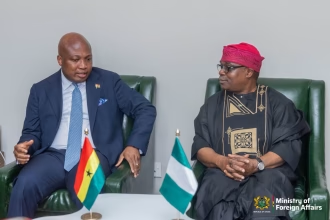
Meanwhile, Nigeria’s Deputy Acting High Commissioner, Olajide Ogunmadeji, issued a formal apology to South African traditional leaders and communities in the Eastern Cape.
The embassy emphasised its respect for South African laws and customs, stating it does not support actions that undermine local authority structures.
Constitutional Principles at the Core
The petition underscores that its demands are rooted in the Constitution of South Africa, particularly principles related to:
- Equality before the law
- National sovereignty
- Human dignity and security
The movement insists its campaign is not driven by xenophobia, but by a call for lawful, transparent governance.
Analysis: A Test of Governance and Social Cohesion
These developments come at a time when South Africa continues to grapple with complex immigration challenges and public sensitivity around foreign nationals.
The Eziko and Adetshina cases, while distinct, highlight broader systemic issues:
- Gaps in immigration enforcement
- The risks of identity fraud
- The delicate balance between cultural expression and legal compliance
How the government responds could set an important precedent—not only for immigration policy but also for managing diplomatic relations and internal social stability.
What Happens Next?
With court proceedings pending and public pressure mounting, attention now shifts to:
- The Department of Home Affairs’ official response
- The outcome of Rungo’s upcoming court appearance
- Possible government action on the petition’s demands
For now, the situation remains a flashpoint in South Africa’s ongoing debate over identity, law, and sovereignty.