The Special Investigating Unit (SIU) has secured a major Special Tribunal judgment against Minenhle Makhanya, the architect and principal agent responsible for the controversial security upgrades at former President Jacob Zuma’s Nkandla residence in KwaZulu-Natal.
- Nkandla project costs ballooned from R27.9 million to R216 million
- Tribunal finds Makhanya’s appointment unlawful
- Millions spent on work beyond security requirements
- Tribunal finds breach of professional duties
- Judge says Makhanya did not act alone
- Makhanya also ordered to pay legal costs
- SIU warns criminal evidence may be referred to NPA
- A costly chapter in the Nkandla saga
Makhanya has been ordered to pay the National Treasury R147,269,444.06, representing the financial loss suffered by the state as a result of unlawful conduct associated with the project.
The judgment was delivered on Wednesday, 26 August 2026.
The Tribunal also ordered Makhanya to pay interest on the amount at 11.25% per year from the date of judgment until the debt is settled, as well as the legal costs of the proceedings, including the costs of two counsel.
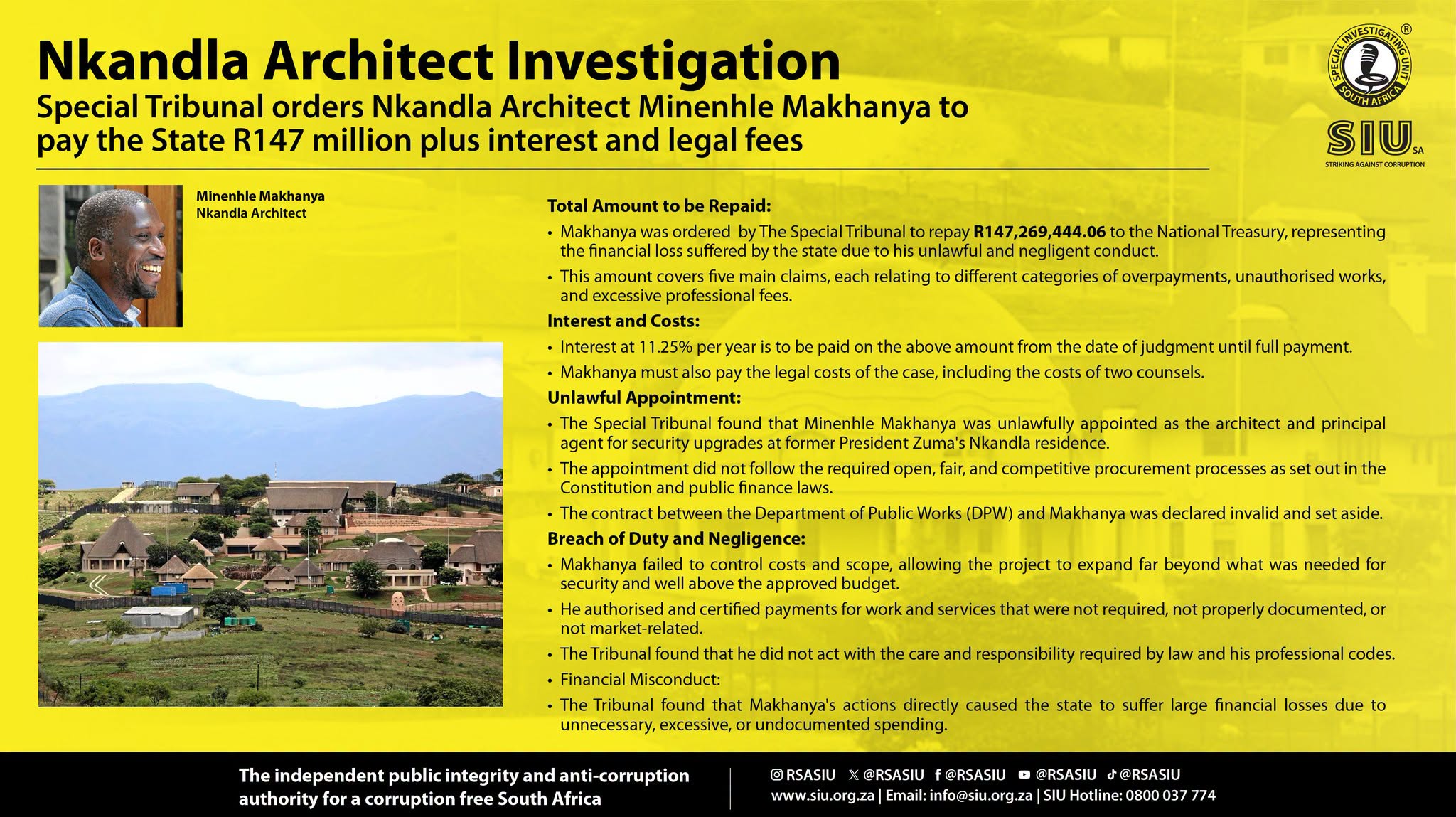
Nkandla project costs ballooned from R27.9 million to R216 million
The Nkandla security project was initially approved at R27,893,067.46 following security assessments conducted by the South African Police Service (SAPS) and South African National Defence Force (SANDF).
Those assessments identified additional security measures required to protect Zuma, his family and the private residence after he became President of South Africa.
However, the project’s final cost escalated dramatically.
According to the SIU, the cost eventually reached R216,010,478.24.
The investigation found that works were authorised and implemented beyond the security requirements identified by SAPS and SANDF.
Tribunal finds Makhanya’s appointment unlawful
Makhanya was appointed as the project’s architect and principal agent by project manager DJ Rindel in August 2009.
His appointment letter was issued on 27 August 2009.
The Special Tribunal found that the appointment did not follow the required open, fair and competitive procurement process.
It further found that there was no emergency or other lawful justification for bypassing the procurement requirements and that Makhanya was not registered as a supplier with the Department of Public Works (DPW).
The contract relating to his appointment was consequently declared invalid and of no force or effect.
Millions spent on work beyond security requirements
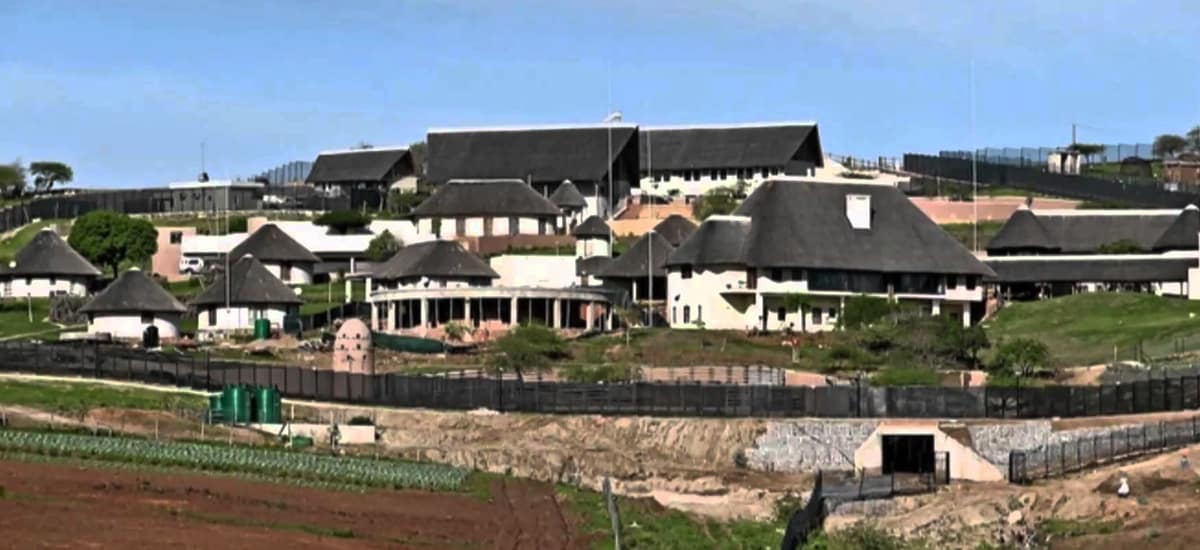
The SIU said Makhanya authorised and oversaw a range of additional structures and improvements that went beyond the measures identified in the security assessments.
These included:
- Tunnels with an exit and three lifts
- 20 additional accommodation units for SAPS and SANDF personnel
- A laundry facility
- A visitors’ lounge
- Basement parking for the clinic
- VIP parking
- A fire pool
- Relocation of 4.5 households
- Internal roads
- Air-conditioning
- Extensive landscaping within the high-security area
The SIU said these structures and works amounted to R68.5 million.
The Tribunal found that Makhanya authorised and certified payments for work and services that were not required by the security assessments.
Tribunal finds breach of professional duties
The Tribunal also found that Makhanya failed to obtain the required written approvals for variations and over-designs.
He was found to have certified payments above market-related costs and approved payments for work that had either not been completed or had not been properly accounted for.
The findings included breaches of statutory, professional and contractual obligations arising from the Architectural Profession Act, the applicable professional code, the Department of Public Works’ architectural manual and the Joint Building Contracts Committee (JBCC) agreement.
The Tribunal rejected Makhanya’s defence that he was simply implementing instructions and decisions made by SAPS and SANDF.
It also rejected his arguments concerning prescription and the alleged time-barring of the SIU’s claims.
Judge says Makhanya did not act alone
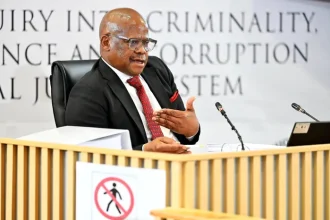
While the Tribunal held Makhanya personally liable for the financial loss covered by its order, Judge K. Pillay acknowledged that the architect was not the only person involved in decisions surrounding the escalation of the Nkandla project.
The judgment noted that Makhanya nevertheless carried responsibility in his role as architect and principal agent to protect the interests of the Department of Public Works and prevent fruitless and wasteful expenditure.
The SIU’s case against Makhanya resulted in the recovery claim being reduced by R7.8 million following a submission relating to an amount repaid by Zuma as a contribution towards non-security-related upgrades.
That amount was deducted from the sum considered just and equitable for Makhanya to repay.
Makhanya also ordered to pay legal costs
In addition to the R147.27 million repayment, Makhanya must pay the legal costs associated with the proceedings.
Interest will accrue at 11.25% annually from the date of judgment until the full amount is paid.
The financial order represents a significant consequence-management victory for the SIU, which has been pursuing the recovery of public money linked to the Nkandla upgrades for years.
SIU warns criminal evidence may be referred to NPA
The Nkandla investigation was authorised under Proclamation R59 of 2013, which empowered the SIU to investigate allegations concerning the procurement of goods, works and services for the project.
The investigation focused, among other things, on whether procurement was conducted in a manner that was fair, equitable, transparent, competitive and cost-effective.
The SIU said that any evidence of criminal conduct uncovered during its investigation will be referred to the National Prosecuting Authority (NPA) for consideration and further action, in accordance with the Special Investigating Units and Special Tribunals Act 74 of 1996.
A costly chapter in the Nkandla saga
The Tribunal’s latest order adds another significant chapter to the long-running Nkandla controversy.
What began as a project initially estimated at less than R28 million ultimately cost more than R216 million, with the SIU arguing that unlawful conduct and unnecessary expenditure contributed to the state’s losses.
The judgment now places personal financial liability on the architect and principal agent for R147.27 million, plus interest and legal costs.
For the SIU, the case represents another attempt to turn investigations into tangible financial recovery and accountability for losses suffered by the public purse.