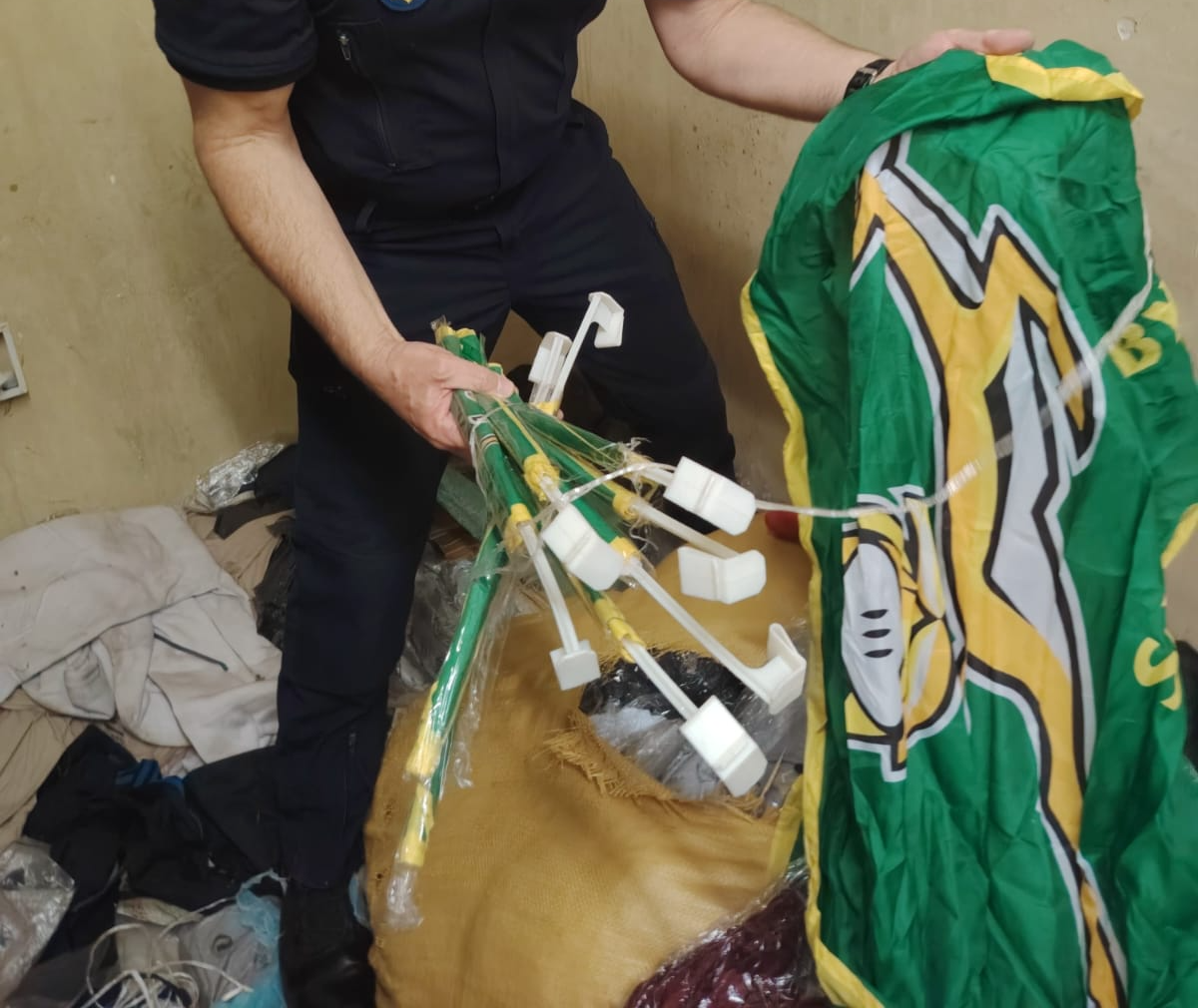
South African police have dealt a major blow to the counterfeit sportswear trade after authorities seized more than 1,700 suspected fake jerseys, sports clothing and footwear worth over R1.5 million during a raid in the Johannesburg CBD.
The intelligence-driven operation was conducted on 5 September 2026 at a storage facility believed to be connected to the production and distribution of counterfeit merchandise.
The seizure included counterfeit Springboks-branded items, other sports apparel carrying protected trademarks, as well as equipment allegedly used to manufacture and brand the fake products.
Counterfeit operation uncovered in Johannesburg CBD
The operation was led by the South African Police Service National Counterfeit and Illicit Goods Unit, working with several law enforcement and brand-protection agencies.
Teams from the Gauteng Counterfeit and Illicit Goods Unit, Public Order Policing, the Johannesburg Metropolitan Police Department, SARS Customs Division and brand protection representatives were involved in the operation.
Authorities executed a number of search-and-seizure warrants, allowing investigators to enter and search premises suspected of being involved in counterfeit-goods activity.
The scale of the seizure suggests that the facility was not simply being used to store finished products.
Police discover equipment used to make fake merchandise
Alongside the counterfeit clothing and footwear, investigators recovered equipment allegedly used in the production and branding of the merchandise.
Among the items seized were an embossing machine, silkscreen plates, counterfeit labels and branded stickers.
The discovery of manufacturing equipment is significant because it indicates that investigators were targeting more than a retail point where counterfeit goods were being sold.
Such facilities can form part of a wider supply chain in which counterfeit products are manufactured, branded, stored and eventually distributed to consumers.
The seized goods and equipment will form part of the investigation.
Springboks merchandise targeted ahead of major match
The operation came just days before the highly anticipated Springboks versus All Blacks match at FNB Stadium, a fixture expected to generate substantial demand for South African rugby merchandise.
Major sporting events can create lucrative opportunities for counterfeit traders.
As supporters look for jerseys, shirts, caps and other team-branded products, counterfeiters can attempt to exploit the increased demand by offering cheaper versions of popular merchandise.
The presence of Springboks-branded products among the seized items therefore highlights the commercial value of one of South Africa’s strongest sporting brands.
Multi-agency operation targets illicit trade
The raid demonstrates the increasingly collaborative approach being used by South African authorities to tackle counterfeit and illicit goods.
SAPS worked alongside SARS Customs, municipal law enforcement and brand-protection specialists, bringing together agencies with different roles in identifying, investigating and disrupting counterfeit supply chains.
Counterfeit merchandise can have consequences beyond trademark infringement.
Authorities are also concerned about the broader criminal networks that can develop around the illegal importation, manufacturing, storage and distribution of fake goods.
SAPS warns consumers about counterfeit products
Police have urged consumers to exercise caution when purchasing branded sports merchandise, particularly during major sporting events when demand can rise sharply.
SAPS encouraged members of the public to purchase official merchandise from authorised retailers and legitimate outlets.
Consumers who encounter suspected counterfeit products are also encouraged to report them to the relevant authorities.
The message comes as law enforcement agencies continue efforts to disrupt the networks responsible for bringing counterfeit products into the market.
Why the R1.5 million seizure matters
The Johannesburg operation illustrates how quickly counterfeit merchandise can become a significant commercial operation.
More than 1,700 items were removed from circulation in a single raid, alongside machinery and materials that could potentially have been used to produce additional goods.
The timing also demonstrates why major sporting events can become a focus for counterfeit investigations.
With thousands of supporters expected to follow the Springboks, demand for team merchandise can create a short window in which illicit traders attempt to capitalise on the national team’s popularity.
For law enforcement and brand owners, disrupting those operations before merchandise reaches consumers can prevent counterfeit products from spreading through the market.
The Johannesburg seizure is now expected to feed into the broader investigation into the source, production and distribution of the suspected counterfeit goods.