Whistleblowers have provided the government with information about an alleged illegal land-allocation scheme at Knoflokskraal in the Western Cape, where state-owned land was reportedly subdivided and sold for approximately R1,500 per plot.
- Whistleblowers expose alleged illegal land sales
- SAPS receives criminal complaint over alleged fraud and extortion
- Government alleges an unauthorised parallel policing structure
- May incidents included alleged assault and arson
- Knoflokskraal security costs exceed R58 million
- Government faces pressure to restore control of state land
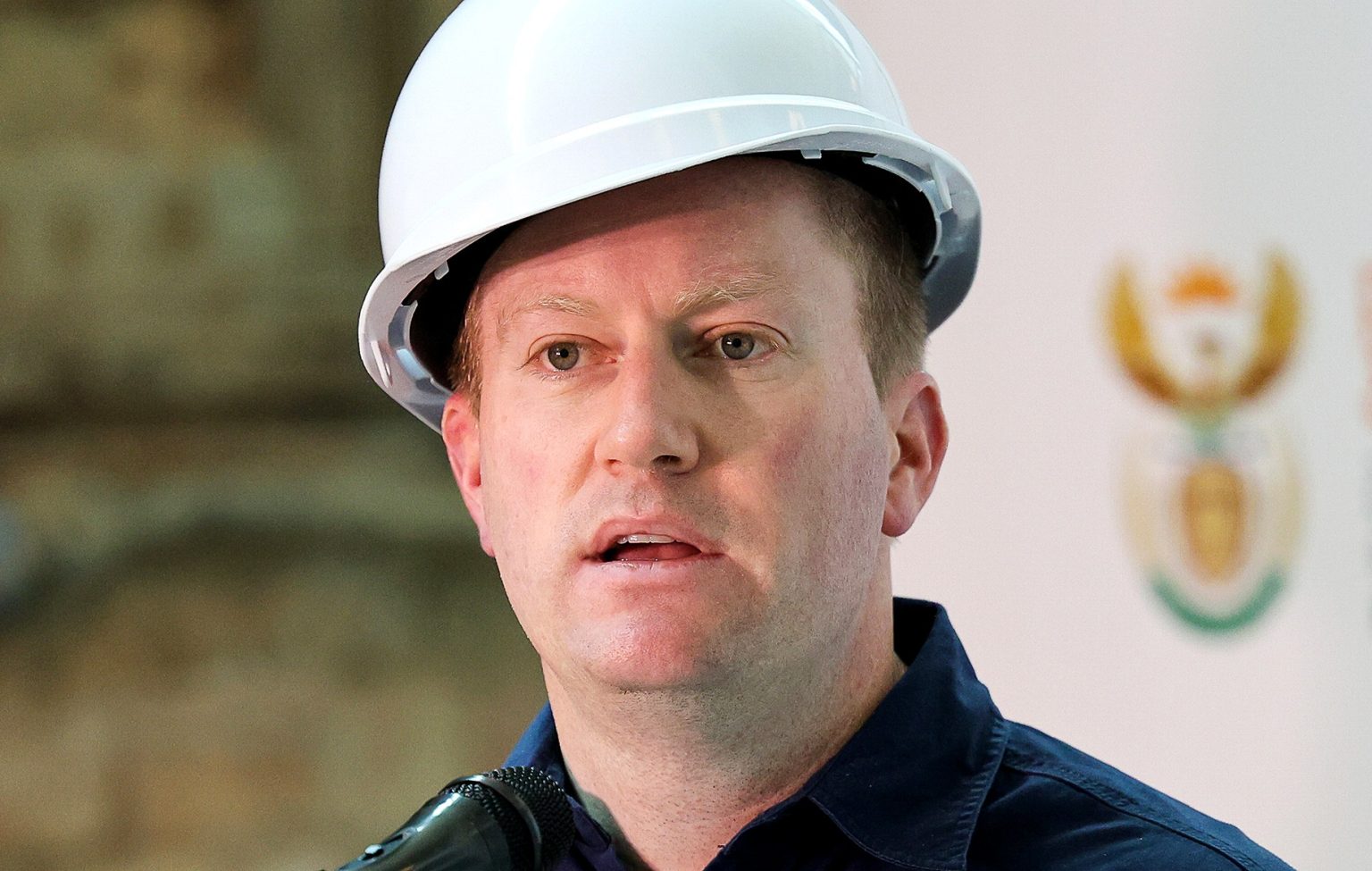
Public Works and Infrastructure Minister Dean Macpherson says the disclosures point to suspected fraud, extortion, violence and the unlawful occupation and subdivision of government property. The department has handed evidence to the South African Police Service (SAPS) and is seeking specialised investigative support.
Briefing the media on Monday, Macpherson said the government had received a database containing details of approximately 820 people allegedly linked to land purchases or allocations through the disputed system.
The allegations raise questions about who controlled the transactions, how payments were collected and whether organised groups were exploiting residents seeking access to land.
Whistleblowers expose alleged illegal land sales
According to Macpherson, whistleblowers approached the department in June with information about an organised system through which state-owned land was allegedly being subdivided and sold without authorisation.
The allegations concern Knoflokskraal, an approximately 2,000-hectare property consisting of six farms in the Elgin Valley near Grabouw.
The information supplied to the government reportedly included payment details and the identities of individuals allegedly involved in the transactions, including community leaders.
The department also received allegations that residents were being charged unauthorised levies connected to the occupation and allocation of land.
Macpherson said some payments were allegedly collected to finance unauthorised activities or serve as protection fees.
“In plain language, this is called extortion, which is also criminal and illegal,” the minister said.
The allegations have not, on the information provided, established the guilt of any particular individual. The identities and roles of those implicated will need to be established through investigation and, where appropriate, court proceedings.
SAPS receives criminal complaint over alleged fraud and extortion
The Department of Public Works and Infrastructure submitted a formal criminal complaint affidavit to SAPS in July.
According to Macpherson, the submission included whistleblower disclosures, supporting documents and security reports concerning alleged illegal land sales, fraud, assault and arson.
The department is also seeking the involvement of additional specialised police investigative units to examine the allegations.
The investigation is expected to examine the alleged land transactions, the collection of money from residents and the individuals or groups suspected of organising the activity.
The database containing details of approximately 820 people could help investigators establish how land was allegedly allocated and whether payments were made through a coordinated system.
However, appearing on a database of alleged purchasers or recipients does not, by itself, establish that a person committed a crime.
Government alleges an unauthorised parallel policing structure
Macpherson also raised concerns about information suggesting that an unauthorised parallel policing structure was operating at the site.
The alleged structure was reportedly performing functions reserved for the SAPS, with information pointing to organised ranks, enforcement activities and facilities used for paramilitary-type training.
The department also received reports of shootings, intimidation, violence, assaults and obstruction involving government officials, contractors and security personnel.
Emergency workers were allegedly threatened while attempting to perform their duties.
Macpherson said the government had a responsibility to intervene when officials and emergency personnel could not safely access the property.
“When firefighters cannot safely respond to a fire, when contractors cannot safely access government property, and when officials cannot perform their lawful duties, the state has a responsibility to act,” he said.
The allegations concerning the purported parallel structure remain matters requiring investigation.
May incidents included alleged assault and arson
Macpherson described two incidents in May during attempts by the department to establish communication channels with residents and improve access control at the property.
On 15 May, a contractor attempting to deploy repurposed containers at access points allegedly encountered a hostile crowd.
According to the minister, one container was set alight, a security guardhouse was damaged and a security officer was allegedly assaulted with a crowbar.
Macpherson alleged that the person responsible for the assault was a community leader occupying the site.
A second attempt later in May reportedly encountered further resistance and obstruction.
The department’s account suggests that the incidents complicated efforts to establish communication with residents and carry out work on government property.
Despite the reported confrontations, Macpherson said some residents had subsequently begun approaching the government directly with information about suspected criminal syndicates and alleged unlawful land sales.
Knoflokskraal security costs exceed R58 million
The dispute has also placed a substantial financial burden on the Department of Public Works and Infrastructure.
Macpherson said the department spent more than R58 million on private tactical security associated with Knoflokskraal between April 2021 and June 2026.
A further R5.47 million was spent on sheriff’s fees connected to serving and enforcing court orders.
According to the minister, the security expenditure came from the department’s baseline budget and other service-delivery programmes.
The combined expenditure reported for private security and sheriff’s fees therefore exceeded R63 million over the period cited.
The figures highlight the financial consequences of maintaining security around disputed state property while legal and enforcement issues remain unresolved.
“These are enormous amounts of public money,” Macpherson said.
He argued that the expenditure demonstrated the cost of allowing the situation to continue without a sustainable resolution and warned against making the arrangement a permanent feature of governance at the site.
Government faces pressure to restore control of state land
The allegations at Knoflokskraal involve more than a dispute over who occupies the land. They raise questions about the protection of public property, the collection of money from residents and the state’s ability to enforce the law where intimidation and violence are reported.
If the alleged sales and levies are substantiated, investigators will need to establish who organised the transactions, who benefited financially and whether residents were misled about their rights to the plots.
The government will also need to distinguish between people allegedly involved in organising unlawful transactions and residents who may have paid money believing they were obtaining legitimate land allocations.
For the department, the immediate priorities are to support the criminal investigation, protect officials and contractors, and address the ongoing security costs.
Macpherson has made clear that the current situation cannot continue indefinitely. The eventual outcome will depend on the evidence gathered by investigators and the legal steps taken to resolve the status of the state-owned property.