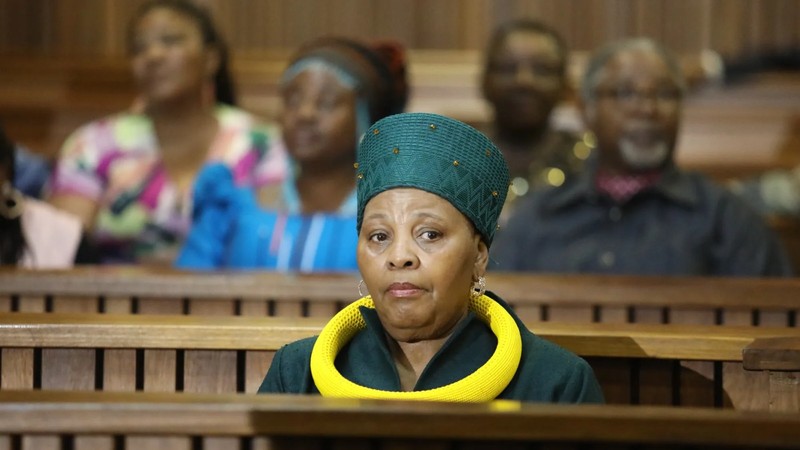
The corruption trial involving former Defence Minister and National Assembly Speaker Nosiviwe Mapisa-Nqakula entered another significant phase on Tuesday as the Gauteng High Court in Pretoria heard detailed testimony about extensive renovations to her Johannesburg residence, allegedly financed through cash payments.
- Interior Designer Details Years of Renovation Work
- Imported Curtains Draw Attention in Court
- Witness Says Every Payment Was Made in Cash
- Engineer Describes Approved Building Plans and Additional Cash Payments
- Corruption Allegations Remain Central to the Trial
- Prominent Advocate Declines to Give Evidence
- Why the Cash Payment Evidence Matters
Witnesses described a renovation project that expanded far beyond its original scope, eventually costing close to R1.8 million. Among the most striking details presented in court was the installation of imported custom-made curtains valued at approximately R600,000, prompting questions from the presiding judge about the extraordinary expense.
The evidence forms part of the State’s broader case, which alleges that Mapisa-Nqakula unlawfully benefited from payments linked to defence procurement contracts during her tenure as Minister of Defence. She has pleaded not guilty to all 12 charges against her.
Interior Designer Details Years of Renovation Work
The State called interior designer Nomsa Patricia Betty Shabangu, who testified that she had known Mapisa-Nqakula for more than two decades and regarded her as a close family friend.
According to her evidence, she managed the redesign and renovation of the politician’s Bruma home between 2018 and 2020.
Shabangu explained that the project initially involved relatively modest upgrades, including bathroom refurbishments and new flooring. Early construction estimates were around R352,000, excluding labour costs estimated at between R100,000 and R115,000.
However, as construction progressed, additional structural work, extensions and high-end interior finishes were added, substantially increasing the project’s overall value.
She estimated that the final cost of construction, furnishings and interior décor reached between R1.6 million and R1.8 million.
Imported Curtains Draw Attention in Court
One of the most talked-about aspects of the testimony involved bespoke curtains designed specifically for the property.
Shabangu told the court that specialised fabric had been purchased overseas after it proved less expensive than sourcing equivalent material within South Africa.
The curtains, together with rails, lining and associated fittings, were valued at around R600,000.
The unusually high figure prompted Judge Mashudu Munzhelele to question the witness directly about the nature of curtains carrying such a price tag.
Beyond the curtains, Shabangu testified that she sourced classic ornamental furniture and premium decorative finishes to complete the home’s redesigned interior.
Witness Says Every Payment Was Made in Cash
Perhaps the most significant aspect of the evidence concerned the payment method.
Shabangu testified that every payment she received during the renovation project was made in cash.
According to her evidence, Mapisa-Nqakula informed her that electronic fund transfers could not be used, resulting in cash being provided throughout the project.
She said the funds were used to purchase construction materials, pay suppliers and compensate labourers working on site. On occasions when she was unavailable, the cash was reportedly handed directly to workers by Mapisa-Nqakula herself.
The witness also told the court she had received approximately R400,000 towards the curtain installation, leaving an unpaid balance of around R200,000 covering blinds, curtain tracks, lining and other related materials.
Despite the outstanding amount, she said she had never pursued legal recovery because of their longstanding personal relationship.
When questioned by the court, Shabangu explained that Mapisa-Nqakula had indicated the balance would be settled after her retirement in 2024.
She further testified that her religious beliefs discouraged her from placing pressure on someone over unpaid money, adding that she had chosen not to actively pursue repayment.
Engineer Describes Approved Building Plans and Additional Cash Payments
The prosecution also heard from engineer and architectural designer Azwindini Emmanuel Mulaudzi.
Mulaudzi testified that he was approached by Shabangu to prepare architectural plans for alterations to the Bruma residence.
He said the plans were submitted to the local municipality, approved and subsequently implemented during construction.
According to his testimony, he initially received a R20,000 cash deposit through Shabangu.
After municipal approval, he said he was paid a further R50,000 in cash during a meeting with Mapisa-Nqakula and her husband, Charles, at their residence in July 2018.
His evidence added another account of cash transactions linked to the renovation project, supporting the prosecution’s attempt to establish how the renovations were financed.
Corruption Allegations Remain Central to the Trial
The renovation evidence forms only one component of the State’s wider corruption and money laundering case.
Prosecutors allege that between December 2016 and July 2019, Mapisa-Nqakula requested or accepted unlawful benefits amounting to approximately R4.5 million.
The allegations centre on claims that defence contractor Nombasa Ntsondwa-Ndhlovu, through her company Umkhombe Marine, provided financial benefits while securing lucrative defence-related contracts.
The State contends that some of those alleged benefits were used to finance work carried out on the Bruma property.
Mapisa-Nqakula has denied all allegations and continues to maintain her innocence.
As the matter proceeds, the court’s responsibility remains to assess whether the prosecution can prove its case beyond reasonable doubt.
Prominent Advocate Declines to Give Evidence
The proceedings also took an unexpected turn when advocate Zola Majavu, who had been expected to testify, informed the court that doing so could place him in conflict with his professional ethical obligations.
Majavu explained that aspects of the case potentially involved confidential communications protected by attorney-client privilege arising from his previous professional relationship with a client connected to the matter.
Judge Munzhelele questioned whether providing testimony could compromise those obligations and cautioned that doing so might have wider professional consequences if issues surrounding credibility later emerged.
Following discussions between the judge, prosecutors and defence counsel, Majavu elected not to continue with his testimony and stepped down from the witness stand before substantive evidence was heard.
Why the Cash Payment Evidence Matters
Although the trial remains far from concluded, the latest testimony illustrates why investigators are focusing closely on the financial trail surrounding the renovation project.
Cash transactions can present challenges for investigators because they often leave fewer conventional banking records than electronic transfers. As a result, witness testimony, invoices, construction documentation and supporting records may become particularly important in establishing the movement of funds.
Ultimately, the court will weigh all evidence presented by both the prosecution and the defence before reaching any findings on the charges.
The trial continues in the Gauteng High Court in Pretoria.