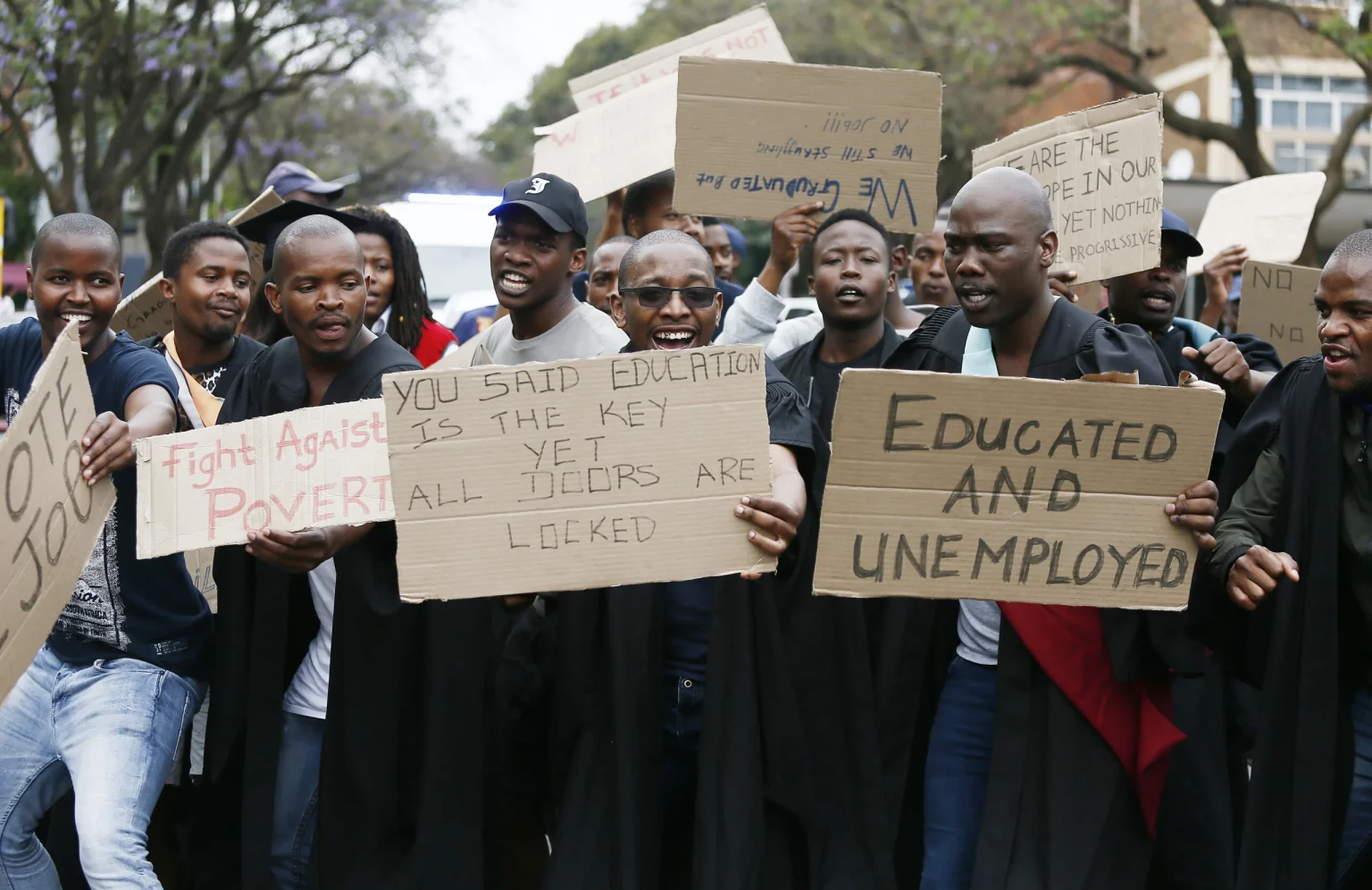
South Africa’s unemployment rate has climbed to 33.6% in the second quarter of 2026, up from 32.7% in the previous quarter, as weak economic growth and mounting global uncertainty place further pressure on an already fragile labour market.
- Middle East conflict adds another economic shock
- Economists warn that the labour market could deteriorate further
- Eastern Cape and Western Cape tell two very different stories
- Northern Cape sees improvement
- The municipal question could become politically explosive
- South Africa’s unemployment problem is not simply a national problem
- 8.5 million unemployed people puts the scale into perspective
- What happens next?
Statistics South Africa reported that the number of unemployed people increased by 345,000 to 8.5 million during the quarter.
The expanded unemployment rate, which also includes people who have stopped actively looking for work, edged higher to 43.8%, compared with 43.7% in the first quarter.
The figures reinforce a problem South Africa has struggled to reverse for years: economic growth remains too weak to generate jobs at the scale required to absorb millions of unemployed people.
The latest deterioration also comes against the backdrop of escalating conflict in the Middle East, which has contributed to higher fuel costs, weaker confidence and increased uncertainty for businesses and consumers.
Middle East conflict adds another economic shock
South Africa entered the second quarter with an economy already struggling to generate meaningful employment growth.
The escalation of the conflict involving Iran, however, introduced another layer of pressure.
Sharp increases in fuel prices between April and June raised operating costs for businesses and squeezed household budgets. For companies already dealing with weak demand and limited economic growth, higher transport and energy-related expenses created another reason to delay expansion and hiring.
Investec economist Lara Hodes said continuing geopolitical tensions had increased uncertainty globally, weighing on business confidence and influencing decisions around investment and employment.
The impact extends beyond fuel prices.
When businesses become less confident about future demand, hiring is often one of the first areas to come under scrutiny. Consumers facing higher living costs may also reduce spending, further weakening the demand that businesses need to justify expansion.
That creates a difficult cycle: weaker confidence reduces investment, weaker investment limits job creation and fewer jobs suppress household spending.
Economists warn that the labour market could deteriorate further
The latest unemployment figures should not be viewed in isolation from South Africa’s underlying growth problem.
Oxford Economics Africa senior economist Jee-A van der Linde said the data reflected the negative impact of the Middle East conflict on business, investor and consumer sentiment.
The warning is particularly significant because the conflict is occurring in an economy that was already failing to generate sufficient employment.
South Africa has now endured an unemployment rate above 30% for more than five years.
Even without the latest geopolitical shock, the country’s unemployment rate would likely have remained above that threshold during the second quarter.
The conflict has instead added another obstacle at a time when stronger domestic growth is urgently needed.
Van der Linde warned that the labour market could weaken further before conditions improve, with near-term economic growth prospects also affected by disruption arising from the Middle East conflict.
Eastern Cape and Western Cape tell two very different stories
Perhaps the most striking feature of the latest unemployment data is not the national figure, but the enormous gap between provinces.
The Western Cape recorded an unemployment rate of 19.5% in the second quarter, remaining comfortably below every other province.
Although still high by international standards, the figure represents a dramatically different employment environment from parts of the country.
At the opposite end of the spectrum is the Eastern Cape, where unemployment surged to 47.5%.
That means almost one in every two people in the province’s labour force is unemployed under the standard definition.
The Eastern Cape’s position is even more concerning when measured against the same period a year earlier. Its unemployment rate increased by 8 percentage points, highlighting how uneven the country’s labour-market pressures have become.
Northern Cape sees improvement
Not every province experienced a deterioration.
The Northern Cape recorded a 1.7 percentage-point decline, bringing its unemployment rate down to 28.7%.
That improvement demonstrates that South Africa’s national employment crisis is not moving uniformly in one direction.
However, the enormous difference between provincial outcomes raises an important question: what are some regions doing differently?
The Western Cape’s comparatively stronger performance has often been associated with its more diversified economy, tourism, services sector, agriculture, manufacturing and established urban economic centres.
By contrast, provinces with weaker infrastructure, struggling municipalities and limited private-sector investment face a much harder battle to attract employers and create sustainable jobs.
The municipal question could become politically explosive
The employment divide between provinces is likely to become an increasingly important political issue ahead of South Africa’s local government elections.
High unemployment is not caused by municipalities alone, and national economic conditions remain critical. However, the performance of local government can have a direct effect on whether an area is attractive to investors and businesses.
Reliable electricity, functioning water systems, efficient waste removal, well-maintained roads, effective permitting processes and predictable municipal administration can all influence investment decisions.
Where these systems deteriorate, businesses face higher costs and greater operational uncertainty.
That can discourage new investment and, in turn, reduce opportunities for employment.
The result can become a self-reinforcing cycle: declining municipal performance makes an area less attractive to investors, weaker investment limits job creation and rising unemployment further weakens the local economy.
South Africa’s unemployment problem is not simply a national problem
The latest figures challenge the idea that South Africa’s employment crisis can be understood through one national number.
The gap between the Western Cape’s 19.5% and the Eastern Cape’s 47.5% is too large to ignore.
Both provinces operate within the same national economy, yet their labour-market outcomes are radically different.
That suggests that national economic growth is only part of the solution.
South Africa needs stronger national growth, but it also needs local economies capable of converting investment into jobs.
This means infrastructure, municipal competence, skills development, transport connectivity and conditions that allow businesses to establish and expand all matter.
8.5 million unemployed people puts the scale into perspective
The increase in unemployment to 8.5 million people provides perhaps the clearest indication of the scale of the challenge.
Behind the headline number are households facing lost income, young people struggling to enter the workforce and communities where limited employment opportunities can fuel long-term economic exclusion.
The expanded unemployment rate of 43.8% paints an even broader picture by including discouraged work seekers who are no longer actively searching for employment.
This distinction matters because a person who has stopped looking for work may disappear from the standard unemployment calculation even though they remain economically excluded.
What happens next?
South Africa’s immediate challenge is to prevent temporary global shocks from becoming permanent damage to an already weak labour market.
The Middle East conflict has demonstrated how quickly international events can affect domestic fuel prices, business confidence and household finances.
But the deeper problem remains structural.
South Africa needs sustained economic growth strong enough to translate into large-scale employment creation. That requires investment, functioning infrastructure, competitive businesses and policy certainty.
The provincial figures also suggest that local economic performance cannot be ignored.
The Western Cape’s comparatively low unemployment rate shows that high unemployment is not inevitable at the same level everywhere. The Eastern Cape’s deterioration, meanwhile, illustrates the consequences when weak economic conditions combine with deeper local challenges.
For millions of South Africans, the question is no longer simply whether the economy is growing.
It is whether that growth is strong enough, broad enough and geographically distributed enough to create actual jobs.
For now, the latest numbers suggest the answer remains no.