
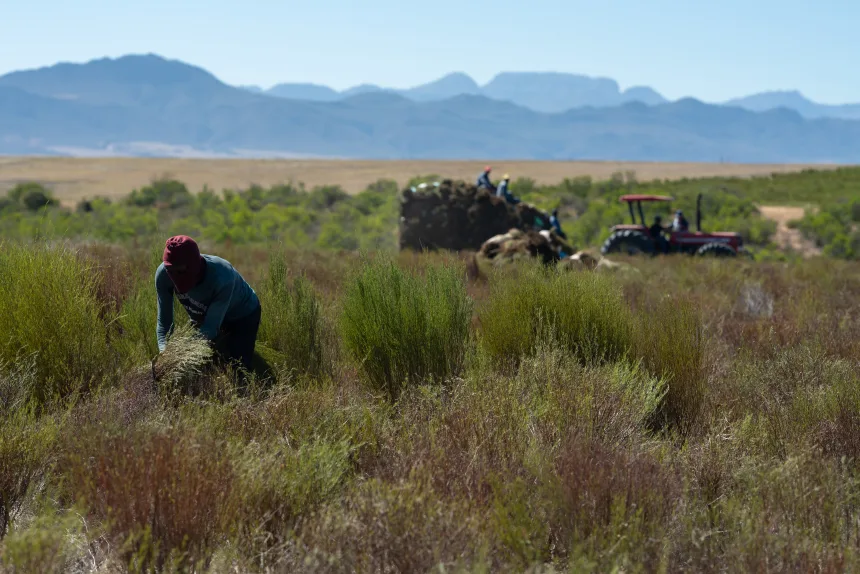
Deep in South Africa’s rugged Cederberg Mountains, a low-growing plant has quietly developed into one of the country’s most recognisable agricultural exports.
- From Cederberg plant to global tea
- Rooibos exports have more than doubled in a decade
- Japan has become a rooibos powerhouse
- The health appeal is powerful — but research still matters
- The Indigenous history behind rooibos
- A landmark benefit-sharing agreement
- Rooibos becomes Africa’s first EU-protected product of its kind
- But rooibos cannot simply be grown anywhere
- Climate change is putting pressure on production
- Rooibos has a natural climate buffer
- Trade tensions create another headache
- China could become the next big market
- South Africa’s little red bush has become a global brand
Rooibos, Afrikaans for “red bush”, is now consumed across the world, appearing in everything from teabags and speciality blends to cosmetics. Yet its global rise is rooted in a very specific place: an arid stretch of the Western Cape where the plant naturally occurs.
The industry is growing rapidly. Global rooibos consumption increased by 12.5% between 2022 and 2024, while South African exports exceeded 10,000 tonnes in 2025 for the first time, compared with about 5,900 tonnes a decade earlier.
But behind the success story are complicated questions about Indigenous knowledge, land ownership, climate change and who ultimately benefits from one of South Africa’s most distinctive natural products.
From Cederberg plant to global tea
Rooibos grows naturally within a relatively small geographical area of roughly 60,000 hectares in the Cederberg region, about 250 kilometres north of Cape Town.
Its needle-like leaves are harvested, processed and traditionally fermented to produce the distinctive reddish-brown tea familiar to consumers in South Africa and abroad.
Unlike conventional black tea and coffee, rooibos is naturally caffeine-free.
That characteristic has become one of its strongest selling points as consumers increasingly look for alternatives to caffeinated drinks.
Martin Bergh, managing director of Rooibos Limited, says the product’s international growth initially came from consumers discovering its distinctive flavour.
More recently, health-conscious consumers have helped drive demand.
The result is a product that has moved well beyond South Africa’s borders while remaining tied to one of the country’s most geographically restricted agricultural regions.
Rooibos exports have more than doubled in a decade
The numbers tell the story of the industry’s international expansion.
South Africa exported approximately 5,900 tonnes of rooibos in 2015.
By 2025, exports had surpassed 10,000 tonnes.
Rooibos Limited alone exports about R400 million worth of rooibos annually to more than 50 countries, accounting for almost half of South Africa’s total rooibos exports.
The company buys rooibos from farmers, processes it and supplies the product in bulk to international companies that package and market it under their own brands.
These include well-known tea names such as Tick Tock, Tetley and Twinings.
The overwhelming majority of rooibos is still sold as tea, particularly in teabag form.
But the international market is not uniform.
Japan has become a rooibos powerhouse
Germany played an important role in the early international expansion of rooibos.
Today, however, Japan is the industry’s largest export market, accounting for about 33% of South Africa’s rooibos exports in 2025.
That is significant because Japanese consumers have a long-established tea culture, yet rooibos has managed to carve out its own space.
The Japanese market is also showing how rooibos can move beyond the traditional cup of tea.
Rooibos-based skincare and other products are increasingly appearing alongside conventional tea products.
Different markets also prefer different flavours.
Plain rooibos remains particularly popular in South Africa, Japan and the United Kingdom, while European and American consumers have shown stronger interest in blends incorporating fruit and herbs.
In other words, the plant may be South African, but its global identity is being shaped by consumers thousands of kilometres away.
The health appeal is powerful — but research still matters
Rooibos has increasingly been associated with the wellness market.
Its naturally caffeine-free status makes it attractive to people seeking alternatives to coffee and conventional tea.
The plant also contains antioxidants and polyphenols, compounds that have attracted scientific interest.
Research has investigated possible links between rooibos consumption and cardiovascular health, cancer-related processes and other biological effects.
However, this is an area where marketing claims need to be treated carefully.
Scientists have identified potentially beneficial compounds in rooibos, but experts caution that more research is needed before broad health claims can be established conclusively in humans.
That distinction is increasingly important as functional beverages become a major global consumer trend.
Rooibos does not need exaggerated health promises to be commercially attractive. Its caffeine-free nature, distinctive taste and South African provenance already give it a strong identity.
The Indigenous history behind rooibos
The global rooibos industry did not begin with commercial plantations.
The plant was traditionally harvested from the wild by the San and Khoi peoples, whose knowledge of the plant predates its commercial cultivation.
European settlers began cultivating rooibos commercially in the 1930s.
That history eventually became part of a much larger debate about Indigenous knowledge and who should benefit economically from natural resources associated with that knowledge.
During apartheid, white-owned businesses benefited from state support, subsidies and protective measures in the rooibos industry, while Indigenous farmers were excluded from many opportunities.
The inequality did not disappear when rooibos became an international success.
A landmark benefit-sharing agreement
In 2011, the South African San Council approached the government over concerns that Indigenous communities were not receiving adequate recognition or economic benefit from their traditional knowledge of rooibos.
Government-backed research supported the recognition of that traditional knowledge.
After years of negotiations, the industry and representatives of the San and Khoi communities reached a benefit-sharing agreement in 2019.
The agreement requires companies in the rooibos industry to contribute an annual levy for Indigenous traditional knowledge holders.
It was a significant development because it formally recognised the contribution of Indigenous communities to the history and knowledge surrounding the plant.
However, the agreement has not ended the debate.
Critics argue that benefit-sharing alone does not resolve deeper structural problems, particularly unequal access to agricultural land.
A 2017 study found that Indigenous communities controlled less than 7% of rooibos-producing land and accounted for only about 2% of national rooibos production.
That means the question is not simply whether Indigenous communities receive a share of today’s industry.
It is also about who owns the land and controls production in the first place.
Rooibos becomes Africa’s first EU-protected product of its kind
Another major milestone came in 2021, when rooibos received Protected Designation of Origin (PDO) status from the European Union.
It became the first African product to receive the accreditation.
The protection means that products sold as rooibos in EU markets must originate from designated areas in South Africa’s Western and Northern Cape and comply with the applicable production requirements.
The principle is similar to geographical protections associated with famous European products such as Champagne and Gorgonzola.
For South Africa, the designation provides an important form of intellectual and commercial protection.
It also helps prevent producers elsewhere from attempting to appropriate the rooibos name for products that do not originate from the recognised South African production region.
The designation has another benefit: it strengthens the association between rooibos and its place of origin.
In an increasingly crowded global tea market, that provenance is valuable.
But rooibos cannot simply be grown anywhere
There is a fundamental limitation facing the industry.
Rooibos is not a crop that can simply be moved to another country when demand increases.
Its natural growing range is highly restricted.
That creates a difficult balancing act.
The industry wants to expand production to meet international demand, but the plant’s geographical requirements place a natural ceiling on how quickly that expansion can happen.
Marthane Swart, secretariat of the South Africa Rooibos Council, has warned that growth must therefore be managed responsibly within the environment where the crop can actually thrive.
This makes rooibos fundamentally different from many global agricultural commodities.
Its exclusivity is part of its appeal — but it is also one of its biggest vulnerabilities.
Climate change is putting pressure on production
The Cederberg’s dry environment is well suited to rooibos, but changing rainfall patterns are creating new challenges.
Annual rooibos production has fluctuated between roughly 13,000 and 25,000 tonnes over the past two decades.
In 2023, lower rainfall contributed to an estimated 17% decline in harvest volumes.
Production in 2025 was also estimated to have fallen.
The industry is increasingly dealing with hotter, drier conditions and changes in seasonal rainfall.
For a crop confined to such a specific geographical area, sustained climate changes could become a serious long-term issue.
At the same time, rooibos has an advantage that many agricultural products do not.
Rooibos has a natural climate buffer
Rooibos is essentially a dry-land crop, adapted to an environment where water is limited.
That gives it a degree of resilience.
There is another unusual advantage at the processing stage: dried rooibos can be stored for extended periods without rapidly losing its commercial value.
Processors can therefore build inventories during stronger harvest years and use those stocks when production falls.
Rooibos Limited describes this role as acting as a kind of “shock absorber” for the market.
That storage capacity can help maintain a relatively stable supply for international buyers despite fluctuations in annual harvests.
It does not eliminate climate risk, but it gives the industry an important tool for managing it.
Trade tensions create another headache
Climate is not the only challenge facing South Africa’s rooibos producers.
International trade conditions can have a significant impact on a specialised export industry.
Shipping costs from Cape Town have risen sharply, adding pressure to an industry that depends heavily on international markets.
The United States has also imposed tariffs on South African goods, although the rate has changed over time.
For rooibos producers, higher logistics and trade costs can make an already geographically limited product more expensive to move around the world.
That makes market diversification increasingly important.
China could become the next big market
The industry is therefore watching China closely.
China has been identified as one of the markets with the greatest potential for future rooibos growth, particularly following changes to tariffs on agricultural imports from many African countries, including South Africa.
For an industry that has already established strong markets in Japan, Europe and the United Kingdom, China represents the possibility of another significant expansion.
But it also reinforces the central challenge facing rooibos.
The more successful the product becomes internationally, the greater the pressure on a crop that can only be produced in a relatively small part of South Africa.
South Africa’s little red bush has become a global brand
Rooibos is an unusual South African export story.
It combines Indigenous knowledge, specialised agriculture, geographical identity and global consumer demand in a way few other products do.
Its rise from a traditional Cederberg plant to an export industry worth hundreds of millions of rand demonstrates the commercial power of local products when their provenance and distinctive characteristics are properly protected.
But the industry’s future will depend on more than selling more tea.
It will have to navigate climate change, land inequality, fair benefit-sharing, international trade pressures and the ecological limits of the Cederberg region.
That is the paradox at the heart of rooibos.
The plant’s greatest commercial advantage is its uniqueness — it can only genuinely be rooibos when it comes from its South African home.
And protecting that uniqueness may ultimately be more important than simply increasing production.