Mpumalanga taxi boss Joe “Ferrari” Sibanyoni has acknowledged receiving R2.29 million from a subcontractor linked to the R3.7 billion Moloto Road upgrade, but has rejected allegations that the payments were extortion or protection fees.
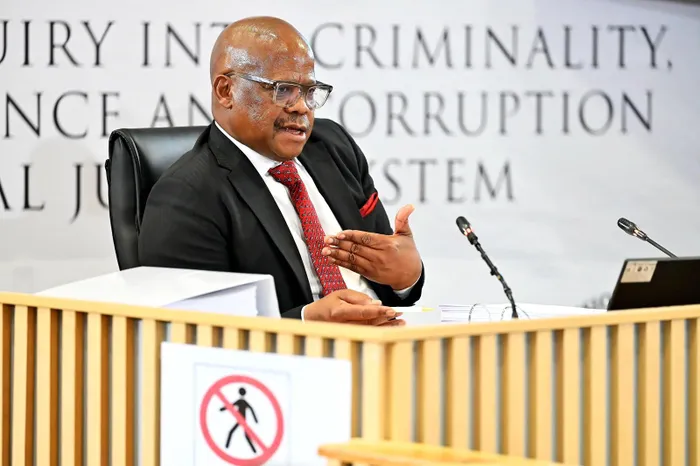
Sibanyoni made the admission while testifying before the Madlanga Commission of Inquiry, which is investigating allegations of organised crime, corruption and extortion within South Africa’s criminal justice and transport sectors.
The payments involved businessman Dr Tengane Thomas Ntuli, whose company supplied aggregate stone to a contractor working on the South African National Roads Agency’s (Sanral) R573 Moloto Road project.
R2.29 million payment trail examined
Evidence presented to the commission by chief evidence leader Advocate Matthew Chaskalson showed that more than R2.29 million was paid into an account linked to Sibanyoni’s company, MJ & Son Transport.
Sibanyoni conceded that he received the money and acknowledged that he had not performed work for the payments.
His explanation, however, differs sharply from the account presented by Ntuli.
Sibanyoni has described his relationship with Ntuli as a business partnership, arguing that his involvement was linked to a claimed local-content requirement connected to the project.
Sibanyoni says the money was an investment
Sibanyoni told the commission that the arrangement was not a protection-fee scheme.
He maintained that Ntuli needed a local partner to meet what Sibanyoni described as a 30% local-content requirement in order to secure the work in Mpumalanga.
Sibanyoni argued that his position as a resident of Kwaggafontein enabled Ntuli to participate in the project.
However, when questioned by Commissioner Sesi Baloyi, he acknowledged that he received money despite providing no actual services.
Sowetan reported that Sibanyoni accepted receiving R100,000 a month for entering into the partnership without performing work for the company.
The commission also heard that Sibanyoni could not point to a specific regulation establishing the 30% local-content requirement he relied upon.
Contractor alleges the payments were made under duress
The explanation is disputed by Ntuli and evidence presented to the commission.
Ntuli has alleged that Sibanyoni and his associate, Oupa “Bafana” Sindane, demanded payments to allow his business operations to continue without interference.
According to Ntuli’s affidavit, the alleged arrangement included demands for regular payments after his company obtained work associated with the Moloto Road project.
Evidence before the commission included financial records and WhatsApp messages concerning the alleged payment demands.
Ntuli’s company director, Bathabile Ntuli, also stated in an affidavit that payments were made because of fears for their safety.
These remain allegations being tested through the commission’s proceedings.
Sibanyoni distances himself from threatening messages
A key part of the testimony involved WhatsApp messages allegedly sent by Sindane.
The messages included demands for payment and warnings that operations could be stopped if payments were not made.
Sibanyoni denied instructing Sindane to threaten Ntuli.
When questioned about whether Sindane had acted independently, Sibanyoni agreed that he had.
“He was acting on his own.”
Sibanyoni also maintained that he had a good relationship with Ntuli and denied ever sending threatening messages to him.
The commission has nevertheless been examining the communications as part of the broader allegations surrounding the payments.
The disputed 30% local-content explanation
The local-content explanation has become another significant point of contention.
Sibanyoni maintained that his involvement was necessary because Ntuli needed local participation to secure the project.
But evidence leader Matthew Chaskalson questioned why there was no documentary evidence showing Sibanyoni’s interest in Ntuli’s business or demonstrating that such an arrangement was required by Sanral or the tender.
Sibanyoni responded that it was Ntuli’s responsibility to provide the relevant documentation to Sanral.
The commission is therefore examining not only the money trail, but also the stated commercial basis for the arrangement.
What the commission is investigating
The R2.29 million payments form part of a wider investigation into alleged extortion linked to contractors and businesses operating around the Moloto Road project.
Evidence leaders have described WhatsApp communications and affidavits as indicating an alleged arrangement in which contractors were pressured to make regular payments in exchange for being allowed to operate without disruption.
Sibanyoni disputes that characterisation.
He has instead presented his involvement as a legitimate business arrangement and has denied the extortion allegations against him.
The separate criminal case also remains contested. Sibanyoni and other accused individuals have denied the charges.
What happens next?
Sibanyoni’s testimony comes as the Madlanga Commission continues examining allegations surrounding taxi industry figures, contractors, alleged protection payments and interference with businesses.
The commission will have to weigh Sibanyoni’s explanation against financial records, affidavits, WhatsApp communications and testimony from other witnesses.
For now, the central dispute remains straightforward but significant: Sibanyoni accepts that R2.29 million changed hands, but rejects the allegation that the money represented extortion.
The Madlanga Commission’s proceedings continue.