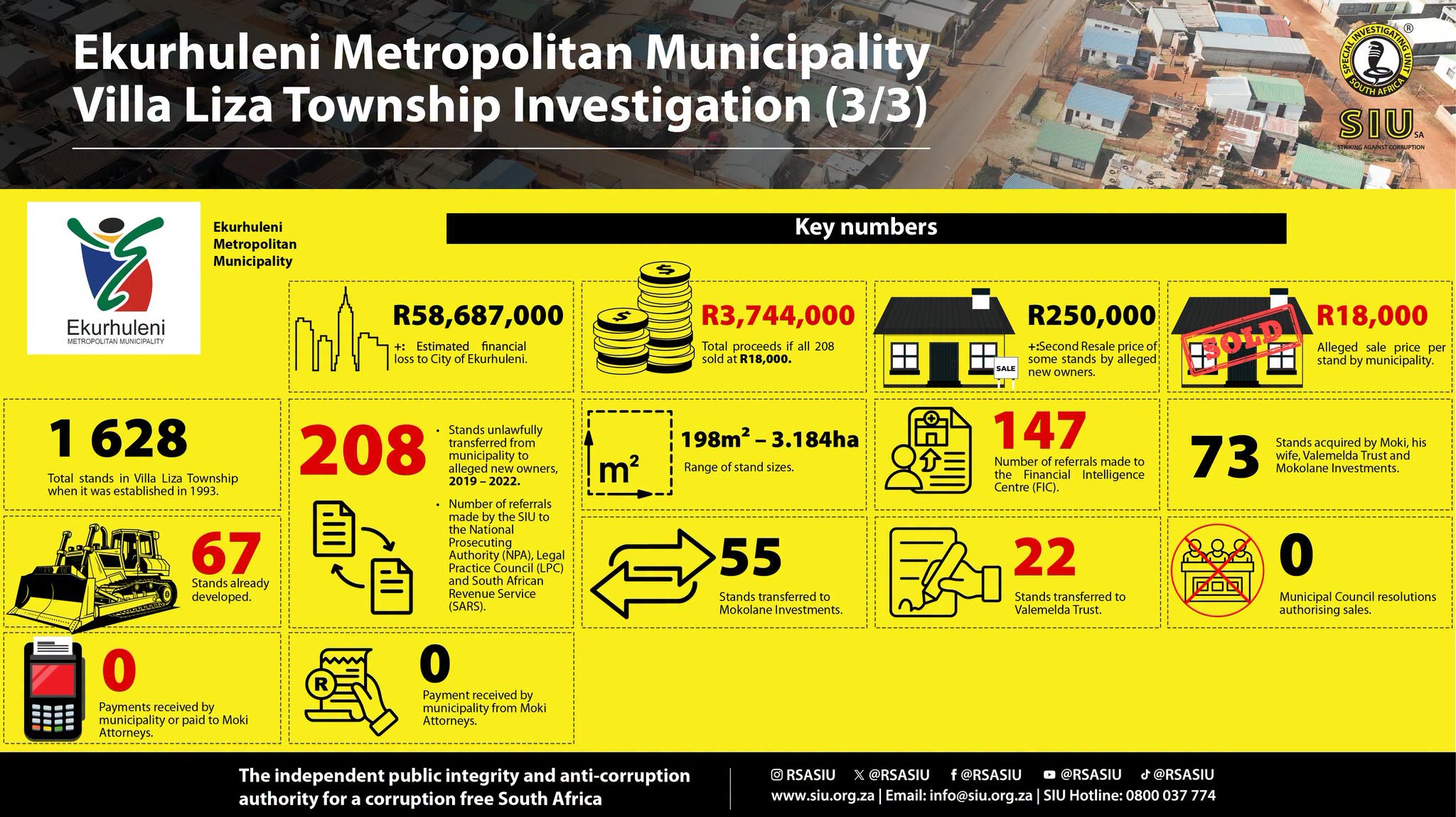
A Special Investigating Unit (SIU) investigation has uncovered what it describes as a deliberate scheme that allegedly stripped the City of Ekurhuleni of 208 municipal stands worth about R58 million and transferred them into private hands without the required council approval.
- 208 municipal stands allegedly transferred without approval
- How the alleged land scheme worked
- Alleged estate agent had already died
- Conveyancer and spouse allegedly acquired 73 stands
- No evidence of municipal or Deeds Office officials’ involvement
- 208 matters referred to NPA
- SIU moves to recover the land
- Legal and tax authorities also brought in
- SIU calls for tighter controls over municipal land
- Why the Villa Liza case matters
- SIU investigation exposes wider governance risk
The vacant properties are located in Villa Liza township near Boksburg and formed part of an investigation authorised by President Cyril Ramaphosa under Proclamation 195 of 2024.
The SIU says the transfers took place between 2018 and 2022, without council resolutions or lawful authority, and that Ekurhuleni received no money from the transactions.
The investigation has now been completed, with the SIU submitting its final report to the Presidency in July 2026.
208 municipal stands allegedly transferred without approval
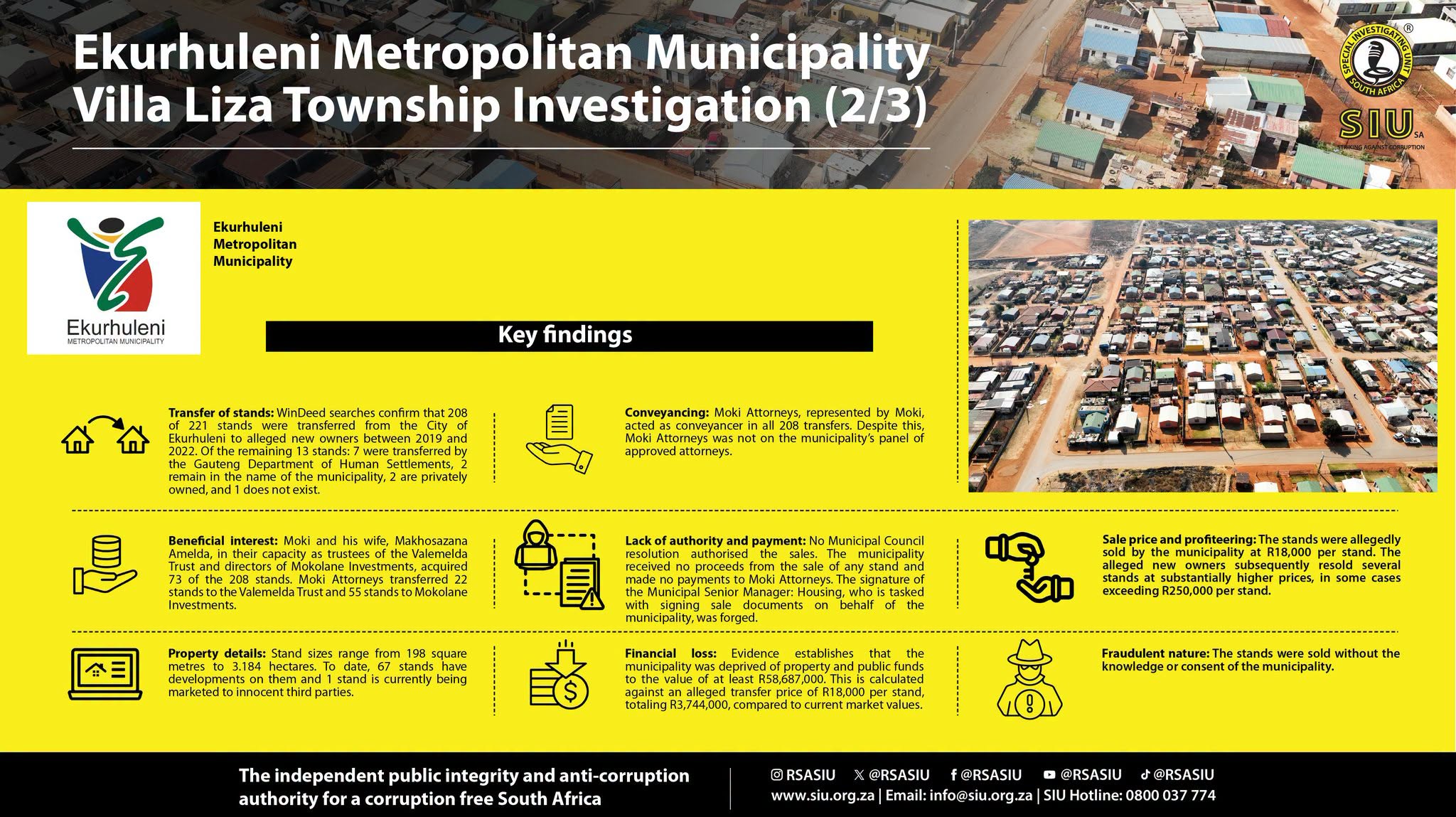
The investigation initially examined 221 vacant stands identified in the presidential proclamation.
The SIU found that 208 of those properties were allegedly transferred fraudulently to private owners.
The remaining 13 properties were accounted for differently: eight were transferred by the Gauteng Department of Human Settlements, two were privately owned, two remain in municipal ownership and one could not be found in the municipal and Deeds Registry records.
The scale of the alleged loss is significant.
According to the SIU, the affected stands had municipal valuations ranging from R80,000 to R3.7 million, although records at the Deeds Office showed that each was sold for just R18,000.
The properties were subsequently resold for an average of approximately R250,000 per stand, according to the investigation.
How the alleged land scheme worked
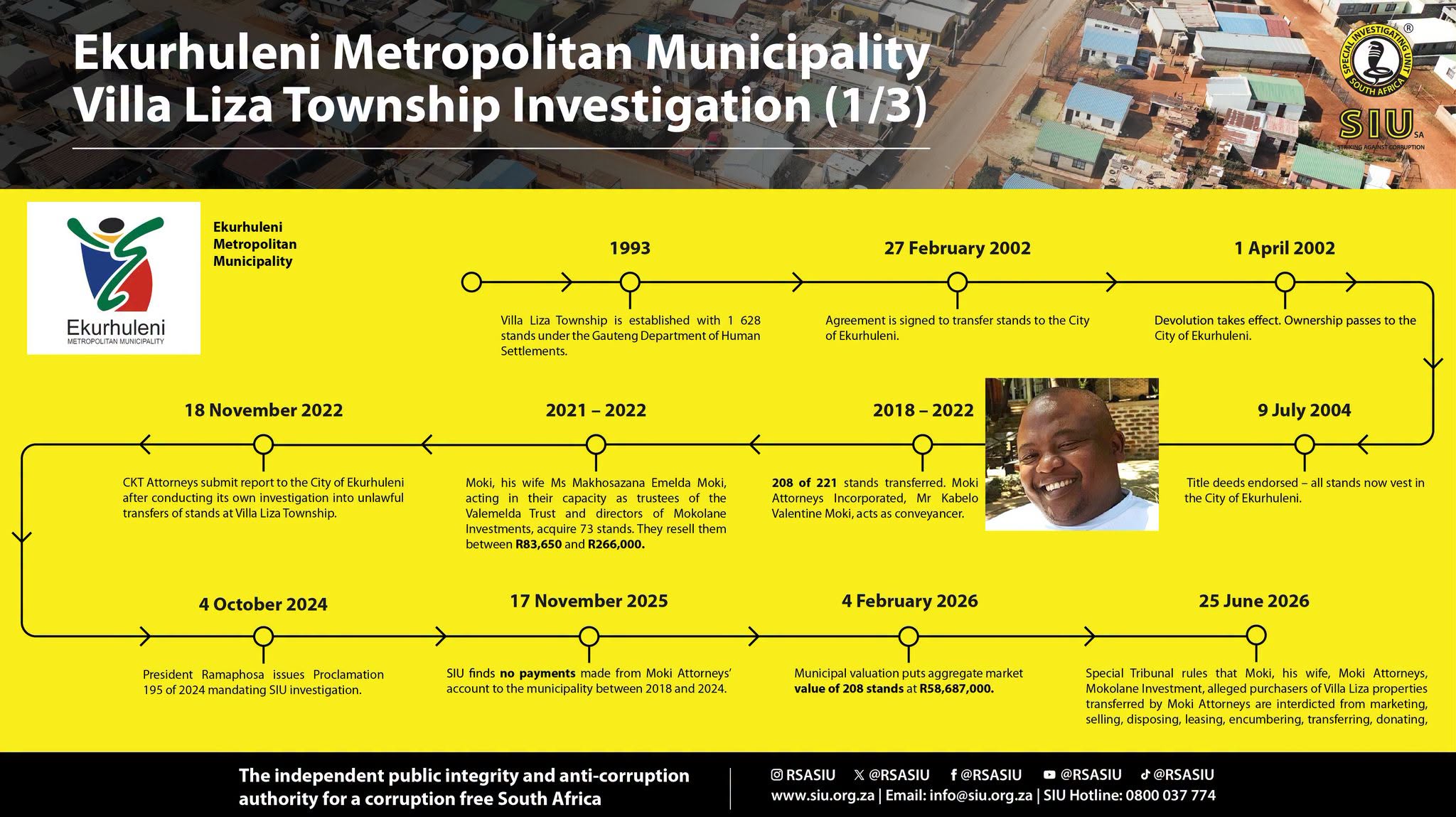
The SIU’s investigation describes a process in which an individual referred to as an alleged “agent” identified unallocated municipal land in Villa Liza.
The person then allegedly arranged for the properties to be sold and transferred to private individuals.
The investigation identified a connection between the alleged agent and Moki Attorneys Incorporated, a conveyancing firm that processed the transactions.
The SIU says forged rates clearance certificates and fabricated powers of attorney were among the documents allegedly used to facilitate the transfers.
The conveyancing firm was not on Ekurhuleni Municipality’s approved panel of attorneys, according to the investigation.
The SIU says the firm nevertheless lodged documents at the Johannesburg Deeds Office and certified that the documentation submitted for registration was authentic and correct.
Alleged estate agent had already died
One of the more unusual findings concerns the person allegedly presented as an estate agent in the transactions.
The SIU says the individual had died on 10 January 2022, with the Department of Home Affairs confirming the person’s death.
Despite this, the person allegedly featured in the process used to facilitate the transfers.
The finding is now part of the material referred to law-enforcement authorities for further investigation.
The SIU has stressed that its findings concern suspected fraudulent conduct and that criminal accountability will ultimately depend on investigations and prosecution through the appropriate legal processes.
Conveyancer and spouse allegedly acquired 73 stands
The SIU says the conveyancer and his spouse, Makhosazana Emelda Moki, personally benefited from the transactions.
According to the investigation, 73 stands were acquired through the Velamelda Trust and Mokolane Investments.
Some of the properties have subsequently been developed by their new owners.
However, the municipality does not receive revenue from those properties as the affected land was allegedly transferred out of municipal ownership without the required lawful process.
The SIU’s findings are now being used to pursue both criminal referrals and civil recovery.
No evidence of municipal or Deeds Office officials’ involvement
Despite uncovering the alleged scheme, the SIU said its investigation did not find evidence that municipal officials participated in the fraud.
It also found no evidence that officials at the Deeds Office participated in the alleged scheme.
The SIU says payments for the stands were made in cash, making it more difficult to trace the flow of money.
That aspect of the investigation has resulted in referrals to financial and tax authorities.
The absence of evidence against municipal or Deeds Office officials in the SIU’s findings does not prevent further law-enforcement investigation if additional evidence emerges.
208 matters referred to NPA
The SIU has referred 208 cases to the National Prosecuting Authority (NPA) for possible criminal prosecution.
The referrals concern the alleged fraudulent transfers and are intended to allow criminal investigators and prosecutors to determine whether offences were committed and who should ultimately face charges.
A referral is not the same as a criminal conviction.
Any individuals eventually charged will remain entitled to challenge the allegations in court, and guilt will have to be established through the criminal justice process.
SIU moves to recover the land
The investigation has also triggered civil action aimed at preventing the properties from being sold or transferred again while the SIU pursues recovery.
In June 2026, the SIU obtained an interim interdict from the Special Tribunal preventing occupants or registered owners of the 208 stands from selling, transferring, marketing, leasing, donating, developing or otherwise dealing with the affected properties.
The next major legal step is expected to be an application before the Special Tribunal seeking to review and set aside the unlawful transfers and recover losses suffered by the municipality.
The SIU has indicated that the application is scheduled to be filed on 18 September 2026.
The objective is not simply to establish what happened but to restore public assets and recover losses where the law allows.
Legal and tax authorities also brought in
The investigation has expanded beyond the NPA.
The SIU has referred the matter involving Moki Attorneys to the Legal Practice Council for consideration of possible professional consequences.
It has also made referrals to SARS concerning potential undeclared income and tax irregularities associated with the transactions.
In addition, 147 referrals have been submitted to the Financial Intelligence Centre (FIC) relating to alleged non-compliance with the Financial Intelligence Centre Act during the conveyancing process.
These referrals could lead to separate investigations and regulatory action.
SIU calls for tighter controls over municipal land
The investigation has also exposed potential weaknesses in the way municipalities monitor and protect their property portfolios.
In March 2026, the SIU recommended that Ekurhuleni strengthen its systems for verifying municipal properties and controlling transfers.
Among the recommendations were regular inspections of municipal-owned land, improved maintenance and verification of the municipal asset register and annual audits of immovable municipal assets.
The SIU also recommended that the municipality consider establishing a memorandum of understanding with the Deeds Registration Office to introduce additional safeguards around the transfer of municipal land.
Why the Villa Liza case matters
The Villa Liza investigation illustrates how the loss of public assets can extend far beyond the initial value recorded on a municipal register.
A property transferred for R18,000 can later change hands for substantially more, leaving the municipality without the proceeds from either the original transaction or subsequent private sales.
The SIU’s findings suggest that the consequences can also continue after the original transfer, particularly where properties are developed and become integrated into the private property market.
For Ekurhuleni, the challenge now moves into the recovery phase.
The municipality and law-enforcement authorities must determine whether the affected properties can be restored to public ownership, whether financial losses can be recovered and whether those allegedly responsible can be held accountable through the courts.
SIU investigation exposes wider governance risk
The Villa Liza case also highlights why municipal asset registers, property inspections and transfer controls are more than administrative requirements.
Municipal land is a public asset intended to be managed in accordance with legislation and in the interests of communities.
When property is allegedly transferred outside approved processes, the immediate loss is not limited to the land itself. Communities can also lose opportunities for housing, development, public facilities or future municipal revenue.
The SIU’s investigation therefore moves beyond the story of 208 individual stands.
It raises broader questions about how municipalities protect land that belongs to the public — and whether existing systems can detect an unauthorised transfer before a public asset disappears into private ownership.
For now, the SIU has completed its investigation and referred the relevant matters to the authorities responsible for prosecution, professional regulation, tax compliance and financial intelligence.
The next phase will be fought through the Special Tribunal and criminal justice system, where the allegations and proposed recovery measures will be tested.