
Volkswagen Group Africa is entering a new chapter just as Chinese carmakers are transforming South Africa’s highly competitive vehicle market, with Porsche executive Christiane Zorn preparing to take charge of the German automaker’s African operations.
- Porsche executive takes over Volkswagen’s African business
- Chinese carmakers are changing South Africa’s vehicle market
- Volkswagen has one major advantage: local manufacturing
- R4 billion investment puts a new SUV at the centre of the strategy
- The SUV could be Volkswagen’s answer to changing consumer tastes
- Martina Biene leaves behind a significant manufacturing milestone
- Zorn faces a very different automotive battlefield
- South Africa becomes a test case for Volkswagen’s African ambitions
Zorn will become chairperson and managing director of Volkswagen Group Africa on 1 October 2026, succeeding Martina Biene, who is moving to Volkswagen-owned Škoda Auto as its board member responsible for sales and marketing.
Her appointment comes at a pivotal moment for Volkswagen.
Chinese automotive brands have expanded rapidly in South Africa, offering consumers competitively priced vehicles with extensive standard equipment, long warranties and increasingly broad model ranges.
Figures cited by Reuters show that Chinese marques accounted for about 40% of new vehicles financed by WesBank in July 2026, compared with virtually no presence in that financing data a decade earlier.
That figure applies specifically to WesBank-financed vehicles and does not mean Chinese manufacturers control 40% of South Africa’s entire new-vehicle market.
Nevertheless, it illustrates the speed at which the competitive landscape has changed.
Porsche executive takes over Volkswagen’s African business
Zorn brings extensive international automotive experience to the role.
According to Volkswagen, she currently serves as Porsche’s Vice President for the Overseas Region and has around two decades of experience in the automotive industry.
Her career has included senior positions at BMW and Audi, including work in China and roles covering sales, product marketing and product strategy.
That international background could prove particularly valuable as Volkswagen attempts to respond to competitors that have arrived in South Africa with aggressive pricing and rapidly expanding product portfolios.
Volkswagen has not said that Chinese competition was the reason for the leadership change.
Instead, the transition forms part of a broader movement of senior executives within the Volkswagen Group, with Biene moving into a global role at Škoda.
Chinese carmakers are changing South Africa’s vehicle market
The scale of the challenge facing established manufacturers is becoming increasingly difficult to ignore.
Brands such as Chery, GWM, BYD, BAIC, Omoda and Jaecoo have expanded their presence in South Africa, competing across passenger cars, SUVs, electric vehicles and bakkies.
Their strategy has increasingly moved beyond simply offering inexpensive alternatives.
Chinese manufacturers are now targeting mainstream buyers with vehicles equipped with technology and features that traditionally appeared higher up the pricing ladder among established brands.
The result is a market in which consumers have more choice than ever — and where established manufacturers have less room to rely solely on brand familiarity.
Reuters reported that Chinese automakers are also using South Africa’s growing interest in electrified vehicles to expand their portfolios, while several manufacturers are targeting the country’s lucrative bakkie market.
Volkswagen has one major advantage: local manufacturing
Volkswagen nevertheless enters this battle with an asset many newer competitors do not yet possess at the same scale — a deeply established South African manufacturing operation.
The company’s Kariega plant in the Eastern Cape produced a record 167,084 vehicles in 2024, its highest annual production figure at the facility.
The plant produces the Polo and Polo Vivo, with the Polo also exported to numerous international markets.
Volkswagen’s South African manufacturing history stretches back more than seven decades, giving the company an extensive local supplier, dealership and distribution ecosystem.
That infrastructure could become increasingly important as global manufacturers seek to balance pricing, localisation and supply-chain resilience.
R4 billion investment puts a new SUV at the centre of the strategy
One of Zorn’s biggest immediate projects will be Volkswagen’s transformation of the Kariega plant to accommodate a third model.
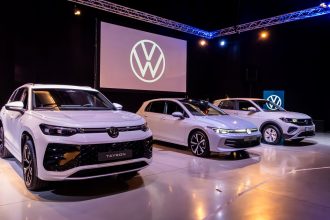
Volkswagen has committed R4 billion to upgrading the facility ahead of production of a new SUV from 2027.
The investment includes manufacturing equipment, tooling, production-facility upgrades and additional automation.
Volkswagen has been preparing the plant for the new model through upgrades to the Body Shop, Paint Shop and Final Assembly areas. The vehicle is being developed in collaboration with Volkswagen Brazil and is intended to serve South Africa and other markets.
The model, known internally as the Tengo, is expected to be built alongside the Polo and Polo Vivo.
That gives Volkswagen an opportunity to attack one of the segments where Chinese manufacturers have been particularly aggressive: affordable SUVs.
The SUV could be Volkswagen’s answer to changing consumer tastes
The importance of the new SUV goes beyond adding another model to Volkswagen’s range.
South African buyers have increasingly gravitated towards SUVs and crossover vehicles, while Chinese manufacturers have used these segments to establish themselves quickly.
For Volkswagen, the new locally produced SUV provides an opportunity to combine its established brand with local manufacturing and a product specifically designed with African and emerging-market requirements in mind.
Volkswagen says the project is also intended to strengthen its footprint across the African continent.
That could give the company an important competitive advantage if production volumes and pricing allow the vehicle to be exported into other African markets.
Martina Biene leaves behind a significant manufacturing milestone
Biene’s departure marks the end of a period that included several important developments for Volkswagen Group Africa.
She became the company’s first female chairperson and managing director when she took the position in November 2022.
During her tenure, Kariega achieved its record production year and Volkswagen committed billions of rand to adding a third model at the plant.
The plant subsequently reached another significant milestone in 2025 when it celebrated the production of its three-millionth locally built vehicle.
Biene’s move to Škoda therefore comes as Volkswagen’s South African operation enters a major investment and product-development cycle.
Zorn faces a very different automotive battlefield
The task awaiting Zorn is not simply to protect Volkswagen’s existing market share.
She will have to help position the company for a South African market in which consumers have rapidly gained access to alternatives from China.
Volkswagen’s traditional strengths — local manufacturing, brand recognition, an established dealer network and a long-standing customer base — remain significant.
But they no longer guarantee dominance.
Chinese competitors have demonstrated that South African motorists are willing to reconsider established brands when new vehicles offer compelling combinations of price, technology, warranty coverage and specification.
That means the success of Volkswagen’s next phase could depend heavily on whether the Kariega-built SUV delivers the right combination of affordability and desirability.
South Africa becomes a test case for Volkswagen’s African ambitions
There is also a bigger strategic question behind Zorn’s appointment.
Volkswagen has positioned its South African operation as more than a domestic business, with the company explicitly linking the Kariega investment to its ambitions across Africa.
South Africa provides Volkswagen with an established manufacturing base from which it can potentially serve other markets.
But the same market is now becoming a proving ground for whether a traditional European manufacturer can successfully defend its position against rapidly expanding Chinese competitors.
The answer may depend on what happens when the new SUV reaches production.
If Volkswagen can use its local factory to deliver a competitively priced SUV with the equipment South African buyers increasingly expect, Zorn will have a powerful tool with which to fight back.
If the vehicle arrives too expensive or fails to match the technology and value offered by Chinese rivals, the company’s manufacturing advantage may not be enough.
For Volkswagen Group Africa, the race is no longer simply about building more cars — it is about building the right cars for a market that is changing faster than at almost any point in its history.