
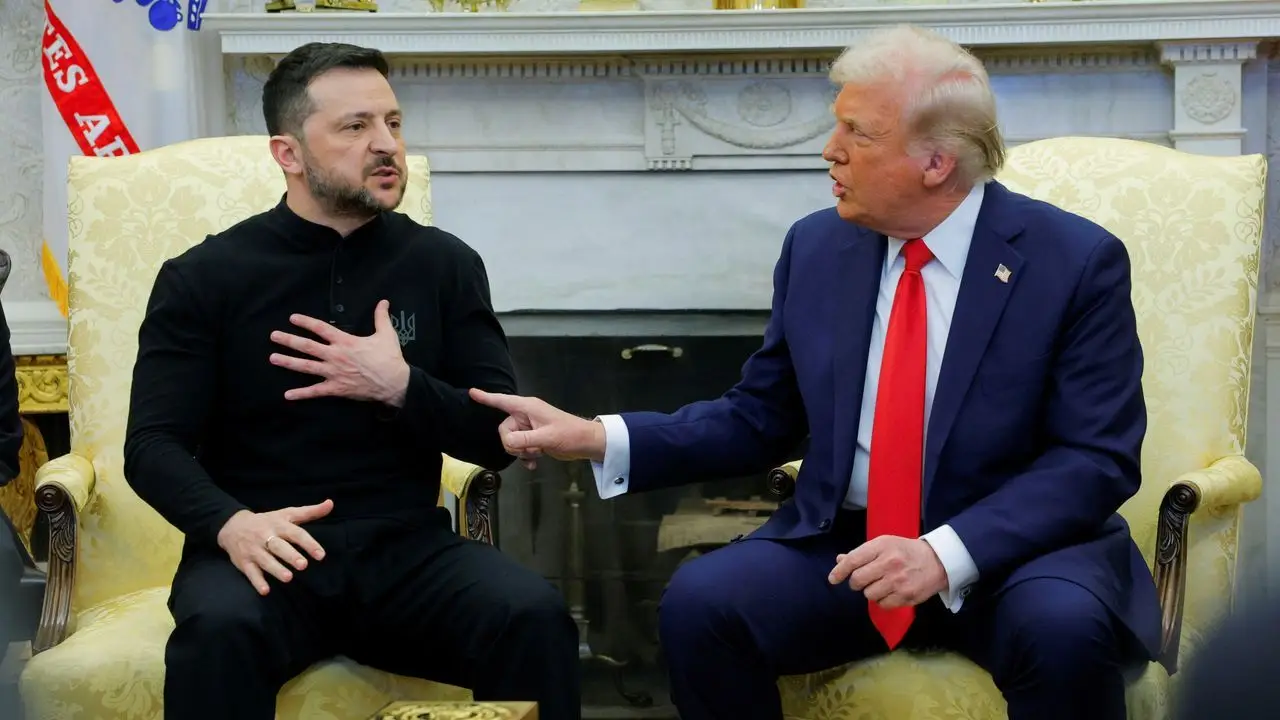
United States President Donald Trump has publicly rejected an offer from Ukrainian President Volodymyr Zelensky to assist the United States with drone detection technology, highlighting the strained relationship between the two leaders.
Trump made the remarks during a phone interview with NBC News while speaking to Meet the Press anchor Kristen Welker. The interview took place as global tensions continue to rise amid ongoing conflicts involving the United States and its allies in the Middle East.
Responding to Zelensky’s proposal to share Ukraine’s expertise in drone detection systems, Trump dismissed the idea outright.
“The last person we need help from is Zelensky,” Trump said during the interview.
Drone Technology Offer Amid Growing Security Concerns
Zelensky had indicated that Ukraine was willing to assist both the United States and Middle Eastern countries seeking support in countering drone threats.
Ukraine has gained extensive experience in drone warfare and defence technologies during its prolonged conflict with Russia, making its systems increasingly relevant to other regions facing similar threats.
However, Trump’s response suggests that political tensions between the two leaders remain a major obstacle to cooperation.
Middle East Conflict Intensifies
The comments come as Iran continues to launch drone and missile attacks targeting military assets belonging to the United States and Israel.
The conflict has entered its third week, with both sides continuing to exchange attacks.
In response to military operations against its forces, Iran has reportedly restricted shipping access through the Strait of Hormuz, one of the world’s most important oil and trade routes.
The move has disrupted global shipping traffic and raised concerns about potential economic consequences for international markets.
Despite the ongoing attacks, the Trump administration has repeatedly claimed that its military operations have achieved significant strategic victories.
Political Pressure Mounts in Washington
As the conflict continues, pressure is building in Washington for the administration to find a diplomatic solution.
Some Republicans, including figures within Trump’s own administration, have reportedly urged the president to pursue an exit strategy to prevent the conflict from escalating further and affecting the American economy.
Meanwhile, Democrats have criticised the military campaign, arguing that it lacks proper legal justification.
However, some conservative Democrats have expressed support for the strategic goals of the operation, illustrating the complex political divisions surrounding the conflict.
Long-Standing Tensions Between Trump and Zelensky
Relations between Trump and Zelensky have been strained for several years.
During Trump’s first term as president, the relationship became politically charged when Zelensky declined to support efforts by the Trump administration to investigate political rival Joe Biden ahead of the 2020 US presidential election.
The controversy eventually led to Trump’s first impeachment by the United States House of Representatives.
Tensions escalated again last year when Trump and Vice President JD Vance reportedly clashed with Zelensky during a meeting at the White House.
Reports at the time described the exchange as a heated confrontation that unfolded in front of journalists and diplomatic officials.
Peace Talks With Russia Remain Stalled
During the NBC interview, Trump also argued that Zelensky was a major obstacle preventing a peace agreement between Ukraine and Russia.
Russia’s invasion of Ukraine has now stretched into its fourth year, with peace negotiations repeatedly stalling over key demands.
Among the major sticking points are Russia’s insistence that Ukraine remain outside the North Atlantic Treaty Organization and territorial demands made by Moscow during negotiations.
Some of the areas Russia has claimed are currently under Ukrainian military control, making negotiations particularly complex.
Trump has previously suggested that Russia could retain some of the territory captured during the conflict, arguing that Russian forces had already sacrificed heavily during the war.
Ukraine’s government, however, has consistently rejected any peace agreement that would require it to surrender territory.
A Complicated Diplomatic Landscape
The ongoing conflict and political tensions between global leaders illustrate the complexity of modern geopolitics, where military alliances, domestic politics and historical grievances often intersect.
While Ukraine continues to seek international cooperation in areas such as defence technology, Trump’s latest comments suggest that personal and political rivalries may continue to influence diplomatic relations between Washington and Kyiv.
With conflicts intensifying in multiple regions and negotiations with Russia still unresolved, the coming months are likely to test the diplomatic strategies of all parties involved.