
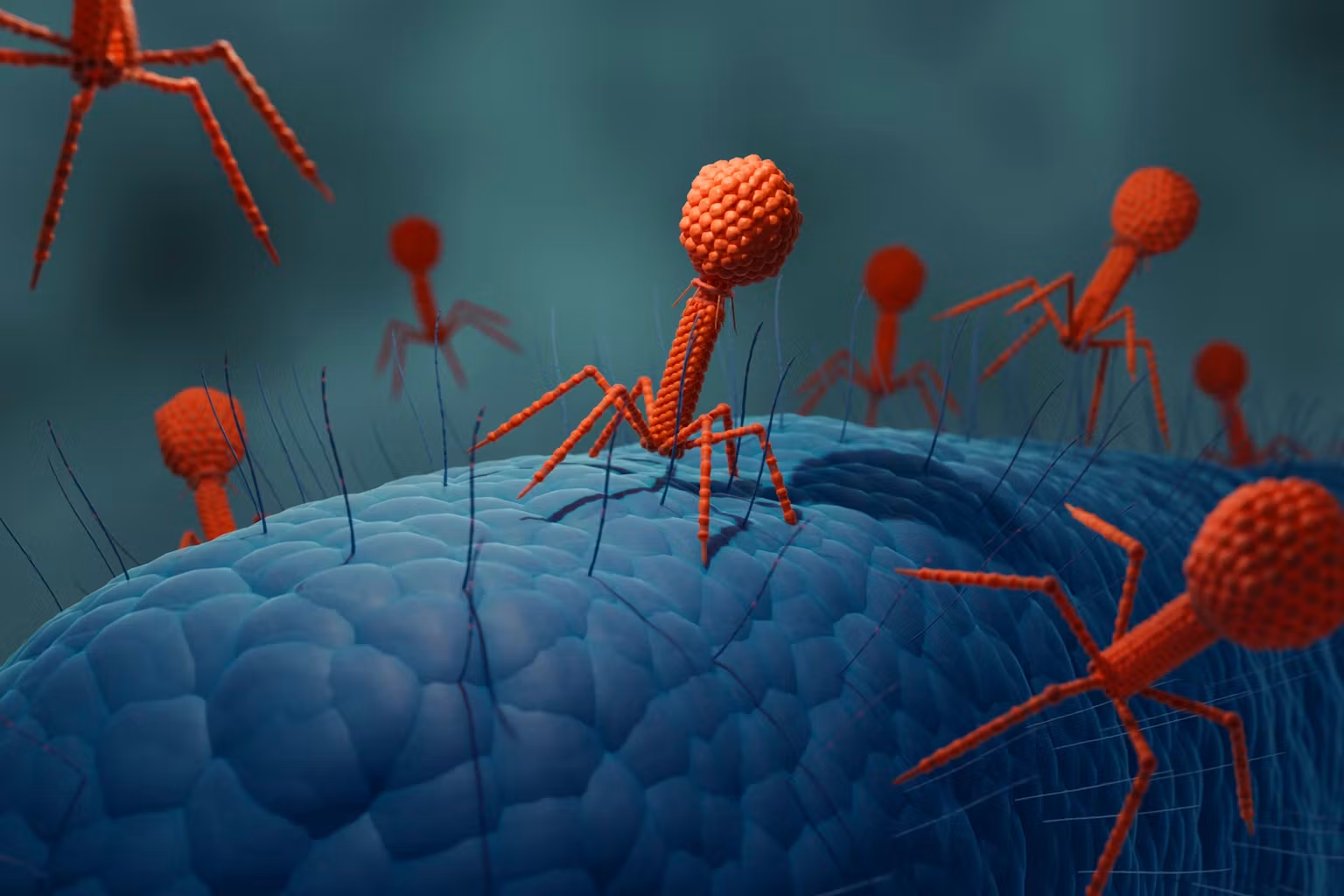
Artificial intelligence has taken another remarkable step into biology — and this time, scientists have used it to design viruses that did not previously exist in nature.
- AI learned the language of DNA
- The AI-generated viruses worked in the laboratory
- These viruses were designed to attack bacteria, not humans
- The same technology could help fight superbugs
- Why biosecurity experts are concerned
- How far could the technology eventually go?
- Regulation is struggling to keep pace
- AI companies are already working on biosecurity
- The real warning may be about what comes next
- A new frontier for AI and biology
Researchers at Stanford University trained an AI model called Evo on vast quantities of genomic data, allowing it to learn patterns and constraints within DNA. The system subsequently generated new viral genomes, which researchers synthesised and tested in the laboratory.
The results were striking: 16 AI-designed bacteriophages successfully infected E. coli, with some overcoming natural resistance mechanisms in their bacterial targets.
The experiment demonstrates that generative AI is no longer limited to analysing biological information. It can also produce entirely new genetic sequences that function in the real world.
That achievement could eventually help researchers develop new treatments for antibiotic-resistant bacteria. But it also raises a difficult question: how far should scientists allow generative AI to go when designing biological systems?
AI learned the language of DNA
The research, published in Science, effectively treats DNA in a way that resembles how large language models process human language.
Instead of learning from books, articles or conversations, Evo was trained using an enormous collection of genomic sequences.
From that information, the model learned patterns associated with biological sequences and the evolutionary constraints that influence how genomes function.
Researchers then asked the system to generate viral genomes rather than simply reproduce sequences already found in nature.
The resulting designs contained genetic patterns that were distinct from known natural viruses.
That distinction is important.
The experiment was not simply an AI identifying an existing virus or rearranging a known genome. The researchers were testing whether a generative model could create functional viral genetic material from scratch.
The AI-generated viruses worked in the laboratory
The researchers synthesised the DNA sequences produced by Evo and tested the resulting viruses against E. coli.
Sixteen of the generated bacteriophages proved capable of infecting the bacteria.
Some also demonstrated the ability to overcome resistance mechanisms that would ordinarily protect the bacteria from viral infection.
That finding gives the research considerable scientific significance.
It suggests that AI-generated genetic sequences can move beyond being theoretical computer outputs and become biological systems capable of functioning under laboratory conditions.
In simple terms, the model generated genetic instructions that researchers were able to turn into working viruses.
These viruses were designed to attack bacteria, not humans
The experiment involved bacteriophages, viruses that infect bacteria.
The researchers deliberately excluded datasets involving human pathogens from the model’s training material.
As a result, the viruses generated in the study were not designed to infect humans.
That distinction is critical when assessing the findings.
The research does not demonstrate that Evo has created a human-infecting virus or a biological weapon.
However, biosecurity experts argue that demonstrating the ability to generate functional viruses represents an important technological threshold.
The concern is less about the specific bacteriophages created in this experiment and more about what increasingly capable biological AI systems could eventually be asked to design.
The same technology could help fight superbugs
There is a potentially significant medical upside.
Antibiotic resistance is making some bacterial infections increasingly difficult to treat. Traditional antibiotics do not always provide an effective answer, particularly when bacteria develop resistance to multiple drugs.
Bacteriophages offer another possible approach.
Because they naturally infect bacteria, researchers have investigated them as potential alternatives or complements to antibiotics.
The ability to generate customised phages with AI could eventually allow scientists to design viruses specifically suited to particular bacterial targets.
Instead of searching through nature for a naturally occurring phage that happens to attack a particular bacterium, researchers could potentially use computational models to explore new candidates.
That could dramatically expand the biological toolbox available to researchers.
But the technology is still experimental, and the Stanford study should not be interpreted as evidence that AI-designed phage therapies are ready for routine medical use.
Why biosecurity experts are concerned
The scientific breakthrough arrives amid growing debate about the risks of generative AI in biology.
Biosecurity specialists Dr Thomas Inglesby and Dr Moritz Hanke, of the Johns Hopkins Center for Health Security, wrote an accompanying commentary in Science warning that advances of this kind demonstrate why stronger safeguards are needed.
They argued for strict regulation around future applications of generative biological models and called for restrictions on using comparable technologies with pathogens affecting humans, animals or agricultural systems.
Their concern centres on a basic technological problem.
An AI system does not inherently understand whether a biological sequence is being designed for a beneficial experiment or a harmful purpose.
If increasingly powerful models can generate functional biological systems, then controlling who can access those systems — and what they can be instructed to do — becomes increasingly important.
How far could the technology eventually go?
One of the biggest questions surrounding biological AI is whether today’s relatively simple experiments represent an early stage of something much more powerful.
The viruses produced by Evo were bacteriophages with relatively compact genomes.
That makes the experiment considerably less complex than designing a sophisticated human pathogen.
Tom Ellis, a professor of synthetic genome engineering at Imperial College London, has argued that the particular viruses created in the experiment represent relatively simple biological systems.
His assessment is an important counterweight to some of the more dramatic interpretations of the study.
Creating a functional bacteriophage is not the same as designing a highly complex human pathogen.
Nevertheless, the basic principle demonstrated by the experiment is significant: an AI model can generate biological sequences that translate into functioning organisms.
That capability is likely to improve as models, training data and laboratory automation become more sophisticated.
Regulation is struggling to keep pace
The rapid development of AI-driven biology has created a regulatory challenge.
Governments and scientific institutions have historically developed rules around biological research based largely on physical laboratories, specialised equipment and human expertise.
AI can change that equation.
A sophisticated biological model could potentially make certain forms of expertise more accessible, reducing some of the technical barriers that previously limited who could perform advanced biological design.
That is why scientists and policymakers are debating whether existing safeguards are sufficient.
The challenge is to prevent malicious use without shutting down legitimate research that could lead to new medicines, diagnostic technologies and treatments.
AI companies are already working on biosecurity
The technology industry has recognised that biological misuse represents a distinct category of AI risk.
Major AI companies have joined the Frontier Model Forum, a non-profit initiative that works on issues involving advanced AI systems.
Among its areas of focus are biological safety, the development of safeguards and research into ways frontier models could be misused.
The underlying challenge is unusually difficult.
AI systems are designed to be useful and capable. Biology, meanwhile, contains enormous amounts of information that can be applied for both beneficial and harmful purposes.
The safeguards therefore have to become more sophisticated as the models themselves improve.
The real warning may be about what comes next
The Stanford experiment is important not because it produced 16 new viruses that threaten the public.
It did not.
The viruses were designed to infect bacteria, not people, and the researchers excluded human pathogen data from their training approach.
The significance lies in what the experiment demonstrates about generative biological design.
AI can now be used to explore genetic possibilities beyond those already observed in nature, and at least some of those computer-generated designs can function when physically constructed.
That creates a fascinating scientific opportunity.
It could help researchers search biological space more efficiently, discover new antimicrobial strategies and investigate organisms that would otherwise be difficult to identify.
But the same underlying capability could become problematic if applied to increasingly dangerous pathogens without appropriate controls.
A new frontier for AI and biology
For years, the conversation around artificial intelligence focused primarily on text, images, software and mathematics.
Biology is different.
A generated piece of text can be deleted. A generated image can be discarded.
A biological design can potentially be synthesised and introduced into the physical world.
That makes the consequences of errors — or deliberate misuse — considerably more serious.
The Stanford research therefore represents both sides of the AI-biology revolution.
On one side is the possibility of designing highly targeted biological tools to tackle antibiotic-resistant bacteria.
On the other is the need to ensure that increasingly capable systems do not make dangerous biological experimentation easier for people who should never have access to it.
The technology is advancing quickly.
The harder question is whether biosecurity rules, laboratory safeguards and responsible AI practices can advance just as quickly.