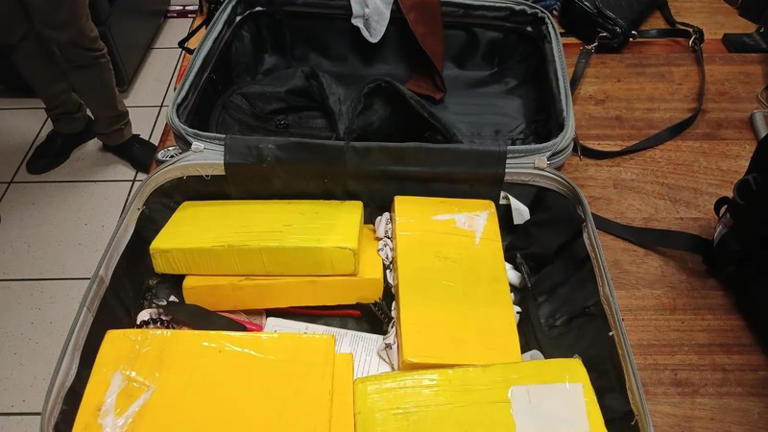
A major drug bust at South Africa’s busiest airport has once again highlighted the country’s growing role in global trafficking routes. Police have arrested a Brazilian national at OR Tambo International Airport after allegedly discovering cocaine valued at approximately R8.7 million concealed in luggage.
The arrest, which took place on Sunday afternoon, forms part of an intensified law enforcement effort targeting organised crime syndicates operating across international borders.
Intelligence-Led Operation Leads to Arrest
According to national police spokesperson Athlenda Mathe, the 26-year-old suspect had just arrived from Brazil when authorities intercepted them based on prior intelligence.
A detailed search of the traveller’s luggage reportedly uncovered multiple blocks of cocaine, carefully wrapped and hidden to avoid detection.
The suspect was immediately taken into custody, marking another significant breakthrough in South Africa’s ongoing fight against narcotics smuggling.
Second Arrest Within 24 Hours Raises Concerns
The incident comes just a day after another drug-related arrest at the same airport, pointing to what authorities describe as a persistent and evolving trafficking network.
In the earlier case, a 33-year-old woman from Kempton Park was apprehended by members of the South African Police Service in a coordinated operation involving the Hawks’ Serious Organised Crime Unit, Border Police, and the Local Criminal Record Centre.
Investigators reportedly seized approximately 1.5kg of cocaine along with crystal methamphetamine, with a combined estimated street value of around R1.5 million.
OR Tambo: A Key Target in Drug Enforcement Efforts
As South Africa’s primary international gateway, OR Tambo International Airport has increasingly become a focal point for anti-drug operations.
Mathe noted that authorities have recorded multiple recent successes in intercepting traffickers attempting to move illicit substances through the airport.
“These interventions are critical in disrupting the flow of illegal drugs and dismantling organised criminal networks,” she said.
Law enforcement agencies have ramped up intelligence-driven operations, combining surveillance, profiling, and inter-agency collaboration to identify high-risk travellers and shipments.
Growing Pressure on Transnational Drug Networks
The latest arrests underscore a broader trend: South Africa’s strategic position in global trafficking routes makes it a key transit and destination point for narcotics.
Experts say traffickers often exploit major travel hubs and diverse passenger flows to move drugs undetected. However, increased coordination between local and international law enforcement is beginning to yield results.
The involvement of specialised units such as the Hawks signals a shift towards more sophisticated investigations aimed not just at couriers, but at entire criminal supply chains.
Court Appearances Expected
Both suspects are expected to appear in court later this week, where formal charges related to drug possession and trafficking are likely to be presented.
Authorities have not yet released further details regarding potential links between the two cases, but investigations are ongoing.
A Broader Fight Beyond the Airport
While arrests at airports are a visible sign of progress, officials stress that the real challenge lies in dismantling the networks behind these operations.
Each interception represents not just a seizure of drugs, but a disruption of supply lines that fuel organised crime, addiction, and violence across communities.
With enforcement tightening at key entry points, traffickers may adapt — but so too are the strategies designed to stop them.
Final Word
The latest drug bust at OR Tambo International Airport sends a clear message: South Africa’s borders are under increasing scrutiny, and authorities are stepping up efforts to combat transnational crime.
As intelligence operations continue to evolve, the focus is shifting from isolated arrests to systemic disruption of global drug networks — a move that could have lasting impact on both local safety and international crime prevention.