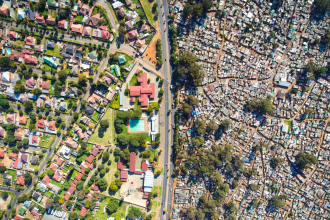
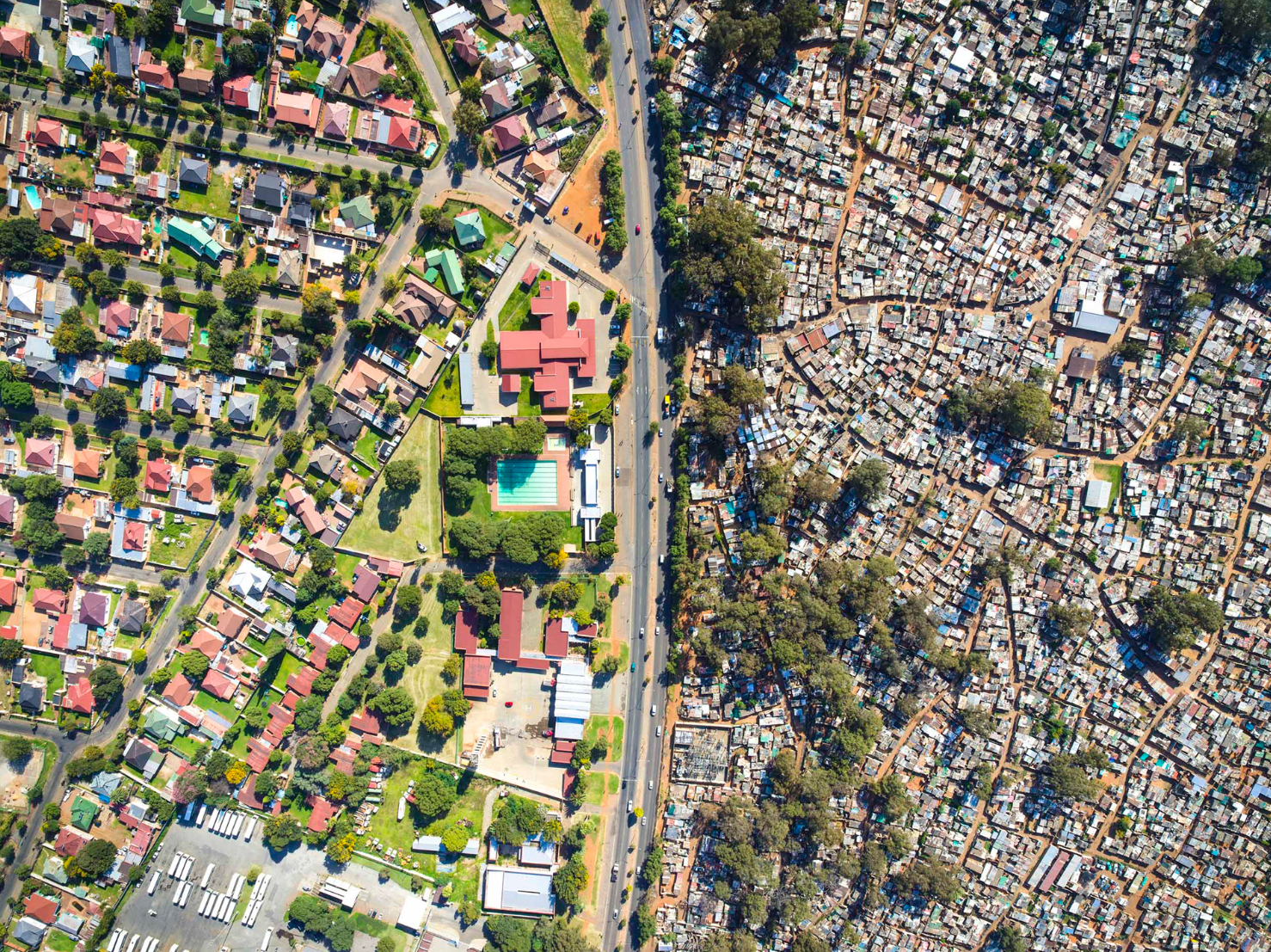
South Africa’s inequality crisis remains as entrenched as ever. A new global report has confirmed that the wealthiest 10% of South Africans continue to control 86% of the nation’s total wealth, a figure that has barely shifted in the past decade. The finding highlights the enormous task facing government as it attempts to lift millions of citizens out of poverty and narrow the economic divide.
The latest World Inequality Report warns that despite some progress in reducing poverty, wealth concentration remains deeply entrenched. The researchers argue that inequality “is a political choice,” shaped by policy decisions, institutions and governance. Their data shows that the income gap between the richest 10% and the bottom half of the population widened between 2014 and 2024, rising from 103 to 118.
Average income per person in South Africa sits at roughly €8,800 (about R174,000) when adjusted for purchasing power, and average wealth is estimated at €29,000 (around R573,000). Yet these averages mask the stark divide that defines daily life for millions.
South Africa’s democratic governments have spent heavily on the social wage, with around 18-million residents receiving grants. But while these interventions have softened hardship, the deep structural inequality reflected in the report remains stubborn.
The World Inequality Report 2026, updating earlier editions, finds a world that is richer overall but increasingly unequal. It argues that where countries strengthen redistribution, implement fair taxation and invest heavily in social services, inequality narrows. Where they do not, social fractures widen — and democracies become fragile.
The report’s release coincides with new findings from Stats SA, which show a significant drop in South Africa’s poverty headcount over the past 17 years. Using newly rebased poverty lines, Stats SA estimates that 37.9% of the population lived below the lower-bound poverty line in 2023. While that figure remains high, it reflects a major decline from the 57.5% recorded in 2006.
The updated poverty line, set at R1,300 per person monthly, captures households struggling to cover both food and essential non-food needs. Stats SA’s analysis indicates that 23-million South Africans remain poor — about 2.5-million fewer than in 2015. The decline is meaningful but demonstrates how vast the scale of deprivation still is.
The rebasing process drew on the 2022/23 income and expenditure survey, the first to use digital data-collection tools. Working with the World Bank, Stats SA introduced a new reference food basket and updated for housing costs, spatial pricing and household size. These adjustments replace the older 2011 poverty lines and create a clearer comparison across time.
The updated thresholds include the food poverty line at R760, the lower-bound at R1,300 and the upper-bound at R1,565. Poverty reduction has been most pronounced among black and coloured South Africans, which the report links to targeted social and economic programmes.
But persistent gaps remain. Rural households and women-headed homes continue to face the highest poverty rates. Provinces such as Eastern Cape and Limpopo carry the heaviest burdens, while Gauteng and Western Cape have lower rates but deal with data collection challenges due to high urban non-response. In some metros, non-response rates reached alarming levels — including 43.3% in Tshwane and 34.6% in Johannesburg — raising concerns about whether poverty in dense cities is being fully captured.
The poverty gap, reflecting how far households fall below the poverty line, has narrowed but remains significant. Service access has improved, with more homes connected to electricity, piped water and sanitation, though disparities still define the national landscape.
Stats SA’s new figures reinforce a dual reality: South Africa has made real progress in reducing poverty, yet inequality remains one of the highest in the world. Social grants and economic support have prevented deeper suffering, but they cannot alone resolve the structural issues limiting job creation and widening wealth gaps.
As policymakers absorb the new data, the message is clear. South Africa has taken steps forward, but reaching the country’s 2030 development goals will require accelerated reforms, stronger redistribution and sustained investment in social services. The tools exist — but the political will remains the decisive factor shaping the country’s future.