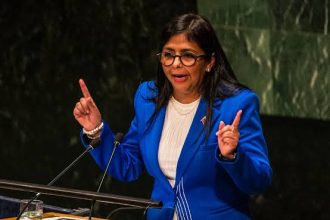
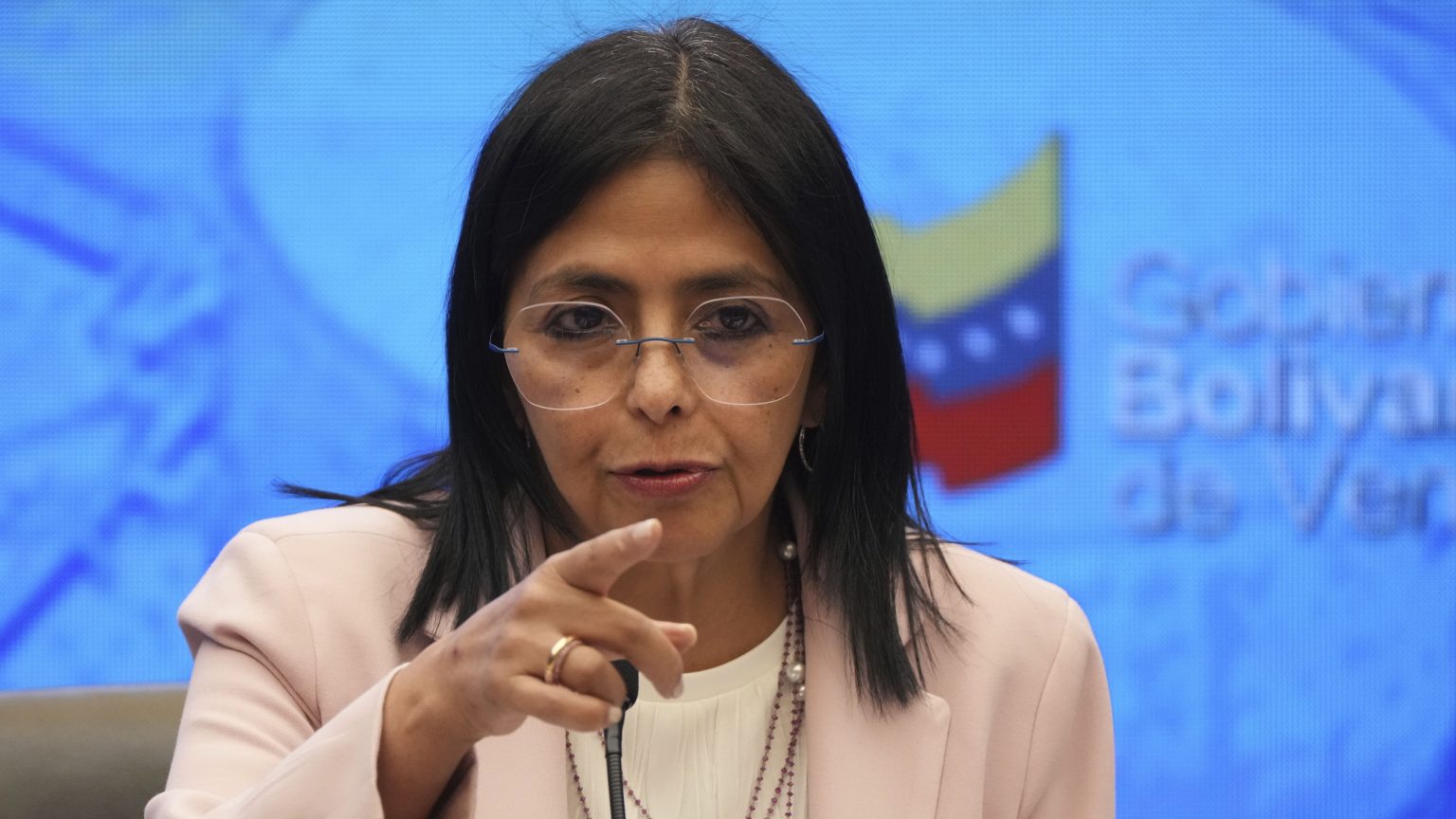
Delcy Rodríguez began her tenure as Venezuela’s interim leader with a show of defiance, condemning the United States and reaffirming her loyalty to Nicolás Maduro. Yet behind the rhetoric lies a far more delicate reality. Washington, under President Donald Trump, appears to have decided that Rodríguez is a figure it can work with, at least for now.
The 56-year-old technocrat steps into leadership following the dramatic capture of Maduro and his wife, Cilia Flores, a move that has left Venezuela’s ruling elite shaken but still clinging to power. While Trump has not ruled out further military action, his administration has signalled a preference for exerting control through Rodríguez rather than direct occupation.
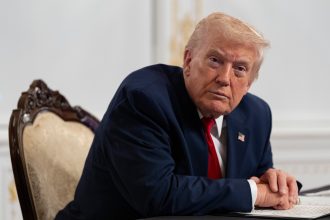
“She’s essentially willing to do what we think is necessary to make Venezuela great again,” Trump said, framing her appointment in characteristically transactional terms.
Defiance for the Home Crowd
In a nationally televised speech on Saturday night, Rodríguez condemned what she called the “abduction” of Maduro and Flores, demanding their immediate return. She described US actions as an “atrocity” and a violation of international law, insisting that Maduro remains the country’s legitimate president.
“There is only one president in Venezuela and his name is Nicolás Maduro,” she declared, striking a tone clearly designed to reassure loyalists within the ruling Bolivarian movement and, crucially, the armed forces.
Analysts suggest the speech was as much performance as policy. With the regime demoralised and its authority under strain, Rodríguez appears intent on consolidating internal support before making any visible concessions abroad.
Washington Sets the Terms
Behind the scenes, the message from Washington has been blunt. US Defence Secretary Pete Hegseth elaborated on Trump’s assertion that the United States would effectively “run” Venezuela, outlining demands that include halting drug trafficking, restoring access to oil resources, and preventing criminal activity spilling into the US.
“It means we set the terms,” Hegseth said. “President Trump sets the terms.”
The implication is clear: Rodríguez may retain the appearance of sovereignty, but her room to manoeuvre is limited. One miscalculation could provoke an internal coup, spark mass protests, or invite renewed US military action.
A Pragmatist Washington Can Work With
While Venezuelan opposition figures see Rodríguez as a loyal enforcer of Maduro’s rule, the Trump administration views her differently. Senior US officials have described her as a professional and pragmatic figure, particularly impressed by her handling of Venezuela’s oil sector.
According to US media reports, intermediaries convinced Washington that Rodríguez would protect and promote future American energy investments. Unlike many figures in Maduro’s inner circle, she has not been indicted in the US on charges such as drug trafficking, making her a more palatable interlocutor.
That calculation appears to have cost Venezuela’s opposition a potential ally. María Corina Machado, who played a central role in last year’s opposition election campaign and later won the Nobel Peace Prize, was once considered a viable alternative. Trump ultimately dismissed her prospects, saying she lacked sufficient support and would struggle to govern.
Opposition Sidelined, But Not Silent
Despite being marginalised by Washington’s approach, opposition leaders believe opportunity remains. Machado has insisted that the opposition is ready to assert its electoral mandate, even as it confronts a military establishment unwilling to accept her leadership.
Millions of Venezuelans continue to support Machado, but her lack of backing from the armed forces has limited her immediate prospects, according to sources in Caracas.
From Revolutionary Roots to Realpolitik
Rodríguez’s rise reflects the transformation of Venezuela’s political project. The Bolivarian revolution launched by Hugo Chávez in 1999 and continued by Maduro has evolved from socialist idealism into a hybrid system marked by authoritarian control and selective capitalism.
Her personal history mirrors that complexity. The daughter of a Marxist activist who died during interrogation by Venezuelan authorities, Rodríguez studied law in Caracas and Paris before joining Chávez’s government in 2003. Her career advanced steadily, aided by her brother Jorge Rodríguez, now head of the national assembly.
Under Maduro, she served as foreign minister, vice-president and oil minister, gaining a reputation as a disciplined and pragmatic operator. Her polished presence often contrasted with the military-dominated leadership around her, but her loyalty was never in doubt.
A Precarious Future
Now, Rodríguez faces what may be the most dangerous phase of her career. She must keep a hostile public and suspicious military onside while accommodating a US administration eager to dictate outcomes.
In her closing remarks, Rodríguez insisted that Venezuela “will never again be anyone’s colony”, rejecting domination by both old and new empires. Whether that declaration proves genuine conviction or necessary theatre remains to be seen.
What is certain is that Venezuela’s interim leader is walking a vertiginous tightrope, with little margin for error and the eyes of the world watching closely.