
South African journalist Heidie Giokos has become the target of intense online backlash following a high-profile exchange with former United States President Donald Trump, after she questioned his repeated claims of a “white genocide” in South Africa.
The exchange took place during an interview at the World Economic Forum in Davos, where Giokos asked Trump what evidence would be required for him to accept that there is no genocide against white South Africans. Her question, posed in a journalistic context, was met with firm resistance.
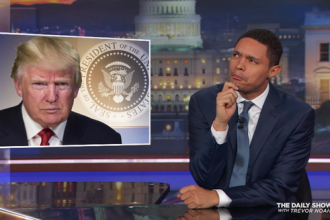
Trump dismissed the premise of the question, insisting that white farmers in South Africa were being “brutally killed” and characterising the violence as a targeted campaign. His remarks echoed claims he has made previously, despite South African crime statistics consistently showing that violent crime affects all racial groups.
“What’s happening in South Africa is a terrible situation and what they are doing to a certain group of people is unbelievable, you wouldn’t think it could happen,” Trump said. “We have seen the numbers and records and it’s taking place.”
The comments have reignited a long-running and highly polarised debate around farm attacks and violent crime in South Africa. The narrative of a racially motivated “white genocide” has been repeatedly rejected by the South African government and several independent studies, which point to the country’s broader violent crime crisis rather than race-based targeting.
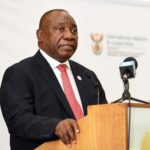
In May 2025, President Cyril Ramaphosa visited the United States to engage with policymakers and directly address these claims. During the visit, Ramaphosa emphasised that farm attacks form part of South Africa’s wider crime problem and are not evidence of an organised campaign against any racial group.
Despite this, the Davos interview quickly gained traction online, with Giokos facing personal attacks on social media. Critics accused her of downplaying the experiences of victims and ignoring what they believe to be evidence of racially targeted violence.
One user, posting under the name @RiseAgainstEvil, accused Giokos and other journalists of dismissing claims of targeted attacks against white South Africans, particularly farmers. The user suggested that personal circumstances and a preference for social cohesion influence how such issues are reported.
The criticism escalated into direct and hostile messages aimed at Giokos, questioning her credibility as a journalist and referencing her past experience as a victim of a home invasion. The user accused her of hypocrisy and alleged that she was suppressing uncomfortable truths in favour of a particular narrative.
The tone of the posts, which included personal insults and accusations of complicity, has drawn concern from media observers about the growing hostility faced by journalists who engage with controversial topics.
At the same time, Giokos has received public support from other social media users and political figures. William Fienies defended her, stating that journalists should not be personally attacked for doing their jobs or for asking difficult questions that challenge dominant narratives.
“We should never allow our personal preferences to overshadow our judgments,” Fienies wrote, adding that disagreement with a report should not justify personal abuse.
Democratic Alliance leader John Steenhuisen has also weighed in on the broader issue, accusing Trump of pushing a predetermined agenda. Speaking to the Press Gallery Association, Steenhuisen reiterated that while white South Africans are victims of violent crime, they are not uniquely targeted.
“We have white people murdered, yes, but we also have coloured and black South Africans as well as Indian South Africans and South Asians of Asian descent that are being murdered as well,” Steenhuisen said.
The controversy surrounding Giokos’ interview highlights the sensitivity and complexity of discussions around crime, race and perception in South Africa. It also underscores the challenges journalists face when confronting deeply entrenched narratives on a global stage, particularly when those narratives resonate strongly with certain audiences.
As debate continues online and internationally, the incident has once again placed South Africa’s crime crisis, and how it is framed abroad, under the spotlight.