
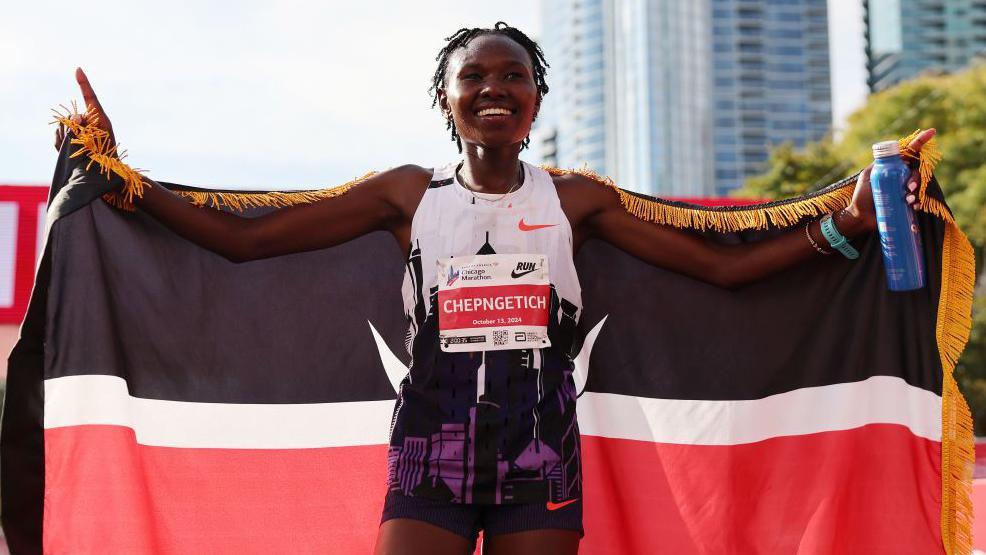
Nairobi, Kenya – The Athletics Integrity Unit (AIU) has announced the provisional suspension of Ruth Chepngetich, the Kenyan long-distance runner who stunned the world in 2024 by setting a new women’s marathon world record in Chicago.
Chepngetich, 30, clocked an astonishing 2:09:56, smashing the previous record by almost two minutes and becoming the first woman to break the 2:10 barrier in a marathon. However, her meteoric rise has now come under scrutiny after she tested positive for hydrochlorothiazide, a banned diuretic often used to mask the presence of other performance-enhancing drugs.
Positive Test and Voluntary Suspension
The banned substance was detected during a March 14 doping test, and Chepngetich was formally notified of the violation on April 16. She voluntarily agreed to a provisional suspension just three days later, according to a statement by the AIU.
“Chepngetich was not provisionally suspended by the AIU at the time of notification. However, on 19 April she opted for a voluntary provisional suspension while the AIU’s investigation was ongoing,” explained AIU chief Brett Clothier.
The AIU has since issued a Notice of Charge, formally initiating the disciplinary process and confirming her provisional suspension.
Withdrawal from the London Marathon
In April, Chepngetich withdrew from the London Marathon, citing mental and physical unpreparedness. The move raised eyebrows at the time, and in retrospect, appears to have coincided with the early stages of the anti-doping investigation.
“I am not in the right place mentally or physically to race my best,” Chepngetich stated during her withdrawal, without disclosing the developing case.
Right to a Fair Hearing
While the AIU has provisionally suspended Chepngetich, she retains the right to defend herself before a disciplinary tribunal. No final judgment has been made, and the case remains under investigation.
Doping in Kenyan Athletics: A Troubling Pattern
Chepngetich is not alone among top Kenyan runners facing anti-doping scrutiny. Other elite athletes—including former half-marathon world record holder Kibiwott Kandie and two-time Frankfurt Marathon champion Brimin Misoi Kipkorir—have also faced investigations in recent years.
The AIU has been increasingly active in monitoring doping violations among Kenyan athletes, citing rising concerns about systemic abuse and inadequate oversight in some training camps.
Conclusion: A Legacy in Question
Chepngetich’s suspension casts a shadow over one of the most remarkable performances in marathon history. As investigations continue, the athletics world waits to see whether her record-breaking run will stand or fall under the weight of doping allegations.
If found guilty, Chepngetich could face a multi-year ban, loss of medals, and the nullification of her marathon world record, which would represent a significant setback not only for her career but for the image of Kenyan long-distance running.