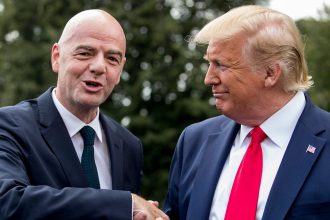
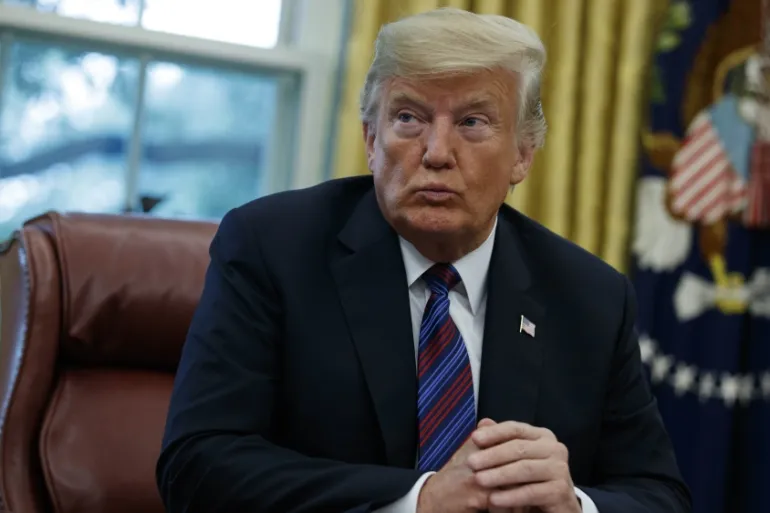
US President Donald Trump stirred fresh controversy this week by telling The New York Times that he does not require international law to guide his use of power and that the only constraint on his actions is his own morality and mind. Trump’s remarks, published Thursday in a wide-ranging interview, have reignited international debate about the limits of executive authority and the role of global legal norms in US foreign policy.
Asked if there were any restraints on his global power as commander-in-chief, Trump responded bluntly: “Yeah, there is one thing. My own morality. My own mind. It’s the only thing that can stop me.” He added, “I don’t need international law. I’m not looking to hurt people.”
When pressed on whether the United States still had to follow international law, the president offered a qualified answer, saying his administration does need to abide by such standards, but “it depends what your definition of international law is.” He made clear that, in his view, interpretation and application rest with the US executive rather than external legal authorities.
Trump’s comments come at a time of heightened geopolitical tension. He has ordered bold military actions abroad, including a controversial operation in Venezuela that saw US forces seize President Nicolás Maduro — actions critics say may violate international norms. The interview also revisited Trump’s renewed interest in Greenland, an autonomous territory of Denmark, which he has suggested might require military measures to secure US strategic interests.
On other global flashpoints, Trump dismissed the likelihood of Chinese President Xi Jinping seizing Taiwan during his presidency, saying he had communicated displeasure to Xi while expressing confidence it would not happen under his watch. He also appeared unconcerned about the looming expiration of the last major US-Russia arms control treaty, suggesting that if it lapses, the US could “just do a better agreement”, perhaps including China in future negotiations.
While Trump claimed his worldview was rooted in national strength and American leadership, his remarks have alarmed legal and diplomatic observers who warn that sidelining international law could weaken established global systems and embolden other nations to act unilaterally. Europe and allies have signalled unease with US policy directions on Venezuela, Greenland and beyond.
Domestically, the interview comes amid sharp political disputes, including backlash over the shooting of a Minnesota woman by federal agents and a Senate vote to curtail presidential war powers following US operations in Venezuela.
Trump’s explicit reliance on his own moral compass rather than external legal constraints represents one of the most candid articulations yet of his approach to power — a stance that continues to generate significant debate about the balance between executive ambition, international law, and the norms that govern global relations.