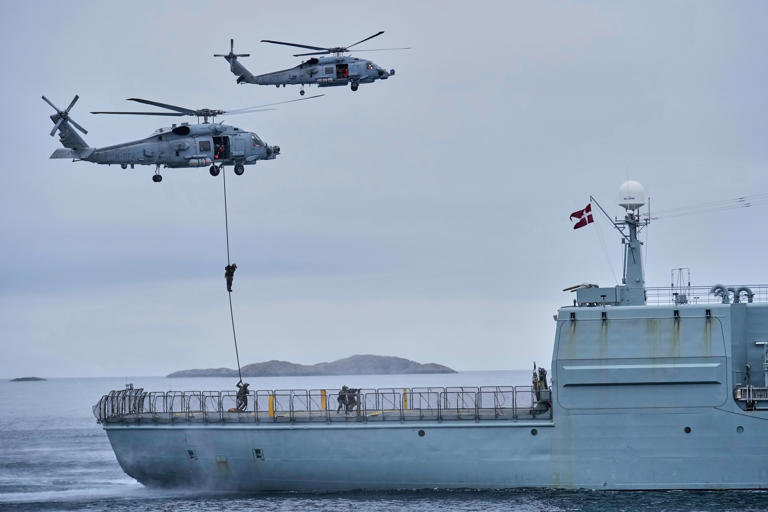
Denmark has made it clear that any foreign attempt to invade Greenland would trigger an immediate military response, with troops authorised to use force without waiting for political or command approval. The warning comes as speculation grows over possible US military action to annex the Arctic territory.
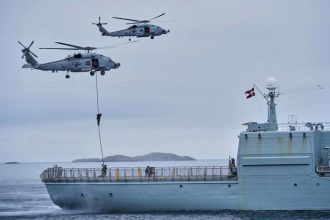
The Danish defence ministry told local media outlet Berlingske that soldiers stationed in and around Greenland operate under strict rules of engagement that require them to respond instantly to an invasion. These rules, rooted in Cold War-era doctrine, remain fully in force despite the passage of decades and changing geopolitical realities.
Under a directive dating back to 1952, Danish forces are instructed to “immediately take up the fight” if attacked. The rule explicitly states that troops must act without waiting for or seeking orders, even if senior commanders are unaware that a formal state of war has been declared.
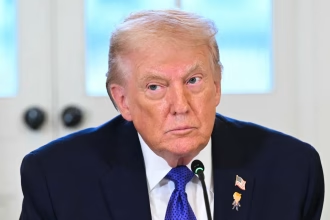
The renewed emphasis on these rules comes as European leaders grapple with how to respond to repeated statements by former US president Donald Trump suggesting that Greenland could be seized by force if necessary. The White House has confirmed that military intervention remains under consideration, despite widespread opposition both in Europe and within the United States itself.
European allies have rallied behind Denmark, signalling a desire for a coordinated response. French foreign minister Jean-Noël Barrot said he would raise the issue with his German and Polish counterparts, stressing that Europe intends to act collectively rather than unilaterally.
Speaking to France Inter radio, Barrot said Europe wants to take action “together with our European partners”, underlining the seriousness with which the situation is being viewed across the continent. He added that US Secretary of State Marco Rubio had dismissed comparisons between Greenland and the recent US military operation in Venezuela, where President Nicolas Maduro was seized and taken to New York to face criminal charges.
Finland has also called for the matter to be escalated within Nato. Johannes Koskinen, chair of the Finnish parliament’s foreign affairs committee, said the issue should be discussed by the North Atlantic Council, Nato’s key decision-making body. Although Greenland is not an independent Nato member, it falls under Denmark’s security umbrella.
Rubio confirmed on Wednesday that he intends to meet Danish officials as early as next week, following requests from both the Greenlandic and Danish foreign ministers. Meanwhile, Bloomberg has reported that US officials are exploring alternative strategies to deepen engagement with Greenland, including commercial partnerships and investment deals, rather than relying solely on military or diplomatic pressure.
Both Denmark and Greenland have repeatedly stated that the territory is not for sale. Greenland’s leadership has consistently rejected any suggestion of annexation, stressing the island’s right to self-determination.
Defending the US position, Vice President JD Vance argued that Denmark has failed to ensure Greenland’s role as a cornerstone of global security. Speaking to Fox News, he said the island is critical to missile defence and broader international stability, and claimed Europe had not adequately addressed these concerns.
Despite such rhetoric, public support in the United States for military action remains extremely low. A recent YouGov poll found that only 8 per cent of US adults support the use of force to take Greenland, while 73 per cent are opposed. Support for purchasing the territory was also limited, with just 28 per cent in favour.
The White House has said that diplomacy remains the preferred option, but has stopped short of ruling out military action altogether. As global tensions simmer and alliances are tested, Denmark’s message is unambiguous: any threat to Greenland’s sovereignty will be met with immediate resistance.