Yaoundé, Cameroon — Defying age, controversy, and calls for change, President Paul Biya has once again secured another term in office, cementing his status as both the world’s oldest head of state and one of Africa’s longest-serving leaders.
The Constitutional Council of Cameroon announced on Monday that Biya, aged 92, garnered 53.66% of the vote in the October 12 presidential election, extending his tenure that began in 1982. His main challenger, Issa Tchiroma, a former government spokesperson and minister, received 35.19% of the vote.
Tchiroma, now in his late 70s, had prematurely declared victory days earlier, claiming his party’s internal vote tallies showed him in the lead. His claims were swiftly dismissed by Biya’s camp as “fabricated and irresponsible.”
Decades of Power and Political Survival
Biya’s re-election is the latest chapter in a political career spanning over four decades, marked by his ability to maintain control through a mix of constitutional manipulation, tight security, and political patronage.
Since assuming office in November 1982, following the resignation of Cameroon’s first president, Ahmadou Ahidjo, Biya has overseen multiple constitutional changes that allowed him to remain in power — most notably, the 2008 amendment that scrapped presidential term limits.
Critics accuse him of ruling through fear and repression, while supporters hail his leadership as a source of “stability” in a volatile region.
Protests and Bloodshed in Douala
While Biya’s victory was being certified, violence erupted in the commercial hub of Douala, where four people were reportedly killed as security forces clashed with demonstrators.
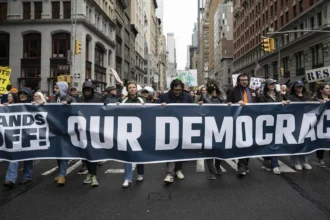
Protesters, many aligned with the opposition, took to the streets demanding “credible results” and transparency in the vote-counting process. Videos circulating on social media showed heavily armed police dispersing crowds with tear gas and live ammunition.
Civil society organisations have raised concerns about the use of force and the overall fairness of the election. Independent observers cited restricted media access, voter intimidation, and limited opposition campaigning in several regions.
The Opposition’s Challenge
Issa Tchiroma, who once served in Biya’s cabinet before breaking ranks, vowed to challenge the results, calling the election “a charade designed to rubber-stamp tyranny.”
“The people of Cameroon spoke, but their voices were silenced,” Tchiroma said at a press conference in Yaoundé. “We will not recognise this result. Our struggle for democracy continues.”
Biya’s party, the Cameroon People’s Democratic Movement (CPDM), dismissed Tchiroma’s statement as “sour grapes,” insisting the election was conducted according to the law and reflecting “the will of the Cameroonian people.”
The Iron Grip of Longevity
Born in 1933, Paul Biya has ruled through an era that has seen the fall of the Berlin Wall, the rise and fall of apartheid, and the digital revolution — yet his governance style remains deeply rooted in old-guard authoritarianism.
Under his rule, Cameroon has faced mounting challenges, including the Anglophone separatist crisis, rampant corruption, and economic stagnation, though Biya continues to project himself as a unifying figure who can preserve national cohesion.
International analysts say his continued hold on power reflects the weakness of opposition structures and the tight control of electoral institutions by the ruling elite.
The Road Ahead
With his new mandate, Biya is expected to continue prioritising political continuity over reform, despite growing domestic and international pressure for change.
Observers warn that Cameroon risks further instability if generational transition and democratic reforms are not addressed soon.
For now, the nonagenarian leader — often governing from abroad for extended periods — remains firmly in command, defying the odds and perhaps time itself.