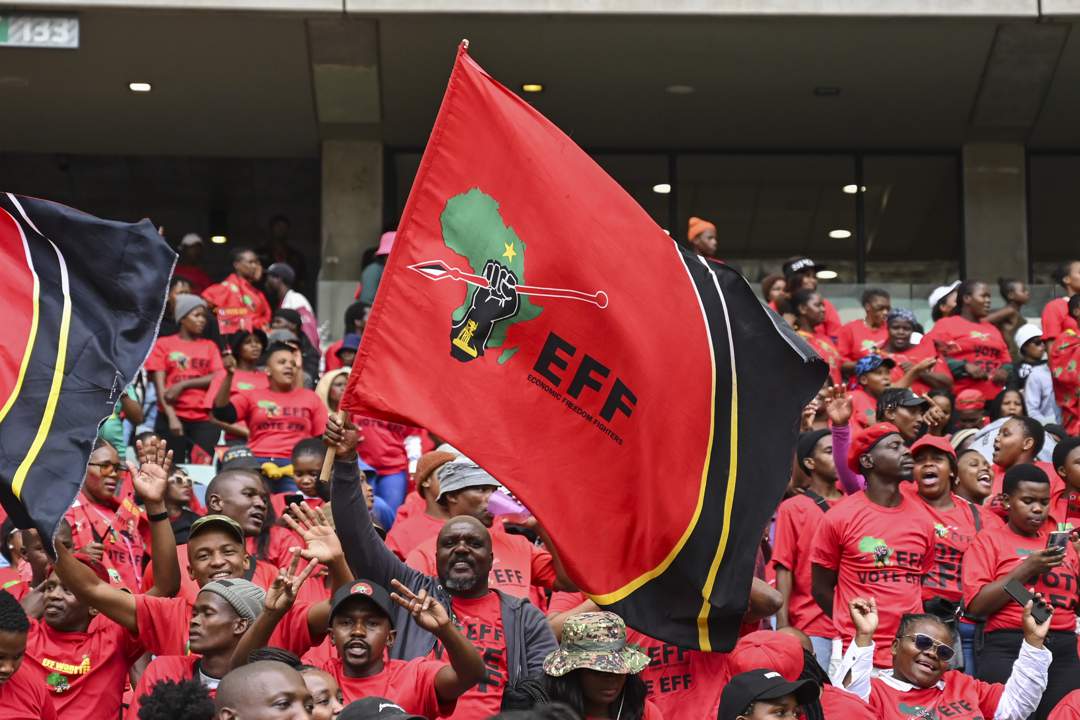
The Economic Freedom Fighters (EFF) has strongly criticised Israel’s decision to recognise Somaliland as an independent state, describing the move as a calculated strategy to destabilise Somalia and expand Israeli geopolitical influence in Africa and the Middle East.
The EFF is the first South African political organisation to publicly condemn Israel following the announcement, aligning itself with growing international opposition. On Friday, representatives from 21 Arab, Islamic, and African countries jointly rejected Israel’s decision, warning that it violates international law and risks further destabilising an already volatile region.
In their joint statement, the countries condemned the recognition “in the strongest terms”, arguing that it contravenes the principles of international law and the United Nations Charter. They emphasised that these principles explicitly require the protection of state sovereignty and territorial integrity, adding that the move reflects what they described as Israel’s expansionist posture.
Israel has framed its recognition of Somaliland as being “in the spirit of the Abraham Accords”, the normalisation agreements between Israel and several Arab and Muslim-majority states. In return, Somaliland has reportedly committed to joining the Accords and establishing full diplomatic relations, including the opening of embassies.
Somaliland occupies a strategically significant position along the Horn of Africa, sitting at the entrance to the Red Sea and the Gulf of Aden, approximately 250 to 400 kilometres south of Yemen. This location places it near critical global shipping routes and offers what analysts describe as a potential “forward defence” position against Houthi rebels and Iranian-backed forces that have disrupted maritime trade in recent years.
According to the EFF, this strategic value explains Israel’s interest. In a statement issued on Sunday, the party said the “so-called Somaliland” would provide Israel with political, economic, and trade access to the Horn of Africa, while also serving broader geopolitical ambitions.
The EFF further alleged that Somaliland could be positioned as a destination for Palestinians who have survived what it described as ethnic cleansing, arguing that the Islamic world has rejected any resettlement programme linked to the annexation of Palestinian land.
The condemnation comes amid a fragile, multi-phase ceasefire in the ongoing war between Israel and Palestinian groups, primarily Hamas, which began on October 10, 2025. The conflict was triggered by the Hamas-led attacks of October 7, 2023, and has since become the deadliest chapter in the history of the Israeli-Palestinian conflict. More than 71,000 Palestinians have been confirmed killed since October 2023, with around 70% reported to be women and children, while over 171,000 people have been injured.
Beyond the Somaliland issue, the EFF accused both Israel and the United States of systematically undermining international institutions whenever they are led by African states that openly support Palestine. The party argued that African leadership in global institutions is often delegitimised when it conflicts with US and Israeli interests.
According to the EFF, recognising Palestine’s right to self-determination or characterising Israel’s actions as genocide results in political isolation and exclusion from global platforms. The party described this pattern not as diplomacy, but as imperialism and racism that seeks to portray African states as unfit to lead international institutions.
The EFF cited what it called US efforts to undermine South Africa’s presidency of the G20, as well as Israel’s recognition of Somaliland, which it believes is intended to weaken Somalia’s position as it prepares to assume the presidency of the United Nations Security Council in 2026. The party also accused US President Donald Trump of repeatedly disparaging Somalia and its people in recent months as part of a broader effort to delegitimise the country on the global stage.
Meanwhile, the United Nations Security Council is expected to convene an emergency session on Monday evening to discuss Israel’s recognition of Somaliland. The meeting will take place under the agenda item “Threats to international peace and security”.
Regional bodies have also weighed in. The Intergovernmental Authority on Development (IGAD) reaffirmed that Somalia remains a sovereign member state whose unity and territorial integrity are fully recognised under international law. IGAD warned that any unilateral recognition undermines the United Nations Charter, the Constitutive Act of the African Union, and the agreement establishing the regional bloc.
African Union Chairperson Mahmoud Ali Youssouf echoed these concerns, stating that any attempt to undermine Somalia’s sovereignty poses a serious risk to peace and stability on the African continent. He confirmed that the AU firmly rejects any initiative aimed at recognising Somaliland as an independent entity.