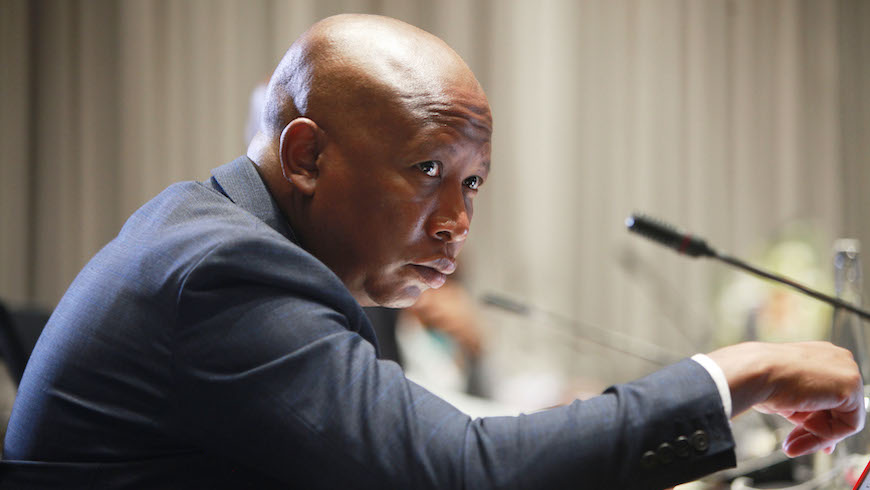
South Africa’s political landscape has once again been shaken by the outspoken leader of the Economic Freedom Fighters (EFF), Julius Malema. This week, the country’s Equality Court found Malema guilty of hate speech over remarks he made at a rally in 2022, a decision that has sparked both relief and outrage across the political spectrum.
The case stems from an incident in which a white man allegedly assaulted an EFF member. Addressing supporters, Malema said: “No white man is going to beat me up… you must never be scared to kill. A revolution demands that at some point there must be killing.”
The Equality Court ruled that such remarks went beyond political theatre. According to the judgment, Malema’s words “demonstrated an intent to incite harm” and therefore crossed the line into hate speech. Two complaints had been filed—one by the South African Human Rights Commission and another by a private individual who claimed to have felt threatened by the EFF leader’s rhetoric.
The ruling emphasised that while calling out racist behaviour may be permissible, advocating violence in response is not. “Calling for someone to be killed because they are a racist who has acted violently, is an act of vigilantism and an incitement of the most extreme form of harm possible,” the court said.
The EFF quickly fired back, dismissing the judgment as a misrepresentation. In a statement, the party argued that Malema’s words had been taken out of context, and that the court’s reasoning underestimated the South African public. “It assumes that the reasonable listener is incapable of understanding metaphor, revolutionary rhetoric or the history of liberation struggles,” the party declared.
A Long Record of Controversy
Malema, 44, is no stranger to controversy. His firebrand style of politics has often landed him at the centre of international disputes. In June last year, he was denied entry to the United Kingdom, after the UK Home Office ruled that his presence was “non-conducive to the public good.”
The decision referenced Malema’s vocal support for Hamas, including his pledge that the EFF would arm the group if it came to power. UK authorities also cited previous statements where Malema allegedly entertained the possibility of violence against white South Africans. The EFF condemned the move as an act of “cowardice” aimed at stifling democratic debate.
Tensions have not been confined to Europe. In May, Malema also drew criticism from then–US President Donald Trump during a tense meeting with South Africa’s President Cyril Ramaphosa. Trump reportedly played a video of Malema singing the struggle-era song “Kill the Boer, Kill the Farmer” at a rally, arguing that such chants endangered white farmers.
The song, which has long been part of South Africa’s political culture, remains fiercely debated. Afrikaner lobby groups have campaigned to ban it, while the Supreme Court of Appeal has previously ruled that a “reasonably well-informed person” would recognise the lyrics as symbolic rather than literal calls for violence.
A Nation Grappling with Free Speech and Responsibility
The Equality Court’s ruling against Malema highlights a deep tension in South Africa’s democracy: balancing the hard-won right to free expression with the responsibility to prevent rhetoric that could fuel violence.
More than three decades after the end of apartheid, the country continues to wrestle with racial divides, economic inequality, and the lingering scars of history. For many, Malema’s rhetoric represents a dangerous slide towards incitement. For others, it is an uncomfortable but necessary reminder of unhealed wounds.
As the EFF gears up for future elections, the judgment will no doubt become another rallying point for Malema’s supporters, who see him as a fearless truth-teller, and for his critics, who view him as a destabilising force.
What remains clear is that the debate over hate speech, revolutionary rhetoric, and the limits of political expression is far from over in South Africa.