
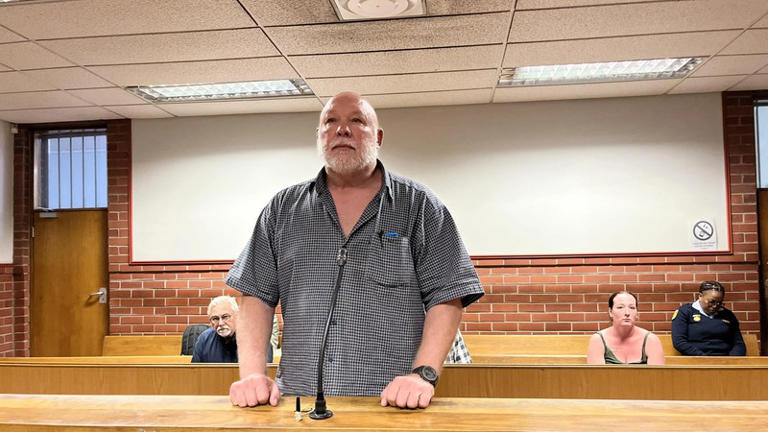
Former South African National Defence Force (SANDF) special forces soldier Nicolas Le Roux has abandoned his bail application in the Pinetown Magistrate’s Court, choosing instead to appeal Legal Aid South Africa’s decision to deny him state-funded legal representation.
Le Roux, aged 67, is accused of premeditated murder after allegedly shooting and killing his wife, Taryn Le Roux, at Waxy O’Connor’s restaurant in Westville last month. The high-profile case has drawn public attention for both its brutality and the accused’s insistence on representing himself — at least temporarily.
Denied Legal Aid
During proceedings on Wednesday, Legal Aid attorney Mandisi Mathebula confirmed that the organization had withdrawn from representing Le Roux after he failed the financial means test, which sets an income threshold of R9,100 per month for qualifying applicants.
“The decision was based on his income, and while he has the right to appeal, the chances of success are slim,” Mathebula told the court.
Le Roux maintained that he should still qualify, claiming his employment contract had ended and that he was no longer receiving a salary.
“I have a letter from my employer stating that I will no longer be receiving a salary because I was a contract worker,” Le Roux said, appearing calm and emotionless as he addressed the court.
Magistrate’s Stern Warning
Magistrate Stan Miloszewski urged Le Roux to seek private legal representation, warning that a premeditated murder charge is not one he could effectively defend without professional assistance.
“Premeditated murder is not a charge you can defend yourself against. It’s very serious. The High Court will not accept you defending yourself since law is not your domain,” he said.
The magistrate reminded Le Roux that the minimum sentence for premeditated murder is life imprisonment, cautioning that proceeding without a lawyer could have devastating consequences.
“It’s a tough and dark world when you’re sitting there alone,” Miloszewski added.
Appeal and Delays
Le Roux told the court that he would wait for the outcome of his appeal to the Legal Aid Board, even though it may delay the case by up to six weeks.
Prosecutor Cameron Roode confirmed that the appeal would be filed on Le Roux’s behalf by a man identified as Mr. Potgieter, who had been granted power of attorney by the accused.
“Mr. Potgieter informed me that they will appeal Legal Aid’s decision,” Roode said.
The court adjourned the matter to November for updates on the appeal outcome and further investigations.
Media Presence and Additional Charges
When members of the media applied to photograph Le Roux in the dock, the former soldier did not object, calmly stating that he had “no problem” being photographed.
In addition to the murder charge, Le Roux faces multiple firearm-related offences, including:
-
Handling a firearm under the influence of a substance,
-
Possession of a firearm or ammunition with intent to commit an offence or resist arrest,
-
Possession of an unlicensed firearm, and
-
Possession of unlicensed ammunition.
The charges collectively paint a troubling picture of a man once trained in military discipline, now facing life imprisonment for an act of alleged domestic violence.
Broader Context
The case has reignited debate over domestic violence and firearm control in South Africa, where gender-based violence remains alarmingly high. Legal experts say the denial of Legal Aid based on income could complicate high-profile criminal cases, especially when the accused faces serious charges but lacks access to affordable legal counsel.
As the case moves forward, the country will be watching closely — not just for justice in Taryn Le Roux’s murder, but for how South Africa’s justice system balances fairness, access, and accountability.