South African authorities have arrested seven Kenyan nationals and ordered their deportation after discovering they were working without the correct documentation on a United States government programme processing Afrikaner refugee applications.
The Department of Home Affairs confirmed on Wednesday that the individuals will be expelled from the country and barred from re-entering South Africa for a period of five years. The case has further inflamed already strained relations between Pretoria and Washington over the controversial US decision to grant refugee status to white Afrikaners.
Arrests Follow Intelligence-Led Operation
The arrests took place during a raid on a refugee application processing centre in Johannesburg on Tuesday. According to the department, intelligence reports indicated that several Kenyan nationals had recently entered South Africa on tourist visas and had illegally taken up paid work at the facility.
“Seven Kenyan nationals were discovered engaging in work despite only being in possession of tourist visas, in clear violation of their conditions of entry into the country,” the department said in a statement.
“They were arrested and issued with deportation orders, and will be prohibited from entering South Africa again for a five-year period.”
Authorities emphasised that no prospective refugee applicants were harassed during the operation and that the raid did not take place at a diplomatic site. No US officials were arrested.
US Afrikaner Refugee Programme Under Scrutiny
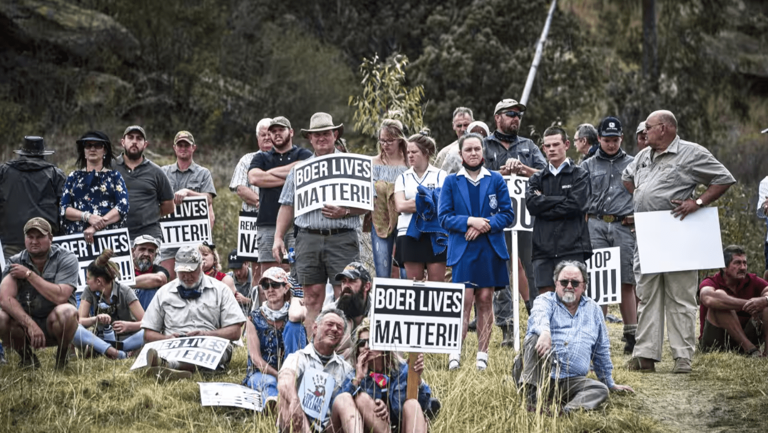
The arrests are linked to a broader dispute over the US Afrikaner refugee programme, introduced under US President Donald Trump’s administration. In May, Washington announced it would offer refugee status to members of South Africa’s white Afrikaner minority, citing alleged discrimination and even claims of “genocide” — allegations strongly rejected by the South African government.
To accelerate the processing of applications, the United States engaged Kenyan nationals affiliated with a Christian non-governmental organisation based in Kenya to work in South Africa. That arrangement is now at the centre of the immigration dispute.
Following the announcement, an initial group of around 50 Afrikaners were flown to the United States on a chartered flight in May, with others reportedly travelling in smaller numbers on commercial flights.
Diplomatic Tensions Deepen
Relations between South Africa and the United States have deteriorated sharply since Trump returned to office. Washington has criticised Pretoria over a range of domestic and foreign policy issues, expelled South Africa’s ambassador in March, and imposed 30 percent trade tariffs.
In October, the Trump administration announced plans to admit just 7,500 refugees in the 2026 fiscal year, down from more than 100,000 annually under former US president Joe Biden. A significant portion of those places is reportedly earmarked for Afrikaners.
The fallout has had wider diplomatic consequences. The United States boycotted South Africa’s G20 summit in November and has since indicated that Pretoria will not be invited to G20 events hosted by Washington, after the US assumed the rotating presidency this month.
US Pushback and Protocol Concerns
Following reports of the raid, US State Department spokesperson Tommy Pigott described any interference in US refugee operations as “unacceptable” and said Washington was seeking immediate clarification from the South African government.
South Africa’s Department of Home Affairs responded by stating that “foreign officials” appeared to be coordinating with undocumented workers, raising “serious questions about intent and diplomatic protocol”.
The department added that South Africa had formally engaged both US and Kenyan officials over the incident, stressing that immigration laws apply equally to all foreign nationals.
“South Africa shares with the United States a commitment to combating illegal immigration and visa abuse in all its forms,” the statement said.
Competing Narratives on Persecution Claims
The Trump administration has repeatedly claimed that white Afrikaners have faced persecution since the end of apartheid in 1994, pointing to farm attacks and black economic empowerment policies as evidence.
Pretoria has firmly rejected these assertions, noting that black South Africans remain the primary victims of violent crime and that transformation laws are aimed at addressing deep economic inequalities inherited from apartheid.
As the diplomatic standoff continues, the expulsion of the Kenyan nationals illustrates how immigration enforcement, refugee policy and geopolitics have become increasingly entangled — with even administrative visa violations now carrying international consequences.