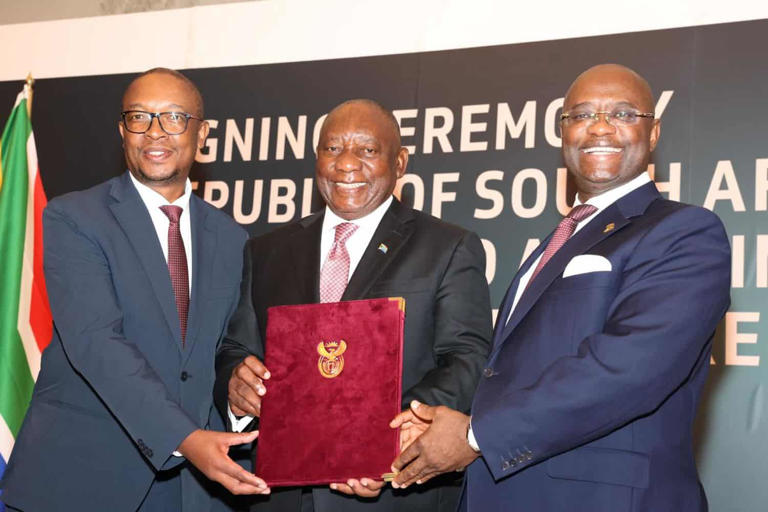
South Africa has secured a significant R8 trillion financing package from Afreximbank, marking a milestone as the country becomes a full “Class A” shareholder in Africa’s largest trade finance institution. The announcement signals renewed momentum for industrial projects across mining, automotive manufacturing, and specialised economic zones.
The financing support, equivalent to $8 billion, was unveiled on Wednesday at a Johannesburg ceremony by Afreximbank President George Elombi. As South Africa steps into a new era of continental financial engagement, the move aligns with broader efforts to strengthen intra-Africa trade and reduce dependency on traditional export markets amid global trade tensions.
Afreximbank Membership and Strategic Financing
South Africa’s full membership in Afreximbank marks the culmination of a long-awaited process. When the bank was established in 1993, the apartheid regime meant South Africa could not join as a full member. It was only last year that the South African Cabinet approved an upgrade to “Class A” shareholder status, paving the way for full participation and access to sizeable development finance.
At the launch event, President Elombi outlined how the $8 billion financing package will be deployed. Priority areas include mineral processing — a key lever for value-added export growth — expansion of automotive manufacturing capacity, and the establishment of industrial parks and special economic zones to attract investment and create jobs.
President Cyril Ramaphosa said South Africa’s full Afreximbank membership reflects a strategic commitment to African industrialisation and deeper integration with continental markets.
Trade Tensions and Diversification of Markets
The timing of South Africa’s new role in Afreximbank coincides with intensifying trade frictions with the United States. Earlier last year, the U.S. government introduced a 30 percent tariff on selected South African exports — the highest rate imposed on any Sub-Saharan African country — triggering concerns about market access and competitiveness.
By enhancing cooperation with Afreximbank and fellow African economies, South African policymakers hope to expand regional trade linkages and lessen the impact of unilateral trade measures from outside the continent.
Ratings Scrutiny and Push for African Alternatives
Afreximbank’s expanded role comes amid heightened scrutiny of its credit profile. Last month, global ratings agency Fitch downgraded Afreximbank to sub-investment grade — commonly referred to as “junk” status — and removed its future outlook rating. The decision has sparked debate about how global agencies assess African financial institutions.
In response, President Elombi defended Afreximbank’s balance sheet and risk management, stating that the bank’s treasury operations remain robust and that strong alignment with member state development agendas will support ongoing investment flows.
Despite reassurances, the episode has reignited calls among African leaders and the African Union for a home-grown ratings alternative. Critics argue that the dominance of the “big three” global credit rating agencies — Moody’s, Standard & Poor’s and Fitch — distorts perceptions of African creditworthiness, often penalising countries and institutions despite improvements in fundamentals. Many believe that a continental rating framework could more accurately reflect the realities of African markets and reduce borrowing costs over time.
Implications for South Africa’s Economic Strategy
For South Africa, the Afreximbank financing package represents both an opportunity and a strategic pivot. The inflow of funds is expected to bolster priority sectors that can drive sustainable growth, create employment and deepen South Africa’s participation in regional value chains.
Mining and mineral processing are central to this vision, with value-addition initiatives expected to help South Africa capture a greater share of global commodity value. Automotive manufacturing, too, stands to benefit from increased capital, particularly as the industry adapts to shifts in global supply chains and seeks to diversify export destinations.
The development of industrial parks and special economic zones further underscores the government’s emphasis on creating hubs of economic activity that can attract private investment, stimulate innovation and generate export revenue.
Looking Ahead
South Africa’s partnership with Afreximbank is poised to shape its economic trajectory during a period of global uncertainty and evolving trade dynamics. By leveraging continental financial collaboration and advancing regional industrialisation, South Africa aims to strengthen its economic resilience and establish itself as a pivotal player in Africa’s growth story.