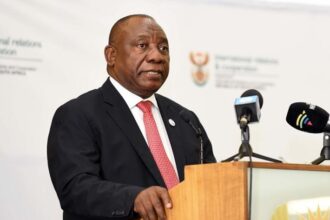

ANC national chairperson Gwede Mantashe has delivered a blunt assessment of the relationship between government and society in South Africa, arguing that it has produced a public that waits for solutions rather than taking initiative.
Speaking to a television news channel on Tuesday morning, Mantashe said the governing party bears responsibility for fostering a system where citizens “sit in the sun” and expect the state to deliver services and employment.
According to Mantashe, this dynamic represents a mistake in governance that the ANC must confront if the country is to move forward.
Defending the ANC’s Record
While critical of public passivity, Mantashe also defended the ANC’s record since the advent of democracy in 1994. He said the ruling party has achieved significant progress in areas such as education and basic services, but those gains are often overshadowed by negative narratives about government performance.
He argued that government successes are frequently underplayed, while failures dominate public discourse, creating an imbalanced picture of the state’s role in society.
Comparing South Africa to China
In illustrating his point, Mantashe drew a comparison with China, referencing the country’s recovery after the Cultural Revolution. He argued that Chinese citizens were actively involved in rebuilding their society, unlike what he sees in South Africa today.
“The difference is that Chinese people put their skin in the fire,” Mantashe said, adding that South Africans have become accustomed to a model where the state is expected to do everything.
He acknowledged that this approach was shaped by ANC governance itself, saying the party had unintentionally created a passive society instead of encouraging active participation.
Education Without Initiative?
Mantashe cited a recent conversation with a young woman as an example of what he believes is missing from the national debate. He said the woman acknowledged the educational opportunities provided by the ANC government, including no-fee schools and access to university education, but complained that government had not helped her secure employment.
“I said to her, the ANC has provided you with a fishing rod; now you expect the ANC to catch the fish for you,” Mantashe said, suggesting that education should empower individuals to seek opportunities rather than wait for state intervention.
Community Projects and Youth Disengagement
Reflecting on his own experiences, Mantashe said he had attempted to run a community farming project in his area but eventually abandoned it because young people were unwilling to participate.
He said this reinforced his belief that South Africa needs a society that takes responsibility for its own development rather than relying solely on government or the ruling party for solutions.
“I would prefer a society that does things for itself,” he said.
Jobs, Age and Expectations
Mantashe also questioned expectations around government-created employment, using his own life as an example. He said that throughout his working life, the government had never found a job for him.
“Today, because there is a progressive government, people expect the government to give them jobs,” he said. “They do not look for jobs, and that must change.”
He argued that citizens need to accept that competition for jobs is a reality and that personal initiative remains essential.
Analysts Offer Mixed Views
Political analyst Thabani Khumalo said Mantashe’s comments were partly accurate, but also reflected contradictions within the ANC’s own history.
“When they came to power, they made promises of delivery and believed they could deliver without the involvement of other stakeholders, including the public,” Khumalo said.
Professor Musa Xulu echoed this sentiment, arguing that political parties have contributed to confusion around the concept of service delivery.
“The idea has been constructed to suggest that once politicians are elected, citizens do not have to do anything,” Xulu said. He added that a lack of civic education has deepened spectator politics, where voters see themselves as observers rather than participants.
A Debate the ANC Can No Longer Avoid
Mantashe’s remarks reopen a long-running debate about accountability, participation and the limits of government responsibility in South Africa. While his comments have drawn criticism from those who argue unemployment is driven by structural economic failures, they have also highlighted uncomfortable questions about citizen agency and political messaging.
As South Africa grapples with high unemployment and slow economic growth, the challenge may lie in redefining service delivery itself — not as something done to communities, but something built with them.