
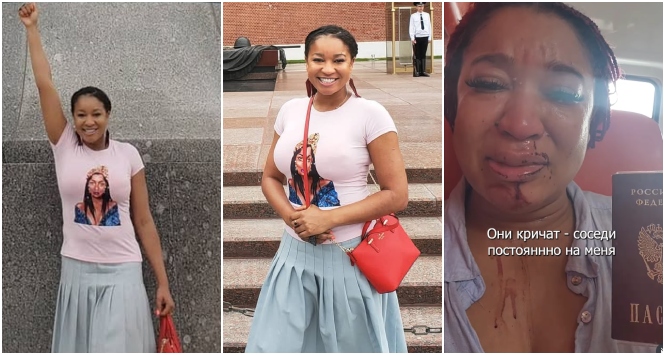
Moscow, Russia – What began as a journey to escape racial discrimination in the United States ended in tragedy for Francine Villa, a Black American woman who was violently attacked by racist neighbors in Moscow—shattering her belief that Russia offered true safety.
Villa, once featured in the 2020 Russian state-backed documentary Black in the USSR, had praised her life in Moscow, declaring:
“I feel free living in Russia. No matter what time it is, I can walk outside and I’m safe.”
But five years later, Villa took to social media with a tearful video exposing the brutal assault she and her child endured—an attack she says was racially motivated.
A Promised Refuge Turned Nightmare
Villa’s story first drew public attention when she appeared in RT’s documentary, portraying Russia as a sanctuary compared to her experiences in America. She moved back to Moscow after a disturbing encounter with U.S. police left her disillusioned with her home country.
However, her recent video—where she shared footage of her injuries—tells a very different story.
The assault, reportedly perpetrated by local neighbors, has sparked global concern and challenged the narrative that Russia is a safe haven for racial minorities.
“I believed I was safer here. I believed in what I said. But this… this was betrayal,” she said in the emotional video.
Contradicting State Narratives
Villa’s ordeal flies in the face of Russian state media narratives that suggest Russia is free from the kind of systemic racism seen in the West. Her experience instead highlights the underreported danger faced by Black and minority residents in Russia.
While hate crimes have been documented in Russia, they are often underreported or downplayed by authorities. Incidents of neo-Nazi violence, particularly in cities like Moscow and St. Petersburg, have been raised by watchdog organizations for over a decade.
Expat Safety in the Spotlight
Villa’s story has renewed global scrutiny around the safety of Black expatriates abroad, particularly in countries that may appear welcoming on the surface, but hide deep-seated xenophobia.
It also raises uncomfortable questions for U.S.-born Black individuals seeking escape from police brutality, social exclusion, or rising racial tensions under right-wing political climates. For many, relocating abroad is a form of resistance and self-preservation—but Villa’s case shows that freedom from racism is not guaranteed anywhere.
A Broader Trend with Global Risks
Villa’s attack comes amid a surge in Black American migration to countries like Ghana, the UK, Portugal, and even Russia—fueled by frustration over America’s racial violence and inequity.
But as this story shows, racism is not confined to U.S. borders. Instead, it is a global issue that manifests differently depending on context—but with equally dangerous outcomes.
A Painful Reality Check
Francine Villa’s experience stands as a powerful reminder of the illusion many face when searching for refuge in unfamiliar lands. For her, what began as a hopeful journey toward safety and dignity has instead become a painful cautionary tale.
Her voice now adds to a growing chorus calling for honest conversations—not just about racism in the U.S.—but about the global structures that allow hate to thrive.