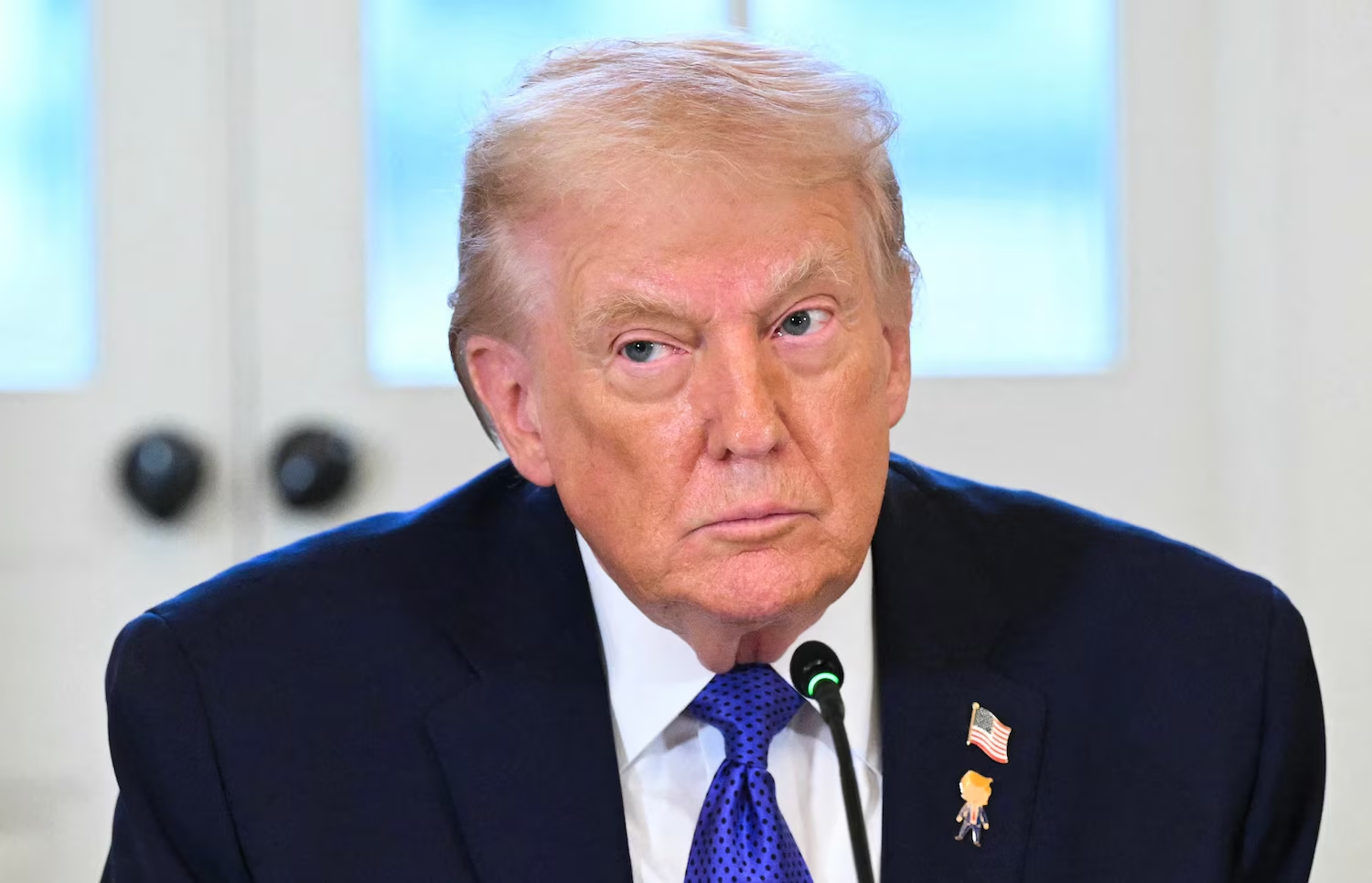
United States President Donald Trump has once again placed race and civil rights at the centre of political debate, claiming that policies designed to correct historic racial discrimination have instead resulted in White Americans being “very badly treated”.
In a recent interview with the New York Times, Trump said the 1964 Civil Rights Act, a landmark law aimed at ending segregation and race-based discrimination, achieved positive outcomes but also caused harm. According to him, some people were unfairly denied opportunities as a result of these reforms.
Claims of “Reverse Discrimination”
Trump argued that civil rights-era legislation prevented certain individuals from accessing jobs and higher education places they “deserved”, describing this outcome as “reverse discrimination”.
The Civil Rights Act was introduced to ensure equal access to education, employment and public life for Black Americans and other marginalised groups following decades of legally enforced segregation and exclusion. Trump, however, suggested that the policies went too far and unfairly penalised White Americans.
This line of argument has been a recurring theme in Trump’s political messaging and played a significant role in shaping his second presidential campaign.
DEI Policies in the Crosshairs
Trump’s comments are closely tied to his administration’s aggressive stance against diversity, equity and inclusion (DEI) initiatives. During his campaign, he vowed to dismantle what he described as “anti-White” policies in both government and the private sector.
“I think there is a definite anti-White feeling in this country and that can’t be allowed,” Trump said while campaigning for a second term.
Since returning to office, his administration has moved swiftly to remove DEI programmes from federal departments and the military. Universities and corporations have also come under pressure, with warnings that federal funding and contracts could be withdrawn if diversity initiatives are not scaled back.
Strong Pushback From Civil Rights Leaders
Trump’s remarks have drawn firm criticism from civil rights organisations. Marc Morial, president of the National Urban League, rejected the notion that civil rights policies harmed Americans.
“Every American, regardless of race, colour, or creed, is better off as a result of the Civil Rights Movement and the ongoing push for racial justice,” Morial said. He added that confronting institutional and historical racism may be uncomfortable, but denying it only stalls progress.
Morial warned that claims portraying racial justice as discriminatory risk entrenching inequality rather than resolving it, ultimately limiting opportunities for everyone.
Project 2025 and Policy Direction
Trump’s approach is closely aligned with policy proposals developed by conservative activists under Project 2025, a plan shaped with the backing of the Heritage Foundation. One of its central objectives is reversing what it calls the “DEI revolution”, including the rollback of affirmative action, which the project labels “affirmative discrimination”.
Within hours of resuming office, Trump acted on these ideas by ordering the removal of DEI initiatives across federal agencies.
Escalating Pressure on Corporations
The administration has also intensified scrutiny of private companies. According to reports, diversity programmes at major corporations are now being investigated under the False Claims Act, a law typically used to pursue government contractors accused of fraud.
The move signals a broader effort to reshape how race, equality and discrimination are addressed in American institutions.
A Divisive Moment for US Civil Rights
Trump’s comments highlight deep divisions in how Americans interpret the legacy of civil rights legislation. While supporters argue that equality policies should be race-neutral, critics warn that ignoring historical and structural inequality risks undoing decades of progress.
As debates over race, opportunity and fairness intensify, Trump’s framing of civil rights as harmful to White Americans is likely to remain one of the most contentious issues of his presidency.