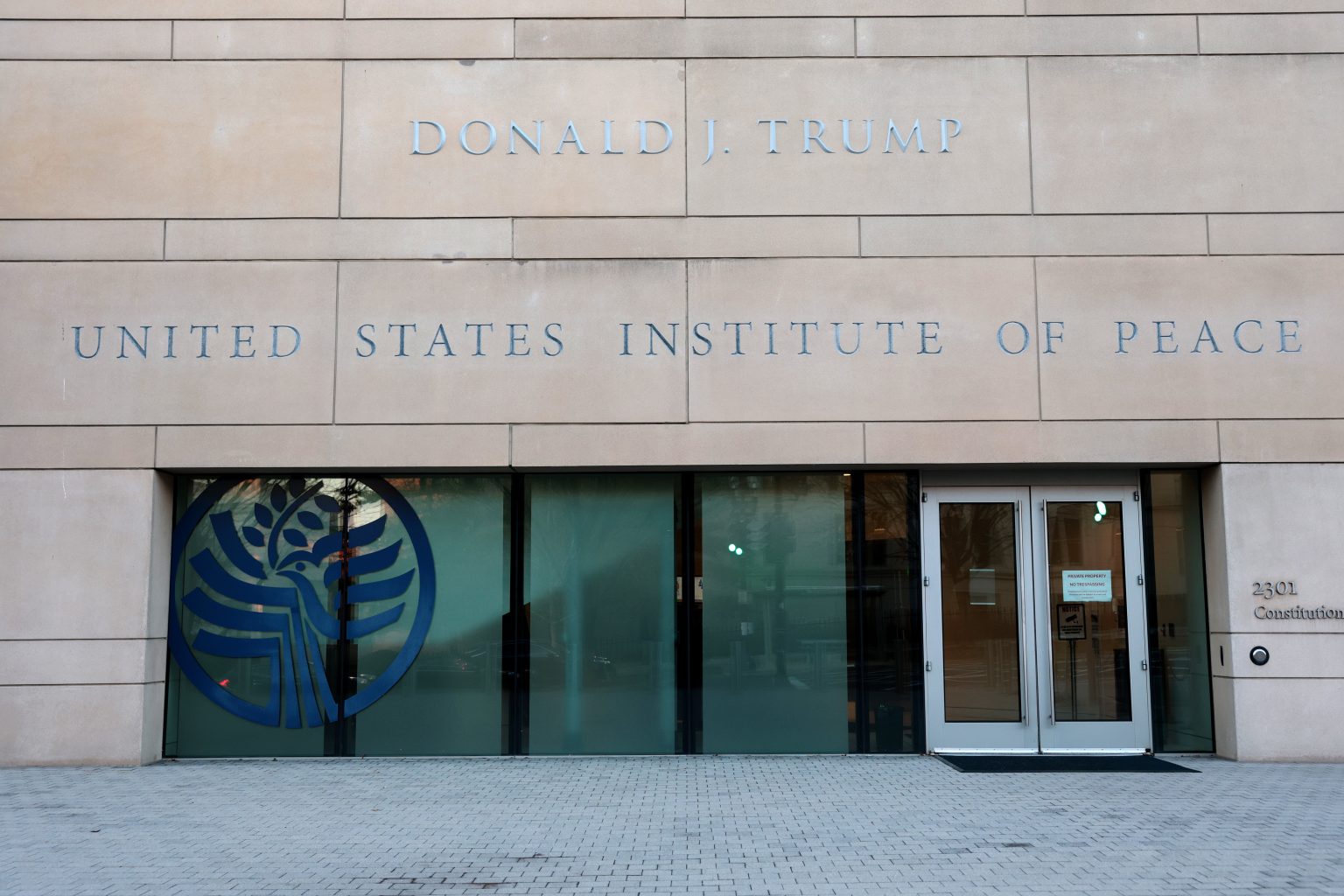
The Trump administration has taken the unusual step of renaming the U.S. Institute of Peace after the president, transforming the independent agency into the Donald J. Trump Institute of Peace. It’s a move that has triggered political outrage, legal challenges and sharp public criticism.
The State Department confirmed the rebranding on Wednesday, praising Trump as “the greatest dealmaker in our nation’s history.” Signs on the Washington, D.C. headquarters—located just steps from the Lincoln Memorial—have already been updated to reflect the new name.
Secretary of State Marco Rubio added his own flourish, declaring on social media that Trump would be remembered as the “President of Peace,” a sentiment that immediately drew divided reactions in Washington and abroad.
The institute, founded in 1985 under President Ronald Reagan to promote peaceful conflict resolution globally, is funded by Congress but operates independently. That independence has become the centre of an ongoing power struggle, as the administration moves aggressively to assert control over the agency.
Earlier this year, officials from the Department of Government Efficiency attempted to enter the building without authorization and later returned accompanied by police. The standoff escalated through multiple firings, board shake-ups and a flurry of lawsuits. More than 200 employees were dismissed in March, according to NPR, leaving the institution hollowed out and its mission in limbo.
Control of the agency has shifted several times due to competing court rulings. Former board members insist the institute falls outside presidential authority, while the Trump administration argues the executive branch has full oversight. A final ruling from a federal appeals court is still pending.
Despite its new name, the institute’s financial future looks grim. Trump’s latest budget proposal eliminates all congressional funding for the entity. Critics say the rebranding is window dressing on an institution already under severe strain.
“It’s ironic that he put his name on an institution he destroyed,” a former official told CNN. Attorneys for the previous leadership described the rebranding as “adding insult to injury,” especially after a federal judge ruled that the government’s armed takeover was illegal—though that ruling is currently paused pending appeal.
The White House has defended its actions with characteristic bluntness. Deputy Press Secretary Anna Kelly dismissed the original institute as a “bloated, useless entity” that spent R907 million per year while delivering little in the way of global peace. She praised the new Trump-branded institute as a symbol of strong leadership, referencing Trump’s claims of ending eight foreign conflicts.
Trump has leaned heavily into peacemaker branding since returning to office, promoting his role in brokering a ceasefire in Gaza and portraying himself as uniquely capable of ending the Ukraine war. His high-profile lobbying for a Nobel Peace Prize—ultimately unsuccessful—was part of the same narrative push.
Yet, his recent actions tell a more complicated story. He has authorised military strikes near Venezuela and openly entertained the idea of annexing Canada, Greenland and Panama—remarks that have drawn global concern.
With its name now changed but its future uncertain, the newly minted Donald J. Trump Institute of Peace stands at the centre of a legal and political tornado. Whether it survives those storms remains to be seen.