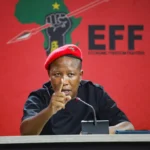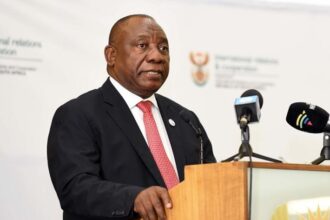
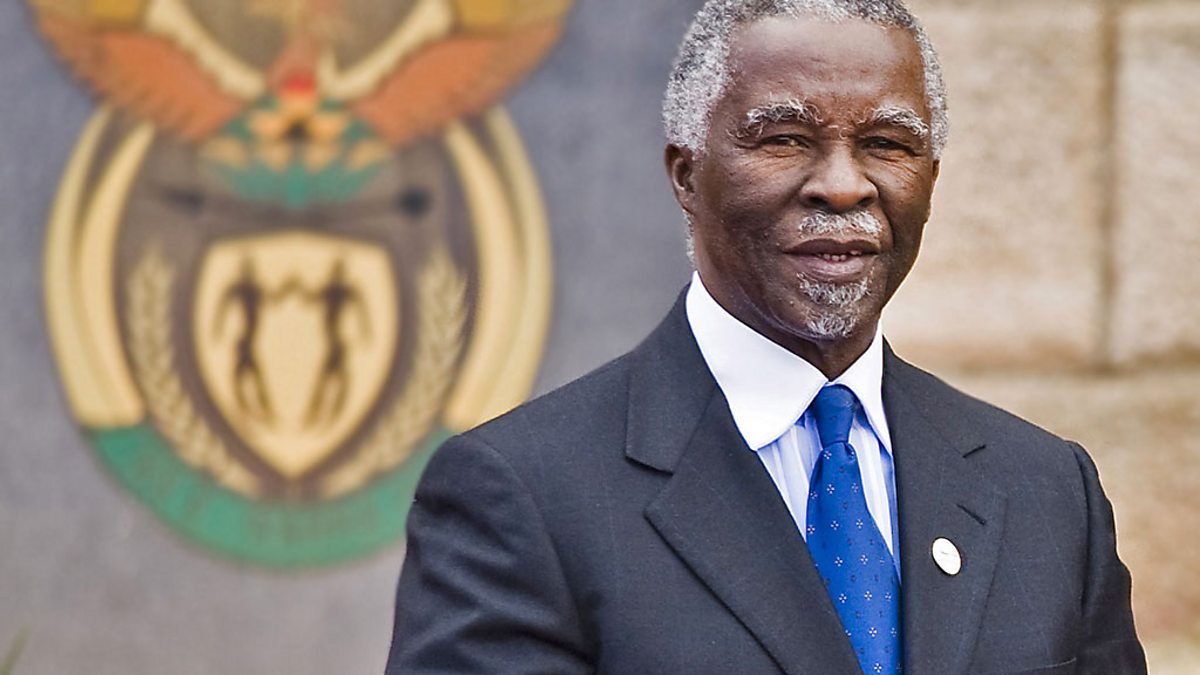
Former President Thabo Mbeki has come out in defence of the controversial “Kill the Boer” chant, widely used by EFF leader Julius Malema, stating that it is a symbolic expression rooted in South Africa’s anti-apartheid struggle, not a literal call to violence.
In an interview with SABC News, Mbeki said critics have misunderstood the chant and its cultural context.
“It’s unchanged. I mean, that thing is a chant. It was a chant during the days of struggle,” Mbeki said.
“Chants of that kind in our tradition, in the African tradition, you don’t take them literally.”
To illustrate, Mbeki referenced his testimony during the Truth and Reconciliation Commission (TRC), where he sang a traditional song that referenced not returning to Zululand due to a mother’s death — a statement not meant to be taken at face value.
“You sing, you say, but you don’t mean that literally. It’s meant to motivate people.”
No ANC Policy of Targeting Civilians
Addressing the line “Kill the Boer, kill the farmer,” Mbeki stressed that the ANC and its armed wing, uMkhonto we Sizwe (MK), never sanctioned violence against civilians.
“There’s no MK soldier who was ever instructed to go and kill a farmer just because they are Boer,” he said.
“In the context of war, they engaged other soldiers, not civilians.”
Mbeki said attempts to portray the chant as incitement to violence were exaggerated for political gain, particularly by right-wing interest groups and foreign commentators.
Trump, Elon Musk and the Chant Controversy
Mbeki’s comments follow an explosive encounter at the White House, where US President Donald Trump asked President Cyril Ramaphosa why Malema was not arrested for singing the chant. Trump presented video footage of Malema and referred to it as evidence of an alleged “white genocide” in South Africa.
According to reports, DA leader John Steenhuisen, also present at the meeting, told Trump that the Democratic Alliance’s participation in the Government of National Unity (GNU) was partly to prevent “extremist parties” like the EFF and uMkhonto weSizwe from gaining influence.
Trump’s claims, which also cited land reform policies as “land seizures” from white farmers, have been strongly denied by the South African government. The tension has added strain to US–South Africa diplomatic relations.
AfriForum, the Courts, and Cultural Rights
The lobby group AfriForum has long sought to ban the chant, accusing Malema of promoting racial hatred. In March, its latest legal effort was dismissed by the Constitutional Court, which ruled the case had no reasonable prospects of success.
The court’s decision echoed a previous ruling by the Equality Court, which found that the chant, when sung in the political context of rallies or struggle songs, did not constitute hate speech.
Malema: “No White Genocide in South Africa”
Speaking to supporters at the Mminara Sports Ground in Kwakwatsi, Free State, Malema reiterated that the chant is part of South Africa’s liberation heritage and constitutionally protected.
“There are so many people killed in South Africa, and the majority of them are Black. There is no white genocide in South Africa,” he said.
Malema dismissed Trump’s use of an alleged mass grave photo, accusing the US president of showing Ramaphosa a picture from the Democratic Republic of Congo and falsely claiming it was from South Africa.
“There are no graves like that in South Africa,” he said.
“That picture does not belong to us.”
Malema said Trump asked Ramaphosa, “Why is Julius Malema not in jail?”, and criticised the president for failing to defend South Africa’s legal system.
“This song was approved by the Constitutional Court,” Malema added.
“We are a constitutional democracy. We must defend the decisions of the court.”
Malema concluded his speech by defiantly singing the “Kill the Boer” chant.