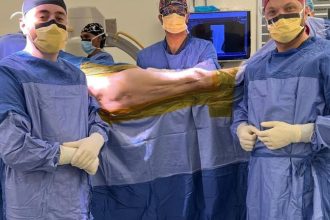
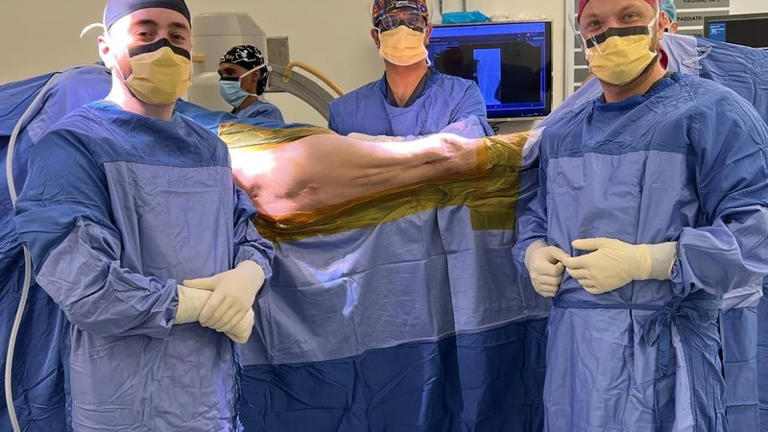
South Africa has recorded a major medical milestone with Tygerberg Hospital performing the country’s first fully internal bone transport and limb-lengthening reconstruction. The groundbreaking procedure was completed on a 64-year-old former police officer who had been living with the aftermath of a severe gunshot injury sustained in 2018.
After several failed surgeries and years of chronic pain, the patient faced an unhealed fracture and a significant leg-length discrepancy that affected his mobility and overall quality of life. The Tygerberg surgical team, working in partnership with Stellenbosch University, reconstructed a 50 mm bone defect and corrected a further 30 mm limb-length difference—restoring stability and laying the foundation for long-term recovery.
This is the first time the technique has been performed anywhere in South Africa, across both public and private healthcare sectors, making Tygerberg Hospital one of only a few facilities globally able to offer this advanced limb-salvage method within a public setting.
Unlike traditional external frame systems, the fully internal device used in the operation allows surgeons to complete both bone transport and limb lengthening without external hardware. The design improves patient comfort, reduces the risk of infection and other complications, and enables quicker rehabilitation.
Professor Nando Ferreira, who led the surgical team, said the breakthrough reflects years of investment in specialised limb reconstruction skills inside the public sector. “This operation demonstrates how far we have come in building world-class limb reconstruction capacity. For patients who have lived for years with chronic pain and disability, advanced internal bone transport offers a true second chance at normal function,” he said.
Ferreira added that Tygerberg Hospital was selected as one of a small number of centres worldwide to use the device during its limited market release. He credited the hospital’s academic partnership and a highly skilled team for making the achievement possible.
Dr Edward Fuzy, part of the surgical team, explained that the technique allowed doctors to treat complex bone loss in a single operation while avoiding many complications associated with older methods. Tygerberg Hospital CEO Dr Matodzi Mukosi praised the team’s work, saying the procedure reflects the exceptional expertise and innovation available in the public healthcare system. “It shows what is possible when clinical excellence and strong partnerships work together for our patients,” she said.
For many trauma survivors in the Western Cape—especially those from communities with limited access to advanced medical care—the breakthrough offers a realistic pathway back to work, independence and improved quality of life. The newly regenerated bone is expected to form over approximately 100 days, followed by several months of consolidation before full recovery.
South Africa’s latest medical achievement places Tygerberg Hospital on the global map for pioneering reconstructive surgery, demonstrating that world-class innovation remains possible within the country’s public health system.