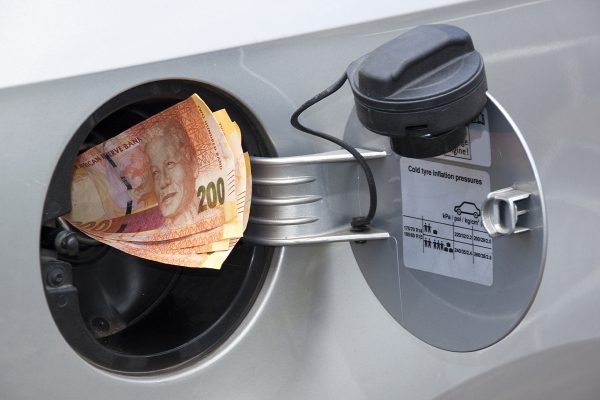
South Africans are forking out as much as R510 in taxes every time they fill up a large petrol tank — a reminder that even the simple act of driving remains an expensive national pastime. In November 2025, taxes accounted for about 30% of the retail price of petrol, maintaining nearly the same proportion as three decades ago despite the introduction of new levies.
The country’s relationship with fuel taxation stretches back to June 1978, when the government introduced a General Sales Tax of just 4%, or 1 cent per litre, on petrol priced at 26.4 cents. Things escalated after the 1979 oil crisis, when a Central Energy Fund levy of 18.75 cents per litre was added. By 1985, that levy had been reduced to 4 cents — but the trend of fuel taxation had already begun.
The General Fuel Levy (GFL) arrived in 1987 at 23.5 cents per litre, and by 1995 it had nearly tripled to 62.9 cents per litre, accounting for about a third of the total fuel price at the time. Back then, leaded petrol cost R1.90 per litre, a nostalgic figure that feels almost mythical today.
Fast-forward to November 2025, and the price of a litre of unleaded 93 petrol stands at R20.97 inland, with the GFL now set at R4.15 per litre for petrol and R4.01 per litre for diesel. While the GFL’s value has ballooned, it represents a smaller proportion of the total price — about 20%.
Another player entered the scene in May 1997: the Road Accident Fund (RAF) levy, currently contributing R2.18 per litre. Add to that customs and excise duties, plus the carbon fuel levy, and total fuel-related taxes reach R6.37 per litre for petrol and R6.24 for diesel.
Historical Perspective: Then vs Now
| Component | November 1995 | % of Price | November 2025 | % of Price |
|---|---|---|---|---|
| General Fuel Levy | R0.63 | 33% | R4.15 | 20% |
| Road Accident Fund Levy | R0.00 | 0% | R2.18 | 10% |
| Transport, Storage & Margins | R0.63 | 35% | R5.27 | 25% |
| Basic Fuel Price | R0.54 | 30% | R9.37 | 47% |
| Total per Litre | R1.80 | 100% | R20.97 | 100% |
In real-world terms, this means that of the R943.65 spent on a typical 45-litre tank, around R290 is taxes. For an 80-litre tank, common in larger vehicles, the tax portion rises to R510.
“Tax Tank Half Full, Wallet Half Empty”
Rob Handfield-Jones, managing director of Driving.co.za, says the government’s dependence on fuel taxes is unsustainable. “The state will need to decouple its tax regime from fuel use if it wants to avoid a catastrophic decline in revenue,” he warned.
He argues that if the GFL were ring-fenced — meaning dedicated purely to road maintenance and transport infrastructure — it might be easier for the public to accept. However, the revenue currently goes into the national budget instead.
“The majority of the cost of the destruction of our road network is outsourced to the private sector as increased vehicle running costs and insurance claims anyway,” he added. “The government simply has no incentive to reinvest any of the fuel tax it collects into roads.”
The Electric Vehicle Challenge
As electric vehicles (EVs) gain traction in South Africa, the looming problem becomes clear: no petrol means no fuel tax. Unlike petrol, electricity can’t easily be taxed at the plug without impacting other users.
At present, the government collects R15 in VAT for every R100 spent on electricity used to charge an EV — less than half of what it earns from fuel taxes on the same amount of energy.
And for many EV owners, even that revenue is out of reach. Handfield-Jones says his home is fully off-grid, powered by solar panels. “My house is off-grid solar and I drive an EV,” he said. “I don’t pay any fuel tax, and nor do I pay VAT on electricity — let alone VAT on the surplus electricity I’d be using to charge my car if I still used the grid.”
The Road Ahead: New Ways to Tax
Handfield-Jones warns that widespread EV adoption and rooftop solar power could drain billions from the fiscus. As the tax base shrinks, he suggests introducing a per-kilometre tax, collected annually when renewing a vehicle’s licence disc.
This system, he argues, could not only replace the GFL but also include a “damage escalator” to reflect the actual wear and tear each vehicle causes on South Africa’s roads.
With more drivers going electric and fewer litres being sold, the question isn’t just how to keep roads repaired — it’s how to keep the Treasury’s tanks full.