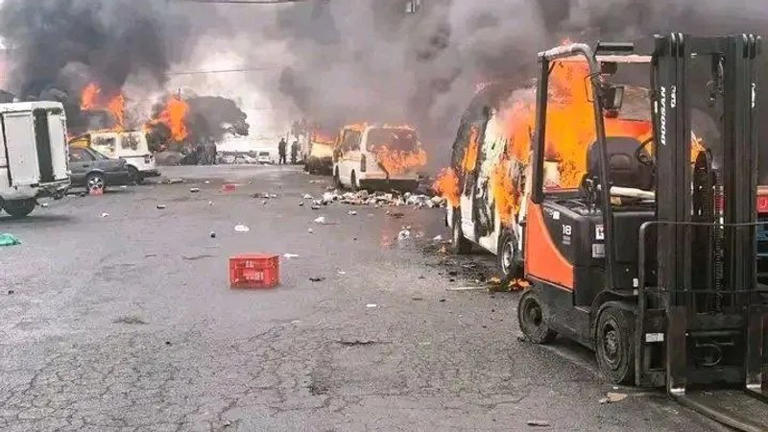
What began as a peaceful protest in the Eastern Cape quickly descended into chaos on Monday, with vehicles torched, property vandalised, and one person injured amid tensions over the alleged coronation of a Nigerian national as a traditional king.
The unrest unfolded in KuGompo City (formerly East London), where demonstrations were sparked by viral videos showing Solomon Ogbonna Eziko being crowned as “Igwe Ndigbo”.
Protest Turns Violent After Initial Calm
According to police, the protest was initially organised as a peaceful march led by traditional leaders and civic groups opposing the reported coronation.
However, the situation escalated after some protesters moved away from the main gathering point at the city hall.
Police spokesperson Nobuntu Gantana confirmed that:
- At least 12 vehicles were damaged
- Several buildings were set alight
- Law enforcement deployed teargas to disperse crowds
Emergency services, including fire departments and public order policing units, remain on the scene.
Stabbing Incident Adds to Tensions
Amid the unrest, a man was stabbed in the back and rushed to hospital.
Authorities stated that the victim was not part of the protest, though conflicting claims have emerged.
Jacinta Ngobese-Zuma, leader of the civic movement March and March, alleged that the injured individual was one of her members and had also been struck by a vehicle.
The circumstances surrounding the incident remain under investigation.
Political Parties and Leaders Reject Coronation
Several political organisations and civic groups joined the protest, including:
- ActionSA
- Patriotic Alliance
- March and March movement
ActionSA Eastern Cape leader Athol Trollip argued that South Africa’s legal framework does not allow foreign nationals to establish traditional kingship structures.
Similarly, Patriotic Alliance spokesperson Steve Motale condemned the ceremony, calling it illegitimate.
Traditional Leaders Distance Themselves
The Royal House of AbaThembu has also distanced itself from the controversy.
Representatives denied claims circulating on social media that King Buyelekhaya Dalindyebo had endorsed or recognised the alleged coronation.
Royal advisor Matthew Mpahlwa dismissed the reports as false and misleading.
Broader Concerns Around Authority and Legitimacy
At the heart of the unrest lies a deeper issue: who has the authority to recognise traditional leadership in South Africa.
Under South African law, traditional leadership structures are:
- Constitutionally recognised
- Subject to strict legal and cultural frameworks
- Typically limited to indigenous systems
The alleged coronation has therefore raised concerns about:
- Legal legitimacy
- Cultural sensitivity
- Community cohesion
Situation Remains Volatile
Authorities have described the situation as ongoing, with law enforcement maintaining a strong presence to prevent further escalation.
Investigations are expected to focus on:
- The origin and legitimacy of the coronation claims
- The cause of the violence
- The stabbing incident
Final Thoughts
This incident highlights how quickly misinformation, identity politics, and unresolved tensions can escalate into violence.
As investigations continue, restoring calm and establishing the facts will be critical—not only for accountability but for maintaining social stability in the region.
Call to Action:
Follow Virgo for verified updates on this developing story. Share responsibly and stay informed on issues affecting South African communities.