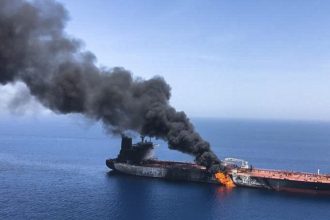
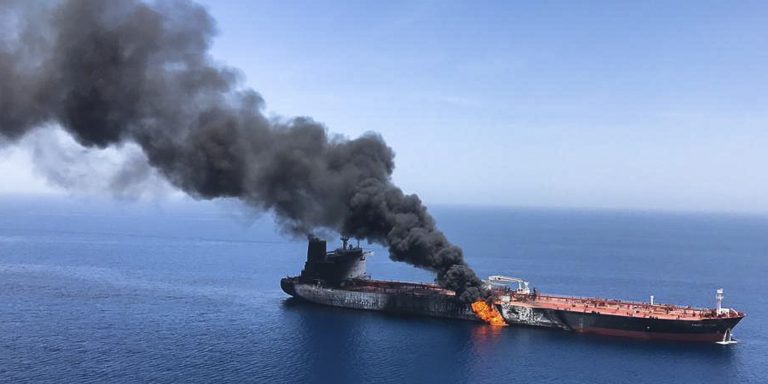
A United States oil tanker has reportedly been struck and set ablaze in the Strait of Hormuz, according to claims by Iran’s Islamic Revolutionary Guard Corps (IRGC), marking a potentially dangerous escalation in the ongoing Middle East conflict.
Iranian state-linked Tasnim News Agency reported that the tanker was hit earlier on Monday morning and was “currently burning” in the strategically vital shipping corridor.
The claims have not yet been independently verified by international authorities, but the incident has intensified global concern over the security of one of the world’s most critical energy routes.
Strategic Strait of Hormuz Under Threat
The Strait of Hormuz is a narrow waterway linking the Persian Gulf to the Gulf of Oman and the Arabian Sea. Despite being only about 60 miles wide at its broadest point, it carries an enormous share of the world’s oil supply.
Roughly one fifth of global oil shipments move through the strait, making it one of the most important maritime chokepoints in the global energy system.
Iran’s Revolutionary Guards warned that Tehran could assert control over passage through the strait during wartime, a move that would have significant consequences for global oil markets and international trade.
Iran has effectively restricted traffic through the strait since hostilities escalated between Iran, Israel and the United States.
Tankers and Commercial Ships Targeted
Shipping in the region has become increasingly dangerous in recent days.
Several oil tankers have reportedly been targeted by drones, and maritime traffic through the area has slowed dramatically as shipping companies assess the risks.
In a separate incident, a Maltese-flagged container ship, the Safeen Prestige, was struck by a projectile while travelling through the Strait of Hormuz.
Shipping sources said the vessel was hit about two nautical miles north of Oman, forcing its crew to abandon ship.
The attack has heightened fears that commercial shipping could become a direct target as the regional conflict expands.
Intensifying Military Confrontation
The maritime incidents come as fighting between Iran and Israel continues to intensify.
The Israeli military said it had launched strikes against Iranian military infrastructure, including a missile launcher in the city of Qom and an air defence system in Isfahan.
Air raid sirens were reported in Tel Aviv and Jerusalem as Iran launched retaliatory missile attacks.
The conflict has also spilled over into neighbouring areas, with reports that Iranian forces targeted Kurdish militant groups launching operations from the Iraqi border region.
According to regional reports, several Iranian Kurdish militias have thousands of fighters operating from bases in the Kurdistan Region of Iraq.
International Involvement Expands
The rapidly evolving conflict is drawing increasing attention from other global powers.
Italy has indicated that it plans to send air defence systems to allies in the Gulf region in response to the escalating threat environment.
Meanwhile, Canadian Prime Minister Mark Carney said Ottawa had not ruled out potential participation should the conflict widen further.
In Washington, US lawmakers recently rejected a measure that would have restricted the president’s ability to conduct military operations against Iran without additional congressional approval.
The vote effectively allows the administration to continue military actions as the conflict develops.
Global Energy and Security Concerns
The possibility of prolonged instability around the Strait of Hormuz is raising alarm among global markets and governments alike.
Any sustained disruption to shipping through the corridor could affect oil supplies heading to Europe, Asia and North America, potentially pushing energy prices higher.
While the full details of the tanker incident remain unclear, analysts warn that continued attacks on commercial vessels could further destabilise an already volatile region.
As military operations intensify and more nations weigh their involvement, the situation in the Middle East appears to be entering an increasingly uncertain and dangerous phase.