![A worker checks labelling of bottles of beer at the production line of Dutch brewer Heineken factory on June 7, 2011 in Schiltigheim, eastern France, during an official visit announcing the group's goals for sustainable development, by reducing the amount of glass in some beer bottles' production, and lowering by 20 percent the energy needed at its Alsacian factory. [Photo by PATRICK HERTZOG/AFP via Getty Images]](https://myvirgo.co.za/wp-content/uploads/2026/02/heineken-plant.jpeg)
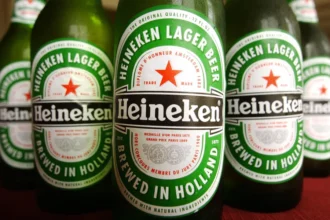
Dutch brewing giant Heineken has announced plans to cut between 5,000 and 6,000 jobs worldwide as part of its new EverGreen 2030 strategy, a restructuring programme aimed at delivering gross savings of approximately R10.8 billion over the next two years.
While Europe and other non-priority markets are expected to bear the brunt of the job reductions, South Africa has emerged as a standout performer within the group’s global portfolio.
The restructuring forms part of a broader effort to streamline operations, sharpen efficiency and accelerate growth in higher-performing regions. Chief executive Dolf van den Brink said EverGreen 2030 builds on earlier reforms but will require what he described as a “significant cost intervention” to unlock future value.
South Africa Named a Priority Growth Market
In its full-year 2025 results, Heineken singled out South Africa as one of its strongest markets globally. While beer volumes declined in several regions, the South African business delivered what the company described as “excellent growth”, driven largely by the premium segment.
Brands such as Heineken and Amstel recorded solid performance locally, contributing to gains and stability in market share.
Chief financial officer Harold van den Broek confirmed during a media briefing that the planned job cuts will focus primarily on Europe and non-priority markets. South Africa’s classification as a priority growth market has, for now, insulated it from large-scale retrenchments.
In a global beer market facing softer consumer demand and cautious spending patterns, South Africa’s resilience has positioned it as something of a safe harbour within the group.
Sedibeng Brewery at the Centre of Strategy
At the heart of Heineken’s South African operations is its Sedibeng brewery in Midvaal, south of Johannesburg. The facility produces up to 8.5 million hectolitres annually and plays a central role in the group’s long-term operational plans.
The site is also home to Heineken’s largest solar installation globally, comprising around 14,000 panels that generate roughly 30 percent of the plant’s electricity needs. In a country grappling with persistent power instability, the investment reduces exposure to grid disruptions while aligning with the brewer’s sustainability objectives.
South Africa’s ongoing energy constraints have accelerated private sector investment in renewable and off-grid solutions. For Heineken, the local operation has effectively become a test case for building resilience in infrastructure-challenged markets.
Water Efficiency and “Future Fit” Ambitions
Beyond energy, water sustainability is another strategic priority. South Africa is classified as a water-stressed country, and the brewing industry is inherently water-intensive.
Heineken has committed to achieving a water-to-beer ratio of 2.4 hectolitres of water per hectolitre of beer at its local plants by 2030. This forms part of its broader “Future Fit” ambitions under the EverGreen 2030 framework, which emphasises operational efficiency alongside environmental responsibility.
The strategy aims to balance productivity gains with long-term resource security, particularly in markets where infrastructure and climate pressures intersect.
Global Cost Cutting Amid Uncertain Market Conditions
Van den Brink acknowledged that while the company is accelerating growth initiatives, near-term beer market conditions remain uncertain. Inflationary pressures, shifting consumer preferences and uneven global demand have forced major brewers to reassess cost structures.
The planned savings of R10.8 billion will be achieved through operating model changes, productivity improvements and workforce reductions, primarily outside priority growth markets.
For employees in affected regions, the announcement signals a period of restructuring and uncertainty. For South Africa, however, the narrative is different — at least for now.
Strong premium beer demand, market share gains and substantial renewable energy investments have positioned the country as a cornerstone of Heineken’s global strategy.
A Rare Growth Engine
As Heineken reshapes its global footprint, South Africa stands out as a rare growth engine in a challenging environment. The question facing the brewer is whether sustained consumer demand and continued operational innovation can protect local jobs over the long term, even as global restructuring accelerates elsewhere.
For now, South Africa appears to be less a casualty of cost cutting and more a proving ground for what the brewer hopes its future will look like: leaner, greener and focused on value creation.



![A worker checks labelling of bottles of beer at the production line of Dutch brewer Heineken factory on June 7, 2011 in Schiltigheim, eastern France, during an official visit announcing the group's goals for sustainable development, by reducing the amount of glass in some beer bottles' production, and lowering by 20 percent the energy needed at its Alsacian factory. [Photo by PATRICK HERTZOG/AFP via Getty Images]](https://myvirgo.co.za/wp-content/uploads/2026/02/heineken-plant-330x220.jpeg)